Mateo Serna (8) swings during an April 23 game against Arkansas at Taylor Stadium in Columbia. Serna was among three Tigers who have announced plans to hit the transfer portal in recent days.
Mateo Serna (8) swings during an April 23 game against Arkansas at Taylor Stadium in Columbia. Serna was among three Tigers who have announced plans to hit the transfer portal in recent days.
Mizzou catcher Mateo Serna has opted to enter the transfer portal, according to his post on Instagram. Serna started 117 games over three seasons with the Tigers. Serna is one of three Tigers who have announced their intention to enter the portal in recent days.
Serna was a consistent bat, hitting .240 last season and .237 with nine homers and 36 RBI in 2025. His greatest strengths were his defense and ability to manage the staff. Serna was an influential piece of the team’s first SEC Tournament win in nine years when it toppled Ole Miss last month.
In addition to his three hits, Serna initiated eight ABS challenges behind the plate, getting seven of those calls overturned, often in key spots when the team needed a strike.
Utility player Tyler Macon and infielder Gehrig Goldbeck also intend to leave the program, as reported by TR Robertson and Black & Gold Fan Zone, respectively, via X.
The Tigers have begun picking up players from the portal to fill in for their departures. Black & Gold Fan Zone has confirmed two additions to the team so far via X.
The most recent acquisition for the team is Carter DeGondea, who previously played at Georgia Southern. DeGondea, a left-handed pitcher, started 14 games last season and finished with an 8.69 ERA while striking out 57.
Another pickup is Wilfred Gonzalez from Florida Gulf Coast. He batted .323 and scored 36 runs last season for the Eagles and will have one year of eligibility remaining. He showed steady defense and led the team with 109 assists. He will look to help fill the void in the middle infield now that Macon and Blaize Ward have left.
Along with Serna, Jamal George who started 15 games, has graduated, leaving Juliomar Campos as the presumed replacement at catcher. Campos appeared in 11 games as a freshman, going 8-for-28 with one homer.
“I am forever grateful for the opportunities the University of Missouri has afforded me and will always appreciate the time I spent in Columbia,” Serna said in his post. He will have one year of eligibility remaining.
Macon came in as a middle infielder and redshirted his freshman year at Mizzou. Over the past two seasons, he has played middle infield, both corner infield spots and outfield. He played in 71 games over those two seasons and started in 56.
Macon hit .327 with an .870 OPS this season, and was a huge part of the early success of the team. In an early-season game against Mount St. Mary’s, Macon became the first player in team history to reach base in all eight of his plate appearances.
Gehrig Goldbeck, who was limited by injuries and played in only four games last season, has also opted to enter the portal. Goldbeck batted .222 with three RBI in 2026 after starting in 35 games in 2025.
The Hechinger Report reports over a quarter of private colleges face closure, with Sterling College closing this semester, underscoring higher education's crisis.
(The Center Square) – Acting U.S. Attorney General Todd Blanche dropped a bombshell of data on Thursday describing Trump administration efforts to find hundreds of thousands of missing unaccompanied alien children (UACs). UACs are minors trafficked to the U.S. border and smuggled into the U.S. under the guise of reuniting with family. In reality, many have been trafficked through a complex network run by transnational criminal organizations.
Keep it Clean. Please avoid obscene, vulgar, lewd,
racist or sexually-oriented language. PLEASE TURN OFF YOUR CAPS LOCK. Don't Threaten. Threats of harming another
person will not be tolerated. Be Truthful. Don't knowingly lie about anyone
or anything. Be Nice. No racism, sexism or any sort of -ism
that is degrading to another person. Be Proactive. Use the 'Report' link on
each comment to let us know of abusive posts. Share with Us. We'd love to hear eyewitness
accounts, the history behind an article.
More than a quarter of private colleges are at risk of closing, new projection shows
Jon Marcus for The Hechinger Report
More than a quarter of private colleges are at risk of closing, new projection shows
More than a dozen newborn lambs cavorted around a fenced-in yard beneath the scrutiny of their mothers and a few watchful students taking turns attending to them.
The lambs’ successful births have been a needed bright spot at tiny Sterling College, which uses a 130-acre farm to teach agriculture and other disciplines in a part of northeastern Vermont so isolated it’s rare to see a passing car, and there’s no cell service.
LillyAnne Keeley, a senior, likes that remoteness. “We have a beautiful view,” said Keeley, in the barn where she’s come for her turn checking on the lambs. “There are beautiful sunsets here. I kind of take it for granted every day.”
She and her classmates have started taking such experiences less for granted now, since Sterling has announced that it will close at the end of this semester.
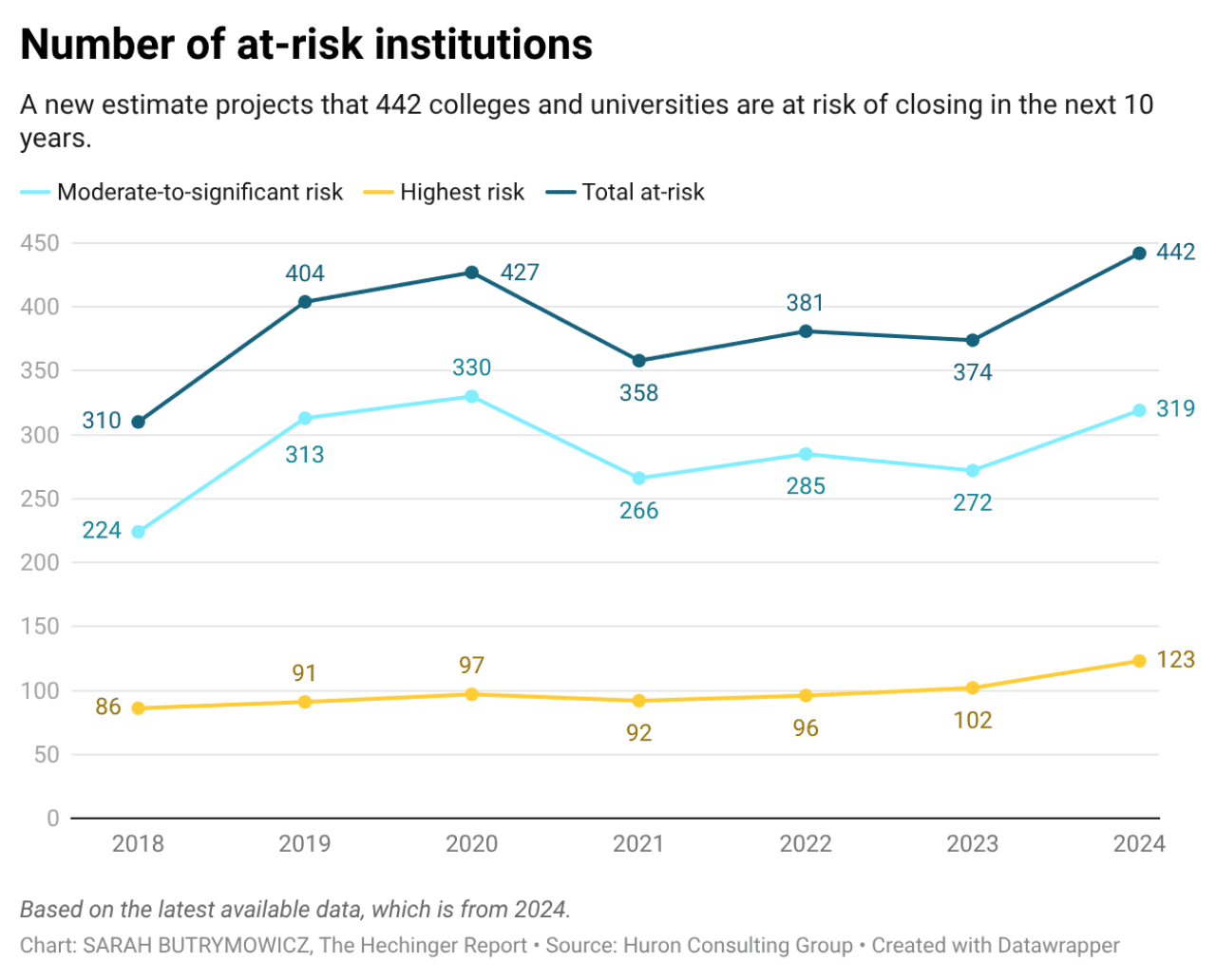
They’re not the last students who will suffer such disruption, notes The Hechinger Report. A new estimate projects that 442 of the nation’s 1,700 private, nonprofit four-year colleges and universities, with a combined 670,000 students, are at risk of closing or merging within the next 10 years.
More than 120 institutions are at the very highest risk, according to the forecast by Huron Consulting Group, which analyzed enrollment trends, tuition revenue, assets, debt, cash on hand and other measures. Many are, like Sterling, small and rural.
“Now that this might be gone, I just really worry about some students out there that are going to have less and less choices,” Keeley said.
It’s a crisis whose magnitude has been shrouded by political and culture-war attacks on higher education and is propelled by the simple law of supply and demand after a long decline in the number of Americans who are going to college.
“We have too many seats. We have too many classrooms,” said Peter Stokes, a managing director at Huron. “So over the coming five to 10 years, this shakeout is going to take place.”
Sterling — the seventh private college in Vermont to close since 2016 — offers a rare glimpse into the human impact of this trend. That’s because it gave students a final semester to stay and complete their degrees or transfer, rather than locking the doors with hardly any notice, as many other colleges have done.
Fewer than half of students at colleges that close continue their educations, according to the most comprehensive study of the issue, produced by the State Higher Education Executive Officers Association, or SHEEO. Of those who do, many lose credits they’ve already earned and paid for, and fewer than half eventually earn degrees.
Twenty-year-old Izzy Johnson has already been buffeted by this. The college he originally wanted to attend closed the month before he graduated from high school. So he enrolled in the fall at Sterling — only to learn that it would also close.
“Having to pick up everything and find a new place to settle down is really miserable,” said Johnson, who is weighing where to go next.
Started in 1958 as a prep school for boys, the remote rural college was never very large. Its enrollment peaked at 120 and fell to about 40 students this year, spread around a few white clapboard buildings indistinguishable from the houses of the surrounding farm town of about 1,300 people.
Those numbers weren’t sustainable, even at a work college whose students pitch in on the farm and in the dorms and kitchen, said the president, Scott Thomas. Though financial documents show Sterling had been breaking even, margins were thin.
Sarah Butrymowicz // The Hechinger Report
In its last semester, the campus appeared surprisingly upbeat. At a weekly community meeting, students, faculty and staff in farm boots and hiking shoes lugged tables to the edge of the dining hall and formed a circle to talk about routine business, including warnings of bears coming out of hibernation and a reminder to provide contact information so everyone could stay in touch after commencement in May.
Students have decided “that we’re just going to have a really good last semester and go out on a really positive note,” said Keeley, who, like several classmates, is cramming to earn the credits she needs to graduate this spring. “And I feel like we’ve been really able to do that so far, but it’s still really sad.”
Most said they were drawn here precisely because of the college’s small size and far-flung location.
“I don’t think I would have done well at a big, traditional college,” said Jack Beatson, a first-year student from California. “I just sort of get freaked out in a big space like that.”
Added Samuel Stover, a senior from Connecticut whose mother also went to Sterling: “I have really amazing role models and instructors and teachers who I feel like I really connect with on a deeper level than just ‘I’m a student and I hand in papers.’ ”
Oliver Parini for The Hechinger Report
As more small colleges close, said Keeley, it’s getting harder for students to find this kind of an alternative to what she called “the larger, monotonous type of education.”
People around town are equally concerned about the local impact of the closing — not only the loss of jobs and spending by the few remaining students at the two local cafes and two general stores, but an end to the pipeline through which many graduates have stayed to work or start businesses of their own in a state whose population is the third-oldest in the nation.
“We always joke that Sterling kids stick around. But it’s true, they do, and they contribute to the community,” said Liz Chadwick, who moved from New Jersey in 2013 to finish her bachelor’s degree at the college, where she now teaches food systems, the study of the process by which food is produced and consumed. “They build families here.”
Losing colleges like Sterling “leaves craters in the small rural communities that they have been a part of for, in some instances, decades or a century,” said Thomas.
Paul Lisai, another Sterling grad, stayed and started his own milking herd and creamery in nearby West Glover: Sweet Rowen Farmstead, named for a particularly sweet kind of hay.
“The impact is far beyond the local economic impact,” said Lisai, whose milk, yogurt and 17 types of cheeses are sold around New England and in upstate New York. “For me as a business owner, what I’m scared about most is not having access to that group of like-minded people.” With a state unemployment rate of 2.6%, he said, “Try running a business here. We really struggle to find good folks.”
Many converging reasons explain why colleges and universities are under existential strain.
There are already 2.3 million fewer students than there were in 2010. Now, a drop in the birthrate that began around the same time means there is about to be a further downward slide in the number of 18-year-olds through at least 2041.
The proportion of high school graduates who go on to college is also down, from 70% in 2016 to 61%in 2023, the most recent year for which the figure is available. The number of visas issued for new full-tuition-paying international students coming to the United States plummeted by nearly 100,000 this year, or 36%. And looming caps on federal loans for graduate study, which take effect in July, threaten to reduce demand for yet another crucial source of revenue for universities and colleges.
While higher education institutions previously weathered short-lived declines in enrollment and increases in costs, today “every major revenue stream and expense category is under pressure at the same time,” the higher education consulting firm EAB warns in a new analysis.
Nearly a third of private, nonprofit colleges and universities nationwide posted deficits in 2024, according to research by Robert Kelchen, director of the Department of Educational Leadership and Policy Studies at the University of Tennessee, Knoxville. More than a third of 44 comparatively small colleges in New England analyzed separately by education consultant Steven Shulman are running out of operating money, Shulman found.
And it’s not just small schools that are affected.
As part of what its president called a “broader strategy to strengthen GW’s long-term financial health,” George Washington University announced in March that it had sold a satellite science and technology campus in Virginia for what the student newspaper reported was $427 million.
Even public universities and colleges are facing deepening financial problems, reports the Fitch bond-rating agency, citing slowing economic growth and federal policy changes. These include cuts to Medicaid and SNAP that will have to be made up by states, according to SHEEO, which projects a dim outlook for state funding for public universities and colleges.
“We are seeing state funding pressure now in a way that we wouldn’t have expected perhaps five or 10 years ago,” said Emily Wadhwani, senior director and sector lead for education and nonprofits at Fitch. “We are seeing federal funding pressure now in a way that we would not have expected a few years ago.”
Community colleges, too — which enroll nearly 5.6 million students — are suffering financial squeezes that leave them less able to adapt or respond to change, according to Daniel Greenstein, former chancellor of the Pennsylvania State System of Higher Education, who now tracks financial exposure in the industry.
In this case, wrote Greenstein, “The risk is not a sudden collapse of the sector. The risk is a slow erosion of capacity in precisely the institutions on which communities rely most.”
“Free market wins!” quipped one commenter on social media, in response to Sterling College’s announcement that it would close. “They woked themselves right out of business,” wrote another. Added a third: “Now where will they teach all the 20 year olds to protest and whine?”
Among its students, however, Sterling elicits something increasingly rare among higher education institutions: gratitude.
“I’m so glad I got to spend at least a year here,” said first-year student Jack Beatson. “Just feeling like you’re really part of something, and other people depend on you — that’s very important to young people especially, and today especially.”
Beatson is transferring to another small college in upstate New York. But even after Sterling closes, he said, “We’ll all take this place with us, wherever we end up.”
This storywas produced byThe Hechinger Report, a nonprofit, independent news organization focused on inequality and innovation in education, and reviewed and distributed byStacker.
Another Guatemalan smuggling ring busted, this time in Ohio
(The Center Square) – Another Guatemalan human smuggling ring has been busted, this time in Ohio.
In this case, three Guatemalan nationals, all illegally in the country, were indicted in connection to an international smuggling ring of unaccompanied alien children (UACs) and defrauding the government.
UACs are minors trafficked to the U.S. border and smuggled into the U.S. under the guise of reuniting with family. In reality, many have been trafficked through a complex network run by transnational criminal organizations. Once UACs arrive in the U.S., federal law requires that their oversight and care be administered by the Office of Refugee Resettlement (ORR), within the U.S. Department of Health and Human Services’ Administration for Children and Families.
The Cleveland, Ohio, smuggling conspiracy occurred between December 2020 and October 2023, prosecutors allege, facilitated through the submission of multiple fraudulent sponsorship applications to ORR to illegally gain custody of UACs. Multiple UAC sponsorship applications were submitted using aliases’ birth certificates and Guatemalan consular ID cards and falsely claiming to be UACs’ close relatives to obtain custody, according to the charges. Successful applications result in sponsors receiving funds from the federal government. Those facilitating the scheme received taxpayer money, according to the charges.
Charges include conspiring to defraud the United States, harboring aliens, and encouraging and inducing illegal foreign nationals to illegally enter the U.S., making false, fictitious, or fraudulent statements, and aggravated identity theft. If convicted, they face up to decades in prison.
“We will not tolerate criminals that use deceptive and fraudulent practices to deliberately abuse our immigration programs for their financial gain,” U.S. Attorney David Toepfer for the Northern District of Ohio said. “If your business plan is to smuggle others into our country for a profit – especially children – you will come face to face with a federal judge for violating our country’s laws. We owe a debt of gratitude to the federal investigators who brought this dark truth to light taking place right here in Northern Ohio. We will aggressively prosecute these alleged crimes and bring those responsible for such actions to justice.”
In another Ohio case, a Guatemalan national pleaded guilty to arranging for a 14-year-old girl to be smuggled into the U.S. using a coyote, instructing her to use his sister’s name and birth certificate so he could falsely claim on his ORR application he was her brother. ORR didn’t vet the information and his application was approved. After he received custody, he sexually assaulted her. He was prosecuted and convicted of sexual battery and is serving two consecutive 4-year sentences in Ohio. He also pleaded guilty to human smuggling charges, making false statements on his application and aggravated identity theft.
Under the Biden administration, ORR often placed UACs with unvetted sponsors,background checksweren’t performed, UACs were released to alleged gang members, human traffickers, non-family members and sent to non-residential addresses, federal inspector general auditsand a Florida grand jury found, The Center Square reported.
On Thursday, Acting Attorney General Todd Blanche said the DOJ had identified more than 475,000 UACs smuggled into the U.S. during the Biden administration. The Trump administration has found 176,000 of them; 300,000 remain unaccounted for; there are more than 15,500 illegal sponsor cases being prosecuted, The Center Square reported.
For decades, Guatemalan human smuggling operations have profited hundreds of millions of dollars from illegally transporting people into the United States. Once in the U.S., they facilitate human trafficking, a crime of exploitation for profit. Human smuggling and trafficking are two separate but linked crimes.
In 2024, the U.S. Attorney for the District of New Mexico prosecuted one of the largest Guatemalan human smuggling cases in U.S. history at the time against eight leaders of the Guatemala-based Lopez Human Smuggling Organization. Members were arrested in California, Arizona and Florida in a coordinated, multistate enforcement operation.
The organization reportedly generated between $104 million and $416 million in illicit proceeds from human smuggling operations between September 2020 and April 2023, The Center Square reported. By 2025, nine of the 10 Lopez crime family members had pleaded guilty and received light sentences. One family member remains a fugitive.
By 2024, nearly one million Guatemalans had illegally entered the U.S. primarily through the southwest border during the Biden administration, The Center Square exclusively reported. Midwestern states like Nebraska were grappling with increased border crimes: Guatemalans were being prosecuted for identity theft, stealing from Americans to work in meat processing plants, The Center Square reported.
By 2025, thousands of foreign nationals were being prosecuted in Tennessee for a range of border crimes, including nearly 600 Guatemalans arrested in just a three-month period.
In California and Arizona, four Guatemalan human smuggling ringleaders were indicted on multiple counts for orchestrating what law enforcement said was one of the largest human smuggling organizations in America.
Their operation reportedly smuggled roughly 20,000 Guatemalans into the U.S. over a period of five years. Overall, the smuggling operation was active for roughly 12 years nationwide, The Center Square reported.
In February, another Guatemalan smuggling ring was busted in Idaho. In this case, smuggled and trafficked UACs were subjected to forced physical labor, The Center Square reported.
DOJ: More than 475k children trafficked to US under Biden, 300k unaccounted for
(The Center Square) – Acting U.S. Attorney General Todd Blanche dropped a bombshell of data on Thursday describing Trump administration efforts to find hundreds of thousands of missing unaccompanied alien children (UACs). UACs are minors trafficked to the U.S. border and smuggled into the U.S. under the guise of reuniting with family. In reality, many have been trafficked through a complex network run by transnational criminal organizations.
More than 475,000 UACs were trafficked to the U.S. during the Biden administration. More than 300,000 were unaccounted as of the end of 2024, Blanche said at a press conference in Washington, D.C.
“The way that this happened is criminals trafficked these children to the border usually committing fraud to do so,” he said. “Oftentimes the children were abused, assaulted and certainly exploited.”
Once UACs arrive in the U.S., federal law requires that their oversight and care be administered by the Office of Refugee Resettlement (ORR), within the U.S. Department of Health and Human Services’ Administration for Children and Families. The ORR has historically sent the majority of children to live with so-called sponsors.
Under the Biden administration, ORR often placed UACs with unvetted sponsors, background checks weren’t performed, UACs were released to alleged gang members, human traffickers, non-family members and sent to non-residential addresses, federal inspector general audits and a Florida grandjury found, The Center Square reported.
“In some cases, individuals would sponsor multiple children, which required them to lie to government personnel and on government forms claiming they were close relatives when in fact they were not,” Blanche said. “They would use fake or stolen identities and make other false claims during the application process in order to obtain custody of the children.”
The crimes committed against hundreds of thousands of children are a direct result of the federal government failing “to protect our borders,” Blanche said. As a result, “it is the most vulnerable who suffer.”
Last fall, the Trump administration launched a welfare check initiative with multiple federal agencies attempting to locate the UACs, The Center Square reported. The Trump administration is also still releasing UACs to sponsors.
U.S. attorneys nationwide are prosecuting human traffickers and smugglers, including of UACs, as well as those who put UACs into forced labor and sex trafficking schemes.
There are more than 15,500 super-sponsor cases the DOJ has identified along with the Department of Homeland Security, Blanche said. Super-sponsor cases involve individuals who sponsor more than three unrelated UACs. The cases involve sexual assault of children, “the stuff of nightmares,” he said.
Secretary of Homeland Security Markwayne Mullin said, “When we started digging into these cases, we started hearing the absolute horrific things that took place under the Biden administration. It was true neglect, at best, and criminal, at worst, to allow 450,000 kids to go missing throughout this country.”
Thanks to Congress fulling funding federal immigration enforcement over the next three years, he said, “We're able to push and go find these kids.”
So far, U.S. Immigration and Customs Enforcement, DHS, the DOJ and other agencies have found 146,000 UACs, Mullin said. “We still have nearly 300,000 missing.”
“We're investigating reports” in response to children claiming “they've been raped 600 to 700 times,” he said.
“I don't care who you are. I don't care if you have kids, you don't have kids. I don't care if you're a liberal, you're an Independent, you're a Democrat, you're a Republican. If you can't stand for law enforcement to go find these kids, who are you?”
Mullin also said federal agents have found the majority of UACs in so-called sanctuary cities run by Democrats. He criticized New York City Mayor Zohran Mamdani, who’s opposed ICE operations. “He knows what's happening in the streets. He knows who he's harboring, and at this point, abetting, by saying that we can't go operate,” Mullin said.
“We're going to go find the worst of the worst” in New York City, he said. “We're going to rescue as many kids as we possibly can. We're going to enforce our nation's laws and we're going to right the wrongs that the Biden administration turned a blind eye to.”
“Four years of a blind eye allowed unvetted sponsors to come pick up 450,000 kids on our borders knowing … it was reported that over a third of the females regardless of age were sexually assaulted before they made it to the border,” he said. The Biden administration “knew it was human traffickers who were trafficking these young kids to the border. Then they didn’t vet the so-called sponsors. There were zero wellness checks.”
ICE officers are finding the children, “the same individuals that the Democrats want to demonize. Every single day it is our law enforcement out there doing that job,” Mullin said.
To missing children, he said, “we're going to find you.”
To their abusers, he said, “we're going to bring you to justice.”
Mizzou's Barrios comes up short on title defense at NCAA Outdoor Championships
Since the women’s javelin became an event at the NCAA Outdoor Championships in 1982, there have been only six women to win back-to-back titles. On Thursday in Eugene, Oregon, that number remained as such.
Mizzou’s Valentina Barrios placed fourth with a throw of 187 feet, six inches, ending her bid for a title defense. The Colombian product would have been the second Tiger in program history to earn more than one national title, a list that only includes Mizzou legend Karissa Schweizer, who earned five track titles.
At last year’s outdoor championships, Barrios secured the title with a program record throw of 203-5.
Competing alongside Barrios, Mizzou Ph. D. candidate Skylar Ciccolini finished 19th with a throw of 160-2. Though Ciccolini entered ranked fifth nationally, she closed her Missouri career with her fourth appearance on the national stage.
In Wednesday’s action, Mizzou senior Sam Innes finished 23rd in the men’s hammer throw with a throw of 206-8.
The small but mighty throwers contingent wrapped up their contention, concluding the Tigers’ season on the biggest stage.
East-Mediterranean 'commerce-over-conflict' energy partnership launches in Houston
(The Center Square) – A new U.S.-Eastern Mediterranean energy “3+1 partnership” has launched among the U.S., Greece, Cyprus and Israel to establish energy security, peace and stability in the region.
The partnership is an outworking of an initiative launched under the first Trump administration when Congress passed the Eastern Mediterranean Security and Energy Partnership Act of 2019. It authorized the Department of State to enter into cooperative energy agreements with Greece, Cypress and Israel, and the Department of Energy to establish a joint U.S.-Eastern Mediterranean Energy Center in the United States. The center will advance cooperation in energy innovation technology, water science, and technology transfer.
On Thursday, U.S. Secretary of Energy Chris Wright announced that center would be housed at the Baker Institute for Public Policy at Rice University in Houston: the Eastern Mediterranean Energy Center (EMEC).
He also signed a Declaration of Intent with the Greece Minister of Environment and Energy Stavros Papastavrou, Cyprus Minister of Energy, Commerce, and Industry Michael Damianos, Israeli Ambassador to the United States Dr. Yechiel Leiter, and Rice University President Reginald DesRoches. U.S. Ambassador to Greece Kimberly Guilfoyle was also in attendance.
The agreement advances President Donald Trump's commitment to strengthening U.S. partnerships with allies in the region where geopolitical turmoil is impacting global energy markets. Under the second Trump administration, as Russia-Ukraine and U.S.-Israel-Iran conflicts continue, the partnership is seen as a way for the U.S. to expand energy development, innovation and investment.
The goal of the partnership is to promote energy security, strengthen critical infrastructure, support emerging technologies, and advance long-term economic growth throughout the Eastern Mediterranean region to meet global energy demands, officials said. Focuses will be on natural gas development, U.S. LNG infrastructure, energy transportation networks, grid reliability, critical infrastructure resilience, as well as facilitating scientific and technical exchanges, research partnerships, workforce development initiatives, and engagement with industry stakeholders.
“The energy industry is by far the most important industry in the world, because the energy industry is what enables every other industry in the world,” Wright said to a full auditorium at Rice University. “The Eastern Mediterranean region is the birthplace of Western civilization, and an emerging energy powerhouse. The Eastern Mediterranean is an increasingly important region for global energy development, and this agreement strengthens cooperation among key allies while advancing our shared goals of energy abundance, economic prosperity, and regional stability.”
He also said the partnership was important “to use commerce to suppress conflict. That is the way to bring nations together when there is geopolitical tensions between countries.”
While others may look at geopolitical conflict as a zero-sum game with winners and losers, he said, with “commerce it's entirely different. By building energy distribution and infrastructure, you bring countries and people together.”
The leaders of Greece, Cyprus and Israel “want to develop energy to bring better opportunities to their people … to their neighbors … and suppress and surpass conflict,” he said. “These are generational investments. They're transforming the energy future of their nations” and the region, he said. The partnership of 3+1 “is just the start. To stitch a region together in commerce, not conflict.”
Greece Minister Papastavrou said the countries were “joining forces in order to deepen our strategic cooperation and strengthen our regional connectivity.” The new EMEC at Rice will “provide the permanent framework for advancing regional stability, energy security and economic cooperation [by bringing] together scientific knowledge, academic excellence, technological innovation and energy expertise at one of the leading academic institutions in the world,” he said.
EMEC’s launch also “sends an unambiguous message which needs to be heard loud and clear: energy must never be weaponized. Unilateral actions and threats, implicit or explicit, that undermine regional stability, have no place in our shared future,” he emphasized.
“Over the past years, our countries have worked together to transform the region defined not by division but by partnership,” he said. “Through the 3 + 1 framework, we have demonstrated that trusted partners with a common strategic vision can deliver tangible results, advanced research interests, and contribute to a more secure, prosperous, and affordable energy future.”
The partnership is “evolving into a catalyst for the next generation of strategic energy and connectivity projects across our region” that will strengthen Europeans’ energy security and positively benefit the broader region, including India and the Middle East, he said.
As conflict continues with Russia and Iran, he reiterated that “energy should be a source of stability and prosperity, not a tool of intimidation.”
Feds suspend funding to Los Angeles homelessness agency
(The Center Square) – A federal agency suspended taxpayer funding to the Los Angeles Homeless Services Authority on Thursday, effective immediately.
A letter was sent to the city of Los Angeles on Thursday by Andrew D. Hughes, deputy secretary of the U.S. Department of Housing and Urban Development. Hughes accused the city of abusing hundreds of millions of taxpayer dollars on programs that failed to substantially reduce homelessness. The letter also alleged that the city’s main agency to help the homeless, the Los Angeles Homeless Services Authority, lacked basic safeguards and requirements to ensure money was spent responsibly.
“HUD has evidence that LAHSA’s repeated false statements and its irresponsible actions and failures, including its lack of financial management, internal controls, and safeguards against conflicts of interest pose a threat to HUD, the public and those living on the streets of Los Angeles,” Hughes wrote. His letter was addressed to LAHSA CEO Gita O'Neill.
Hughes told O'Neill that the Los Angeles Homeless Services Authority receives more federal taxpayer dollars from his department to aid the homeless than any other city agency in the country – more than $220 million in 2024 and $944 million total since 2021. The letter also details how the agency's former CEO resigned after it was found she committed $2 million of the agency’s money to her husband’s employer. That CEO was Va Lecia Adams Kellum, who Hughes noted also committed federal funds to her former employer.
Both those incidents were just two in a string of examples that established a pattern of misuse of taxpayer funds, Hughes said in his letter.
“HUD cannot ignore LAHSA’s wanton mismanagement of public funds,” Hughes wrote. “HUD’s mission is to reduce the plague of homelessness in America. Turning over billions of dollars from American taxpayers to an organization under investigation and suspected gross misuse of federal funding and ‘obvious fraud’ does nothing to reduce homelessness.”
“Indeed, diverting dollars from worthy programs to LAHSA merely makes the homeless crisis worse," Hughes added.
The Center Square previously reported that the Los Angeles Homeless Services Authority was jointly funded by both the city of Los Angeles and Los Angeles County. In April 2025, the county suspended funding to the authority to fund its own homeless services agency after the authority failed two audits.
Hughes and other officials from the U.S. Department of Housing and Urban Development on Thursday afternoon did not return The Center Square's calls and emails to The Center Square requesting an interview. However, in a press release sent on Thursday afternoon, the department said that homelessness has skyrocketed in Los Angeles on the Los Angeles Homeless Services Authority's watch.
“Under President Trump’s leadership, HUD will fund results, not corrupt failure or the homeless industrial complex,” said Secretary Scott Turner in a press release from the U.S. Department of Housing and Urban Development. “Year after year, hundreds of millions of taxpayer dollars were funneled to LAHSA with little accountability. Meanwhile, homelessness skyrocketed. Taxpayers will no longer bankroll an organization that puts its own self-interests ahead of the Americans it was created to serve.”
City officials, including Los Angeles Mayor Karen Bass, did not respond to The Center Square's requests for an interview on Thursday.
However, Bass’s office said in a press release sent on Thursday afternoon that she was also concerned about misuse of taxpayer funds by the Los Angeles Homeless Services Authority.
“Mayor Bass, too, has grave concerns about LAHSA and zero tolerance for mismanagement and negligence, which is why she previously directed the City to evaluate how to move away from the agency,” that statement read. “Threatening federal funds does nothing to house people and jeopardizes the progress Mayor Bass has led to reduce homelessness for two years in a row, after it only went up in Los Angeles for years. We urge HUD to work with the City of Los Angeles to provide the necessary funding to reduce homelessness.”
Officials from the Los Angeles Homeless Services Authority did not respond to The Center Square on Thursday.
Susan Shelley, vice president of communications for the Los Angeles-based Howard Jarvis Taxpayers Association, who has been critical of homelessness funding in Los Angeles, also did not respond to The Center Square.
Gov. Josh Shapiro talks tariffs and Canadian sovereignty in trip to Ontario
(The Center Square) – Gov. Josh Shapiro met with Ontario Premier Doug Ford in Toronto on Wednesday to sign an agreement aimed at strengthening the economic relationship between the two jurisdictions.
“Canada, as you heard from the Premier, is Pennsylvania's largest trading partner. We import about $13.5 billion in U.S. dollars, in goods, from Canada each year, and that's critically important,” Shapiro said. “Our imports from Ontario represent nearly half of that total amount.”
“At the same time, Pennsylvania exports $13.9 billion of goods to Canada each year, roughly an even split,” he continued. “That is balanced trade, and Ontario accounts for 77% of Pennsylvania exports.”
Ford noted that Ontario was Pennsylvania’s number one customer for exports last year.
On Wednesday, the two signed a Memorandum of Understanding, MOU, which the Shapiro administration said is a step to increasing collaboration, spurring economic growth, and attracting investment to Pennsylvania.
“I see a historic opportunity to expand that relationship, create jobs, and make life more affordable in both our jurisdictions,” Ford said.
The MOU, Shapiro said, will “double down” on areas where they see the greatest opportunity for mutual growth and will create a working group composed of members from both administrations to share ideas and collaborate.
Ford said he was particularly excited about the agreement to explore increased cross-border energy trade.
The sectors cited by Ford that were critical to both regions' economies also included advanced manufacturing such as steel, automotive, and electric vehicles, critical minerals, life sciences, technology, and AI, agriculture, and forestry.
While Shapiro emphasized the importance of collaboration between Canada and Pennsylvania, he criticized the Trump administration's tariff policy.
“The tariffs that the Trump administration has put in place are a real threat to both of our economies, as a result of that and the unpredictable approach to our allies, including Canada,” Shapiro said. “Our trade with Canada has gone down, has declined, about $500 million. That means fewer goods available for Pennsylvanians to buy, and fewer markets for Pennsylvania businesses to sell to.”
“All that chaos at the federal level in the United States is making us all worse off,” he added.
Ford mentioned that he recently was in Washington D.C. to meet with U.S. members of elected office and leaders from critical industries, specifically citing the automotive, aerospace, defense, and agricultural sectors.
“In every conversation, I've made one thing very clear: tariffs and uncertainty hurt workers, businesses, and families in both our great countries,” Ford said.
In addition to Shapiro’s criticism of Trump’s tariff policies, he also blasted the president, seemingly over his comments about making Canada the 51st state.
“I know that many Canadians, to many of them, the United States does not feel very welcoming right now,” Shapiro said. “I get that, given the reckless and disrespectful rhetoric coming from our President. Hear me on this: I respect Canadian sovereignty. Period.”
Shapiro noted the longtime relationship between the two countries and that there’s only a 29-mile difference between the Port of Erie and Port Dover in Ontario.
Shapiro’s trip north of the border was not his first since he’s taken office.
On Thursday evening, Shapiro is scheduled to speak at the U.S.-Canada Summit, a gathering which is slated to feature business leaders, policymakers, and experts to discuss the future of the U.S.-Canada relationship.
Trump taps Jay Clayton as new DNI, too late to salvage FISA vote
(The Center Square) – In a move meant to pacify congressional Democrats and unstick Republican policy priorities, President Donald Trump has named U.S. attorney Jay Clayton as the next Director of National Intelligence.
The pick follows Trump’s controversial decision last week to temporarily fill the position of DNI with Federal Housing Finance Agency Director William Pulte, who has no apparent national security or intelligence experience but is staunchly loyal to the president.
While Clayton’s career has focused largely on financial security rather than national security, he still faces far less pushback from lawmakers than Pulte did.
Clayton chaired the U.S. Securities and Exchange Commission from 2017 to 2020. He became chairman of private equity firm Apollo Global Management in March 2021 and resigned in 2025 to serve as U.S. Attorney for the southern district of New York.
“Few people anywhere in the Legal Community are respected at the level of Jay. I encourage the United States Senate to confirm Jay as soon as possible,” Trump said in his social media announcement.
But Trump’s olive branch arrived too late to salvage Republican congressional leaders’ last-ditch attempts to prevent Section 702 of the Foreign Intelligence Surveillance Act from expiring Friday night.
All but seven House Democrats voted against a three-week extension of FISA Section 702. Since 19 privacy-wary House Republicans also opposed the extension, it failed 198-218, and both chambers of Congress left town.
Democrats had warned they would refuse to extend the federal government’s authority to conduct mass electronic surveillance unless Trump removed Pulte from his new position.
Had Trump nominated Clayton as the incoming DNI before the House voted, the outcome could have been different.
Vice Chairman of the Senate Select Committee on Intelligence Mark Warner, D-Va., – who, notably, called Clayton “a capable public servant” – questioned Trump’s timing in a statement released after the House vote.
“[I]f the president intended to nominate Mr. Clayton, why spend the last ten days insisting that the Intelligence Community be led by an acting director who lacks the extensive national security experience required by statute and whose appointment raises serious concerns about the politicization of intelligence?” Warner asked.
“The president could have put forward a qualified nominee from the beginning. Instead, he waited until the House of Representatives went out of town, choosing a path that raises the risk of an entirely avoidable lapse in a critical national security tool.”
A lapse in FISA Section 702 authorization doesn’t necessarily jeopardize national security, since the FISA Court approved a year-long certification in March. Even without congressional reauthorization, intelligence agencies can still legally collect the metadata of foreign nationals without a warrant until March 2027.
But a lapse might cause confusion for communications providers or potentially slow federal surveillance operations, even as millions of international travelers enter the U.S. over the next few days to attend the 2026 World Cup tournament.
Regardless, Warner and Democratic leaders still hold that Pulte’s immediate removal is “non-negotiable” if Republicans want to reauthorize FISA Section 702.
“[L]et me be clear – while I am glad to see the president finally come to his senses, before the Senate can take up a FISA extension there needs to be a clear guarantee that Mr. Pulte will not serve as acting DNI,” Warner stated. “Either Director [Tulsi] Gabbard must remain in place or the administration must designate the Senate-confirmed Principal Deputy DNI as the acting head through any transition.”
The DNI serves as principal advisor to the president on intelligence issues, overseeing the entire 18-agency U.S. Intelligence Community with its $81.9 billion intelligence budget.
Senate Republicans who had remained silent or noncommittal on Pulte’s appointment praised Trump’s selection of Clayton and pledged to swiftly advance his confirmation in the Senate.
Republican Conference Vice Chair Sen. James Lankford, R-Okla., called Clayton “a great pick” who is “smart, ethical, experienced in national security, and he has a tenacious work ethic."
“He has handled some of the toughest international cases, and he knows well the threats our nation faces each day,” Lankford said on social media. “His background as the Chairman of the Securities and Exchange Commission has also given him the executive experience needed to lead an agency in desperate need of reorganization.”
Rollins defends tax policies, calls for domestic fertilizer
(The Center Square) - Brooke Rollins, secretary of the U.S. Department of Agriculture, on Thursday defended tax policies to support farmers and called for more domestic manufacturing of fertilizer amid the conflict with Iran.
At a hearing of the Senate Agriculture Committee, Rollins estimated more than two million family farms have been saved through the exemption of federal estate taxes. The Working Families Tax Cuts Act doubledthe exemption for estate taxes to $15 million for individuals and $30 million for married couples, allowing farms to avoid estate taxes over certain thresholds.
“No one has done more for the American farmer and rural America than President Trump has done these last two years,” Rollins said. “We doubled the death tax exemption.”
Rollins said federal estate taxes, or “death taxes,” have previously crippled American farmers and caused family farms to shut down. She estimated deregulatory efforts have saved $212 billion for farmers since the beginning of the administration.
“We can and we will continue building on the progress that has already been made,” Rollins said.
U.S. Sen. Amy Klobuchar, D-Minn., pushed back on the optimism Rollins projected. She said she is concerned about the effect of deregulation on conservation practices. She criticized the USDA’s efforts to relocate field offices across the country.
“We are asking for transparency and an open dialogue with the shared goal of ensuring the USDA is efficient and effective in its mission,” Klobuchar said.
Sen. John Boozman, R-Ark., celebrated the Trump administration tariff and trade policies. He said the policies have improved agricultural yields.
Rollins estimated a 35% increase in corn production; 10% increase in dairy; 100% increase in sorghum; 11% increase in ethanol and soybean production up 129%.
“This is what farmers want. They don’t want to farm for a check from the government,” Rollins said. They want a farm to be able to sell their goods on an open market that is fair.”
Since the conflict in Iran began, researchfrom the University of Illinois estimated fertilizer prices surged from around $800 per ton before the conflict to $1,100 per ton, driven by the global energy crisis and closure of the Strait of Hormuz.
Rollins called for greater support from Congress for domestic fertilizer production to lower prices. She said the department is working to return phosphate and ammonia manufacturing to the United States.
Klobuchar said Rollins could use the Commodity Credit Corporation, the financial wing of the USDA, to fund the reshoring projects. However, Rollins pushed back and said the loan rate has not been updated for more than 80 years.
She said the CCC is not an adequate tool to rely on for planned investment of domestic fertilizer manufacturing.
“What is left in the CCC right now we’re going to need to meet the obligations of the working families tax cut act,” Rollins said.
Democrats on the committee slammed the Trump administration for rising fertilizer prices. Sen. Peter Welch, D-Vt., said Trump’s tariff policies and the conflict in Iran have driven up prices.
“I am really concerned about the well-being of agriculture in this country where farmers have to pay more than they're getting paid for the crop that they make,” Welch said.
Sen. Tommy Tuberville, R-Ala., said policies of the Biden administration first drove the spike in fertilizer prices, before Trump’s tariff policies or the conflict in Iran broke out. He blamed foreign competition for driving up prices in the industry.
“At the end of the day we have got to save the people that make things in this country,” Tuberville said. “Let's tear up the hell out of people that are shipping in stuff that we can't undercut.”
POLL: Voter inflation concern hits record high as prices keep climbing
(The Center Square) – Voter concern about inflation and prices has surged to its highest level since The Center Square began tracking the issue.
According to The Center Square Voters' Voice Poll, conducted by Noble Predictive Insights, a nonpartisan public opinion polling firm, 43% of registered voters included inflation or price increases among their top three concerns in June, up from 37% in March.
The shift comes as the conflict with Iran has disrupted global oil markets and driven up gas and fuel prices. The Strait of Hormuz, a critical oil shipping route, closed on Feb. 28, 2026, when Operation Epic Fury began, according to the U.S. Energy Information Administration.
U.S. regular gasoline averaged $2.94 per gallon that week, according to EIA data. As of June 11, the national average had climbed to $4.13 per gallon, according to AAA.
"Cost of living just still dominates," said Mike Noble, founder of Noble Predictive Insights, which conducted the poll. "Inflation is still the top issue."
Inflation and price increases topped the list of voter concerns, with 20% ranking it as their top issue, up from 15% in March. Government corruption (27%), economy and jobs (27%), healthcare (26%) and illegal immigration (19%) rounded out the top five concerns among registered voters.
Throughout the 2024 presidential campaign, then-candidate Donald Trump repeatedly promised to bring prices down after taking office.
"When I win, I will immediately bring prices down," he said at an Aug. 15, 2024 press conference in Bedminster, N.J.
Because of the rise in gas costs, other prices continue to climb. Ground beef has risen 22%, from $5.55 to $6.75 per pound since January 2025, while ground coffee has jumped 35%, from $7.02 to $9.51 per pound, according to Bureau of Labor Statistics average price data. Overall consumer prices rose 4.2% over the past year, with energy costs up 23.5%, according to the U.S. Bureau of Labor Statistics May 2026 Consumer Price Index report.
Karlyn Bowman, a distinguished senior fellow emeritus at the American Enterprise Institute, a Washington-based public policy research organization where Bowman has tracked public opinion trends for decades, said the findings align with broader national trends.
"When inflation is included as a category, it is the top problem in almost every poll these days and concern about it has been rising," Bowman told The Center Square.
The inflation anxiety is playing out against a backdrop of growing pessimism. Sixty percent of voters say the country is headed in the wrong direction, up from 53% in March, while the generic congressional ballot has shifted from a one-point Democratic advantage to a six-point Democratic advantage over the same period.
Among true independents – those who declined to lean toward either major party, whose subsample carries a larger margin of error than the overall poll – Trump's net approval is -51 points and nearly seven in 10 say the country is on the wrong track.
"Republicans got a problem on their hands if these economic pain points continue or get worse," Noble told The Center Square.
True independents are even more pessimistic about the electoral landscape. Nearly half remain uncommitted on the congressional ballot despite their deep dissatisfaction with the current political environment.
"If they're feeling all this economic pain, I don't think they're going to stick with them when it comes time that they have to make a decision," Noble told The Center Square.
Kyle Kondik, managing editor of Sabato's Crystal Ball at the University of Virginia Center for Politics, said the Iran conflict has compounded existing Republican vulnerabilities.
"The fallout from the war in Iran, namely on gas prices, has very likely contributed to the Republicans' preexisting political problems," Kondik told The Center Square. "I think that helps explain a lot of what you found."
On true independents, Kondik offered a cautionary note.
"Independents are not very keyed into elections, and a great deal of them may not even vote," he said. "So it doesn't necessarily surprise me that they are both very upset but also somewhat disengaged from the vote choice. But these are people Republicans should likely be worried about if they do in fact vote."
Alan Abramowitz, a political scientist at Emory University in Atlanta who specializes in elections and voting behavior, said the poll results are consistent with a political environment that historically produces wave elections, in which one party makes large, broad gains across many races.
"At this stage in 2018, the last time we had a midterm wave election, Democrats picked up 40 seats in the House, and going into the 2018 midterm elections, the generic ballot had Democrats at about plus seven, plus eight – similar to where it is now," Abramowitz told The Center Square.
"It's shaping up to be a big wave. Democrats only need to pick up three seats," he said.
Republicans hold a 218-212 majority in the House, according to the House Press Gallery.
The Republican National Committee did not respond to requests for comment.
A Democratic House majority would control the chamber's floor agenda, all committee and subcommittee chairmanships, and the origination of revenue legislation – giving Democrats influence over the trillions of dollars in federal spending, according to the Congressional Research Service.
Bowman noted the dissatisfaction is bipartisan.
"Americans aren't happy with the administration, or with the Democrats and Republicans in Congress," Bowman told The Center Square.
White House spokesman Kush Desai said the administration expects prices to fall once the Iran conflict is resolved.
"President Trump has always been clear about the fact that oil and gas prices – and thus overall inflation – will rapidly drop as soon as the Iran situation is resolved," he told The Center Square. "Prior to the start of Operation Epic Fury, American workers had recovered almost half of the real wage losses they experienced under Joe Biden thanks to this Administration's commonsense agenda of deregulation, tax cuts, and energy abundance – an agenda that the Administration continues to implement to deliver more economic relief for the American people."
However, Bureau of Labor Statistics data shows real average hourly earnings stood at $11.24 in May 2026 – unchanged from when Trump took office in January 2025 and below the $11.43 recorded when Biden took office in January 2021.
The Center Square Voters' Voice Poll was conducted by Noble Predictive Insights, a nonpartisan public opinion polling firm, from June 1-4, 2026 and surveyed registered voters nationally via opt-in online panel and text-to-web cell phone messages. The sample included 2,585 respondents comprised of 915 Republicans, 1,013 Democrats, and 297 True Independents. The margin of error is +/- 1.93%. The margin of error for the 297-person True Independents subsample is larger than the overall survey margin of error.










(0) comments
Welcome to the discussion.
Log In
Post a comment as Guest
Keep it Clean. Please avoid obscene, vulgar, lewd, racist or sexually-oriented language.
PLEASE TURN OFF YOUR CAPS LOCK.
Don't Threaten. Threats of harming another person will not be tolerated.
Be Truthful. Don't knowingly lie about anyone or anything.
Be Nice. No racism, sexism or any sort of -ism that is degrading to another person.
Be Proactive. Use the 'Report' link on each comment to let us know of abusive posts.
Share with Us. We'd love to hear eyewitness accounts, the history behind an article.