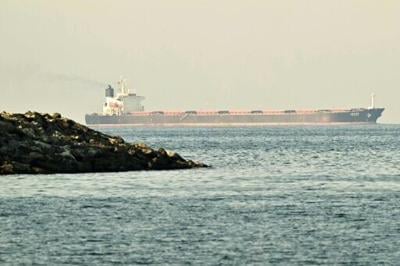
A handful of oil and gas tankers crossed the Hormuz Strait Saturday during a brief reopening, tracking data showed, but others retreated and two were reportedly attacked as Iran closed the route again.
Iran reversed its pledge to reopen the strait to commercial traffic during a ceasefire in the Middle East war in protest at an ongoing US counter-blockade of the route, a crucial passage for commodity shipments.
During the reopening, at least eight oil and gas tankers crossed the strait early Saturday after the Iranian announcement on Friday afternoon, data from tracking firm Kpler indicated.
However tracking platform MarineTraffic showed several other crude oil tankers approached the strait but then turned back near Iran's Larak Island, a checkpoint for vessels seeking to exit the Gulf under Iranian forces' blockade of the passage.
Four French-owned container ships bearing the name of major shipping firm CMA CGM also made U-turns in the strait on Saturday around 1000 GMT after starting to exit, the platform indicated.
Gunboats of Iran's Revolutionary Guards Corp fired on a tanker in the strait northeast of Oman, the UK Maritime Trade Operations Centre (UKMTO) said in an online statement.
"Tanker and crew are reported safe. Authorities are investigating."
The UKMTO said later that it also received a report of a container ship in the same area "being hit by an unknown projectile which caused damage to some of the containers" but no fire.
Around a fifth of the world's oil and liquified natural gas pass the strait in peacetime but traffic through the route came to a near-standstill after the war erupted on February 28 with US and Israeli strikes on Iran.
- Iran tightens control -
Iran's central military command on Saturday appeared to reverse the decision to reopen the route, saying it would resume "strict management" of the strait because of the continued US naval counter-blockade.
Iranian forces' closure of the strait has trapped hundreds of ships in the Gulf and driven up the price of oil and the costs of shipping goods, with captains avoiding the region for fear of attacks or mines.
At least three of the vessels tracked exiting via the strait on Saturday were listed as being under US sanctions.
MarineTraffic indicated that a cruise ship, the Celestyal Discovery, became the first passenger vessel to transit the strait since the start of the conflict.
It crossed close to the coast of Oman on Friday afternoon after having been docked for about 47 days in the United Arab Emirates.
"Reports indicate the vessel is sailing without passengers," Marine Traffic said in a post on X.
At least two other passenger ships showed up on the tracking platform passing the strait close to Oman on Saturday.
- Shippers wary -
The shipping industry had reacted guardedly to the reopening on Friday.
"The status of mine threats in (Iran's maritime) traffic separation scheme is unclear," Jakob Larsen, chief security officer of major shipping association BIMCO, said in a statement emailed to AFP.
"BIMCO believes shipping companies should consider avoiding the area."
Shipping analysis firm AXSMarine estimated in a note Saturday that there were currently about 108 to 116 million barrels of crude oil held on vessels at sea in the Gulf.
It estimated that load could transit the strait within six to eight days following a full reopening, but shipments would take several weeks to reach key markets in Asia.
pa-rlp/rmb
Keep reading
(The Center Square) – American prices for transportation fuels gasoline and diesel remained at four-year highs on Tuesday as the war with Iran moved into the 53rd day and the Strait of Hormuz remained mostly closed to vessel traffic.The national average price of a gallon of unleaded regular gasoline stood at $4.02, a 28.1% increase from $3.14 a gallon average at this time last year. National gasoline prices have averaged more than $4 per gallon for 22 consecutive days.The national average price of diesel fuel, used extensively to power industry, trucking, and railroads, has risen about 52% from the year prior to more than $5.51 a gallon on Tuesday. In Texas, Florida and Arizona, diesel costs have jumped by more than 60% year-over-year.“The near closure of the Strait of Hormuz really isn't hitting the United States in terms of supply – because our supplies are reliable – but it does raise prices,” said David Blackmon, a veteran oil markets analyst and Forbes contributor, told The Center Square.U.S. supplies of crude oil and gasoline remain at near-normal levels, Energy Department data shows.Commercial crude inventories held in storage tanks in Oklahoma and across the United States are currently at 463.8 million barrels, which is about 1% above the five-year average for this time of year.While the Strategic Petroleum Reserve has been drawn down to roughly 409 million barrels to limit pressures on the U.S. prices, domestic production and stable imports from Canada and Mexico have prevented any physical fuel shortages.Blackmon said prices are higher in part because many of the refineries in the United States that convert crude oil to gasoline, diesel and other fuels were engineered during the last 50 years to process heavy oil produced in Venezuela and countries in the Middle East. The United States is the biggest producer globally, but much of the light sweet crude that flows from America’s shale basins is processed abroad and not by domestic refiners, he said.“We don't have to be worried in the United States about long gas lines, a lack of gasoline supply or diesel supply, because we produce so much of our own oil and our imports are mainly from countries like Canada and Venezuela, Guyana, Mexico, and Brazil – other countries in the Western Hemisphere, in the Americas,” said Blackmon.According to the U.S. Department of Energy, the U.S. set a new annual production record in 2025, averaging 13.6 million barrels per day, fueled primarily by efficiency gains in the Permian Basin.U.S. crude oil production reached a record high 13.86 million barrels per day in October, but national output has declined in recent weeks to a near three-month-low 13.60 million barrels a day in the week that ended on April 10, according to the Energy Department.Blackmon said that since September 2008, when an American company drilled the first shale well in the Eagle Ford basin in Texas, the growth in U.S. oil production has been “incredible.”“From a base of about 3.6 million barrels of oil per day in 2008, we've added 10 million barrels of oil per day, which is the equivalent of adding the production of Saudi Arabia,” Blackmon said.While American drivers are feeling the pinch, costs remain significantly lower than in other global hubs like Paris and London, where high taxes push prices to approximately $8.20 and $7.50 per gallon, respectively. In Asian markets, consumers in Seoul paid $5.23 per gallon earlier this week, while the price in Tokyo sat at $4.75.In India, the government has shielded consumers by pressuring state-run refiners to freeze prices at approximately $3.86 per gallon in New Delhi, even as those companies reportedly lose nearly $200 million a day. This artificial stability stands in contrast to the U.S. market, where prices remain tethered to global volatility despite high domestic output.Ramping up U.S. production further would take time, even if companies chose to do so, according to University of Houston energy economist Ed Hirs. Individual firms make drilling decisions based on long-term price outlooks rather than short-term spikes, Hirs said. "Drilling in the shale basins is technically demanding," Hirs told The Center Square. "Furthermore, it is difficult for these drillers to scale back up after the layoffs of the last few years, and it is currently hard to source enough steel, especially with the Trump administration's tariffs in place."Hirs also pointed to the ongoing releases from the Strategic Petroleum Reserve as a bridge that has helped to limit price spikes, providing a temporary cushion while the global market remains bottlenecked. Hirs warned, however, that these releases are a finite tool that cannot replace the long-term need for clearing the international shipping lanes."The primary reason we are seeing such significant dislocations in pricing is that a massive portion of the world's tanker fleet is bottled up behind the Strait of Hormuz," Hirs said.He noted that while diesel recently hit $170 a barrel in Asia and jet fuel surged to $200, these prices are driven by logistics rather than a lack of raw crude."If we could get those tankers out into the open ocean," he said, "we would see these prices finally begin to settle out."

Brazilian President Luiz Inacio Lula da Silva on Tuesday championed trade multilateralism, saying Brazil seeks commercial ties "without preference" with partners from China and the United States to Russia and France.

COP31 co-hosts Australia and Turkey said Tuesday that a major energy crisis ignited by the Middle East war underscored the urgency of reducing fossil fuel dependency and investing in renewable alternatives.




(0) comments
Welcome to the discussion.
Log In
Post a comment as Guest
Keep it Clean. Please avoid obscene, vulgar, lewd, racist or sexually-oriented language.
PLEASE TURN OFF YOUR CAPS LOCK.
Don't Threaten. Threats of harming another person will not be tolerated.
Be Truthful. Don't knowingly lie about anyone or anything.
Be Nice. No racism, sexism or any sort of -ism that is degrading to another person.
Be Proactive. Use the 'Report' link on each comment to let us know of abusive posts.
Share with Us. We'd love to hear eyewitness accounts, the history behind an article.