(The Center Square) – New data and reports from the Committee for a Responsible Federal Budget have shown that if no legislative action is taken soon, Social Security could run out of money as soon as 2032.
Other recently released data from within the federal government reflected the projection agreed the Old-Age and Survivors Insurance and Disability Insurance funds are now set to run drya year soonerthan anticipated.
Roughly 2.1 million Illinois retirees, or 16.5% of the state population, who receive benefits would be impacted by a statutory cut to benefits if the program goes insolvent, according to Ben Tomchik, vice president with the CRFB.
That cut would result in a newly estimated $507 reduction in benefit payments per month for Illinoisans, based on previous years data.
Tomchik told The Center Square that work to find a solution in Congress needs to happen soon.
“We have to agree that any solution has to be bipartisan in nature. Seventy million Americans receive benefits as a part of social security. For 40% of seniors, it makes up the majority of their income. So, both parties have to come together on a solution,” Tomchik said.
Tomchik said the process to finding a solution isn’t new, and lawmakers can look to the last time Social Security faced insolvency, which was in the 1980s under President Ronald Regan.
“This is where you would have members from both parties come together along with outside experts. They would look at the problem, what is driving social security's fiscal challenges, and then put forward a series of solutions,” Tomchik said.
The Greenspan Commission, organized in 1981 under Reagan, did exactly what Tomchik described.
Two congressmen, U.S. Reps. Tom Cole, R-OK, and Tom Suozzi, D-NY, introduced House Resolution 9187 early last week to create a current day commission similar to that of the 1980s.
As for specific solutions, Tomchik said a few considerations may be raising the cap on how much money Americans pay into the program, lift the payroll tax cap, or the limiting of benefits.
“The good thing with Social Security is that there's a ton of options to save the program. The bad thing is we just need leaders who have the political courage to do it,” Tomchik said.
U.S. Sen. Tammy Duckworth, D-Ill., co-signeda letterto President Donald Trump this week that criticized his administration’s handling of Social Security, such as policies in HR1, or the “One Big Beautiful Bill Act,” a tax and spending package.
Federal trustees that oversee the program’s status attributed the projection to some of the same problems Duckworth cited, including reduced projected immigration levels and policies within HR1.
One consideration within the Trump administration Duckworth sought clarity on in the letter is a potential increase on the age of eligibility.
Multiple members of the administration have floated a potential change to the retirement age, which is currently set at age 67, including Social Security Administration Commissioner Frank Bisignano.
Bisignano floated the idea before the SSA walked it back in aposton the social platform X.
SSA Commissioner Bisignano is committed to protecting and preserving Social Security.
SSA Commissioner Frank Bisignano said, "Let me be clear: President Trump and I will always protect, and never cut, Social Security. That's why we have made many vital reforms, such as cutting…
In the post, the commissioner also reiterated that both he and Trump seek to protect Social Security recipients, rather than making cuts.
Bisignano went on to later tellFox Newsthat he instead planned to cut wasteful spending and target fraudulent and abusive payments.
“Under the Trump Administration, Social Security is serving more Americans better, faster, and with higher quality. We have made it a priority to have a pristine control environment and to eliminate waste, fraud, and abuse,” Bisigano said in a statement last week.
Tomchik told The Center Square that Illinoisans interested in securing future funds that they have paid into during their careers should pay attention to congressional candidates running in the November general elections.
He noted that the next elected U.S. senator from Illinois will serve a term that will end the same year as when benefit payments would be reduced.
(The Center Square) – U.S. Secretary of Housing and Urban Development Scott Turner visited Lansing this week to promote a number of affordable housing projects in mid-Michigan.
(The Center Square) - A Wisconsin state senator is pledging to make changes after a Thursday Wisconsin Supreme Court ruling that a minority scholarship aid program was unconstitutional.
Keep it Clean. Please avoid obscene, vulgar, lewd,
racist or sexually-oriented language. PLEASE TURN OFF YOUR CAPS LOCK. Don't Threaten. Threats of harming another
person will not be tolerated. Be Truthful. Don't knowingly lie about anyone
or anything. Be Nice. No racism, sexism or any sort of -ism
that is degrading to another person. Be Proactive. Use the 'Report' link on
each comment to let us know of abusive posts. Share with Us. We'd love to hear eyewitness
accounts, the history behind an article.
HUD secretary discusses housing affordability during Michigan visit
(The Center Square) – U.S. Secretary of Housing and Urban Development Scott Turner visited Lansing this week to promote a number of affordable housing projects in mid-Michigan.
This comes as Michigan continues to struggle with rising housing costs and a shortage of inventory, which some have labeled a "crisis" for Michiganders.
Turner joined U.S. Rep. Tom Barrett, R-Michigan, for tours of several housing developments.
“Housing affordability is one of the biggest challenges working families are facing across mid-Michigan and the country,” Barrett said. “The solution isn't more bureaucracy—it's building more homes, expanding opportunities for homeownership, and making sure families can compete in the housing market.”
One of the tours included The Residences at Walter French, a low-income apartment complex developed inside a former Lansing school building.
Turner said this is an example of the importance of "public-private partnerships."
“Lansing is a powerful example of how public-private partnerships can drive meaningful economic growth and community revitalization,” Turner said. “Innovative construction practices and strategic investment through Opportunity Zones are helping increase housing supply and transform historically forgotten communities.”
Turner also met with local housing, business and government leaders to discuss ways to expand housing opportunities across the region, which they said should include continued taxpayer-funded federal housing spending.
“From retention of Community Development Block Grant dollars to funding for housing and homeless resources, federal investments are necessary for Lansing, and all cities, to be successful,” said Andy Schor, mayor of Lansing.
Following the visit, Turner applauded what he saw in Michigan.
“Mid-Michigan is leading the way,” he posted to social media. “Great visit . . . to see public-private partnerships expanding access to affordable housing. That is exactly what the Trump Administration promised to deliver—affordable housing and the American Dream within reach for every family.”
Amy Hovey from Michigan State Housing Development Authority was present as the state-level representative.
"Thank you to U.S. Department of Housing and Urban Development Secretary Scott Turner for touring Michigan this week to see the innovative solutions that are expanding housing opportunities and enhancing communities across the state," the authority said in a statement following Turner's visit. "It’s always valuable to come together with our federal partners to strengthen our collaboration, advance our shared mission, and continue making an impact for Michiganders."
State lawmakers from both sides of the aisle have advanced dozens of housing bills this year as housing availability and affordability remains a growing concern, both in Michigan and nationally.
Last month, Michigan House Republicans approved a package of bills they say would reduce housing costs by eliminating the state property tax, as previously reported by The Center Square.
Many other housing-related proposals continue to move through the state legislature.
Just this week, State Rep. Cam Cavitt, R-Cheboygan, testified before the House Regulatory Reform Committee in support of Michigan's First-Time Home Buyer Savings Program, which allows first-time homeowners to save for down payments through tax-advantaged accounts.
Meanwhile, the Republican-led House recently approved bipartisan legislation that would allow communities to permit certain multi-family housing developments with single-staircase designs.
Yet another proposal would prohibit large corporations from purchasing single-family homes if they already own significant housing portfolios.
“My legislation could not be clearer: corporations will no longer take advantage of our broken housing system for their own gain,” said State Rep. Karl Bohnak, R-Deerton and the bill’s sponsor. “By stopping these predatory practices, we’re ensuring that single-family homes on the market are available for the people who need them.”
Barrett is leading a similar push in the U.S. Congress.
Israel-Hezbollah agree to ceasfire, U.S. official says
(The Center Square) – Israel and Hezbollah agreed to a ceasefire on Friday, a U.S. official confirmed to The Center Square.
Overnight, 18 people were killed in Lebanon amid strikes between Israel and Hezbollah, the Lebanon Health Ministry said. Four Israeli soldiers were also killed, according to the Israeli military.
A U.S. official confirmed on background that Israel and Hezbollah agreed to the ceasefire. The overnight attacks, first by Hezbollah and countered by Israel, appeared to stall peace talks between the United States and Iran.
Vice President JD Vance delayed a planned trip to Switzerland that was set to include discussions of Iran's nuclear program. The first article in a memorandum of understanding between Iran and the U.S. calls for an end to the fighting in Lebanon between Israel and Hezbollah.
The memorandum sets out a 60-day ceasefire for negotiations to continue on the future of Iran's nuclear program, and set up a $300 billion reconstruction fund for Iran.
Israeli Prime Minister Benjamin Netanyahu previously vowed to retaliate after the four Israeli soliders were killed.
"Israel will remain in the security zone in southern Lebanon for as long as required to protect the settlements in the north," Netanyahu said before the ceasefire was announced.
The terms of the Israel-Hezbollah ceasefire are unclear. The ceasefire's effect in ongoing negotiations between the United States and Iran is also unclear.
Wisconsin senator wants to reinstitute race-based scholarships via zip code
(The Center Square) - A Wisconsin state senator is pledging to make changes after a Thursday Wisconsin Supreme Court ruling that a minority scholarship aid program was unconstitutional.
Wisconsin Sen. Dora Drake, D-Milwaukee, said that she intends to introduce a bill that will restart the grant program for students based on income and zip code instead of the qualifications in the program since it began in 1985, including those who are “Black American,” “American Indian,” “Hispanic” or a former citizen of Laos, Vietnam or Cambodia who entered the country in 1976 or later.
Drake received the scholarship while she attended Marquette. The program awarded between $250 and $2,500 per year to students. The scholarships went to private college and technical college students.
The Wisconsin Supreme Court ruled that the program violated the Equal Protection Clause in the 14th Amendment. The case was filed by filed by six taxpayers against the Wisconsin Higher Educational Aids Board and Executive Secretary Connie Hutchinson, who was in charge of administering the grants.
The ruling was based on precedent from a 2023 U.S. Supreme Court ruling.
“That federal case was based on admissions while this program is about a student retention enacted by the state legislature and funded since 1985,” Drake, Chair of the Wisconsin Legislative Black Caucus, said in a statement. “They are setting a dangerous precedent by applying this federal ruling to distinctly different programs.”
Sen. Eric Wimberger, R-Gillett, applauded the ruling and said that it showed that a bill he sponsored, Assembly Bill 669, was the right move because it would have ended race-based scholarships in the state. That bill was vetoed by Gov. Tony Evers.
“Giving benefits based solely on race presumes someone has individual personal characteristics simply because they belong to a race category,” Wimberger said in a statement. “That is stereotyping and racism at their plainest and simplest.
“The Higher Education Aids Board could not identify to the Court any objectives or benefits it hoped to achieve through the policy. The Court is right today to call race-based government policies for what they are: odious.”
Wimberger vowed to continue to work to end other state programs that are solely based upon race because he wants to “pursue equality under the law.”
Drake said that the decision “emboldens an extreme conservative agenda” that hopes to end all protections and programs “to remove all disparities in America and secure a fair democracy for all.”
“We can’t continue to make the same mistakes like our nation did post reconstruction and Jim Crow if we do we will never achieve true equity in our democracy.” Drake said.
Drake called a constitutional amendment on the Nov. 3 statewide ballot “misleading.” The billt would prohibit Wisconsin governmental entities from giving preferential treatment based on race, sex, color, ethnicity or national origin. She said the programs are meant to eliminate disparities between those groups.
“Legislators like State Sen. Dora Drake benefitted from these programs, and now countless Black and Brown Wisconsinites won’t have the same opportunities because of the Supreme Court’s decision,” WisDems spokesperson Philip Shulman said in a statement. “Even worse is this decision will undoubtedly set the stage for more rulings that undercut similar programs and further disenfranchise Wisconsinites.
“This fight is not over, and I am confident we will see Democrats fight this ruling and continue to give every Wisconsinite the best chance possible to make a better life for themselves.”
Poll: Data center opposition more important than competition with China
(The Center Square) – American voters believe building more data centers in the United States are not worth the potential strain on local electricity, water and infrastructure and that the negatives outweigh the importance for national security and competing with China, according to a new poll.
The Center Square Voters’ Voice Poll found that 54% believe that data centers are not worth the strain while 29% said they believed that building more data centers in the United States is important for national security and competing with China.
The poll showed 17% were not sure.
The results come from a survey conducted by Noble Predictive Insights from June 1-4 and polled registered voters nationally via opt-in online panel and text-to-web cell phone messages. The sample included 2,585 respondents comprised of 915 Republicans, 1,013 Democrats, and 297 True Independents (Independents who, when asked if they leaned toward one of the major parties, chose neither). The margin of error is +/- 1.93%.
The poll was closest amongst those who voted for President Donald Trump, with 41% of Trump voters saying it is most important to compete with China and 44% believing that the costs are not worth the strain.
Among those who voted for Kamala Harris in the last presidential election, 63% said it was not worth the strain while 19% believed it was most important to compete with China.
Mike Noble, founder of Noble Predictive Insights, said that the idea that competing with China in artificial intelligence and data centers fell flat.
“I think that really goes back to that they haven’t done a good job with their messaging,” Noble said. “Even then, only 29% thought it was important for national security in that race with China.”
Foreign billionaires have provided funding upwards of $39 million to the anti-AI data center movement in the United States, according to an American Energy Institute report in April.
“The world we leave behind for our children and grandchildren will be a very dark one if a communist regime has technological dominance over the United States of America,” Founder, CEO and Chairman of State Armor Michael Lucci told The Center Square after the report.
Jason Isaac, CEO of the American Energy Institute, said that report showed that data center opposition is not “organic or purely local” and that transparency matters with what the report showed.
Here’s why Utah has become one of America’s surprising plastic surgery hot spots
Andy Larsen for The Salt Lake Tribune
Here’s why Utah has become one of America’s surprising plastic surgery hot spots
Billboards flank the freeway, encouraging you to “love thy selfie.”
Heather Gay, one of “The Real Housewives of Salt Lake,” estimates she’s spent $200,000 on cosmetic procedures.
Everywhere you look, it seems there are fuller lips, lifted faces and madeover mommies.
Yes, Utah has become a hot spot for plastic surgery.
But how hot? And why?
Surgeons, researchers and the data tell a fascinating story.
How much plastic surgery is there in Utah?
Maybe you’ve heard the claim that Utah leads the nation in plastic surgeries. But it’s hard to know how many cosmetic procedures are actually performed here.
The American Society of Plastic Surgeons compiles data by region, piling Utah into a Western cohort that includes all of the states from California to Colorado. That region does have the highest rate of plastic surgeries nationwide — but it’s hard to know if that’s due to Hollywood or Holladay
Overall, surgeons don’t like to share their data.
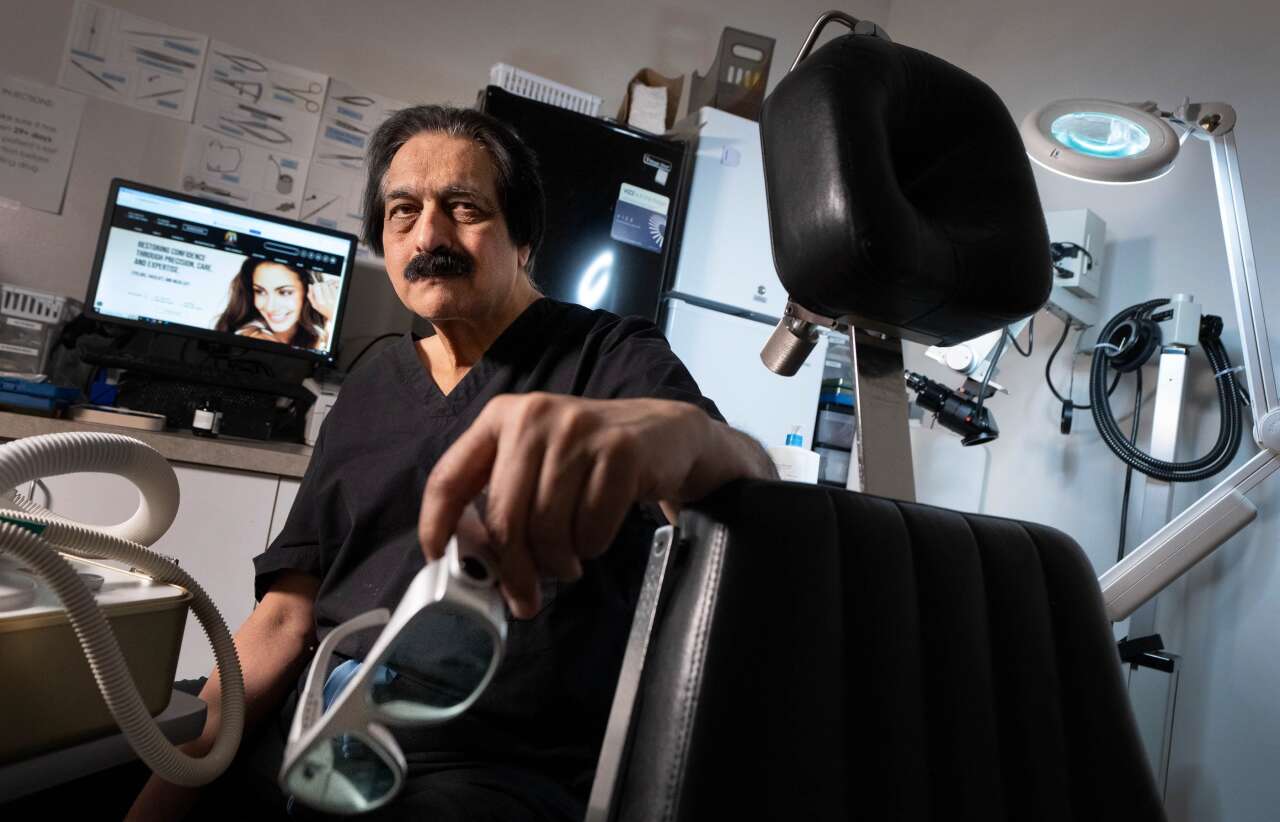
“They all have their own and everybody keeps their data secret because they don’t want other people to know,” Dr. Bhupendra Patel, a Salt Lake City facial surgeon, pictured below, told The Salt Lake Tribune.
Francisco Kjolseth // The Salt Lake Tribune Reply
So that question had to be answered via proxies. An obvious one is the number of plastic surgeons in any given area; the thinking being that if there’s more plastic surgery somewhere, there are likely to be more plastic surgeons.
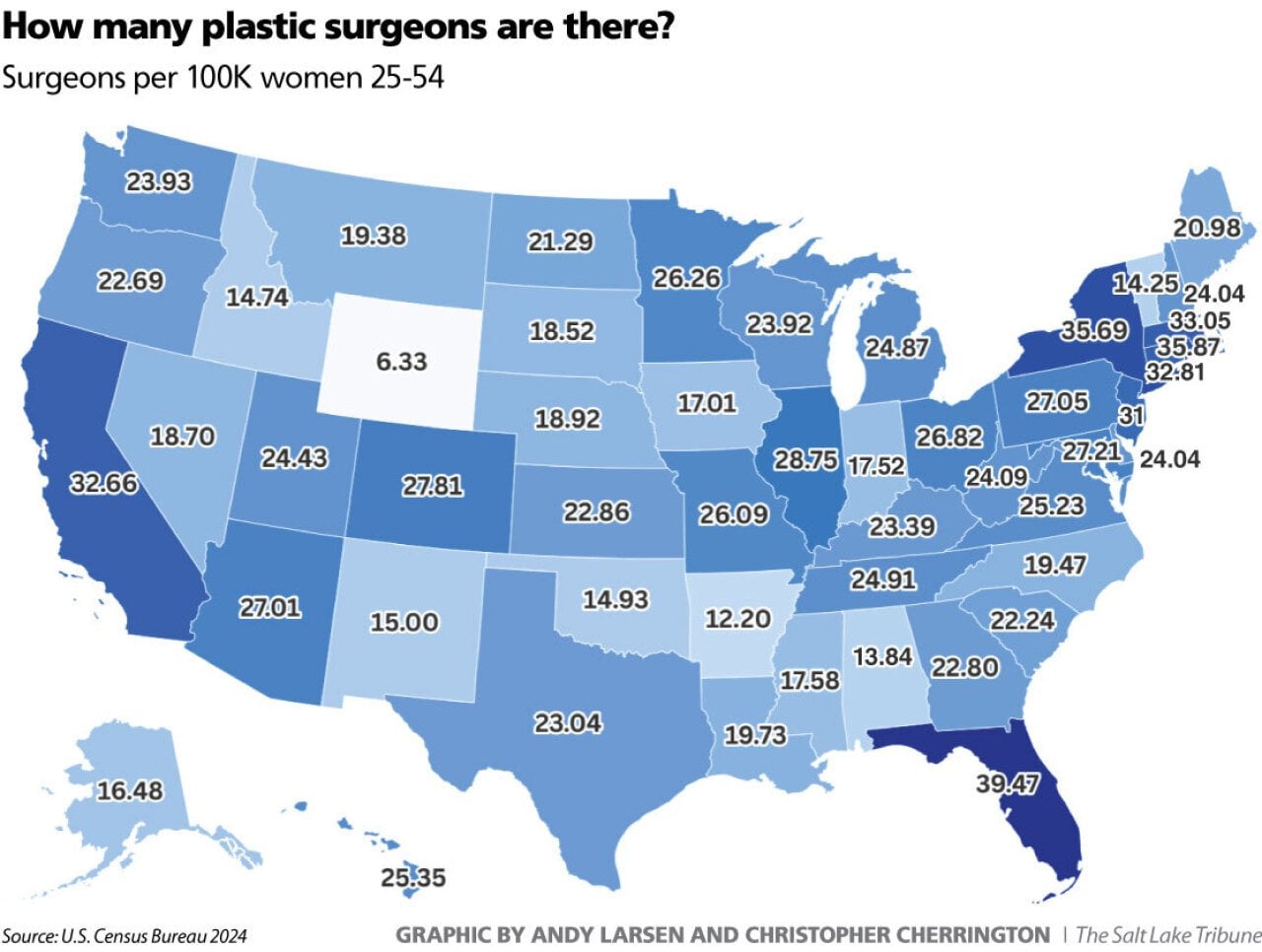
Perhaps the best count comes from the National Plan and Provider Enumeration System (NPPES), which any doctor who takes health insurance is required to sign up for. This database indicates there are 110 plastic surgeons in Utah. On a per-capita basis, that ranks seventh in the U.S.
Andy Larsen and Christopher Cherrington // The Salt Lake Tribune
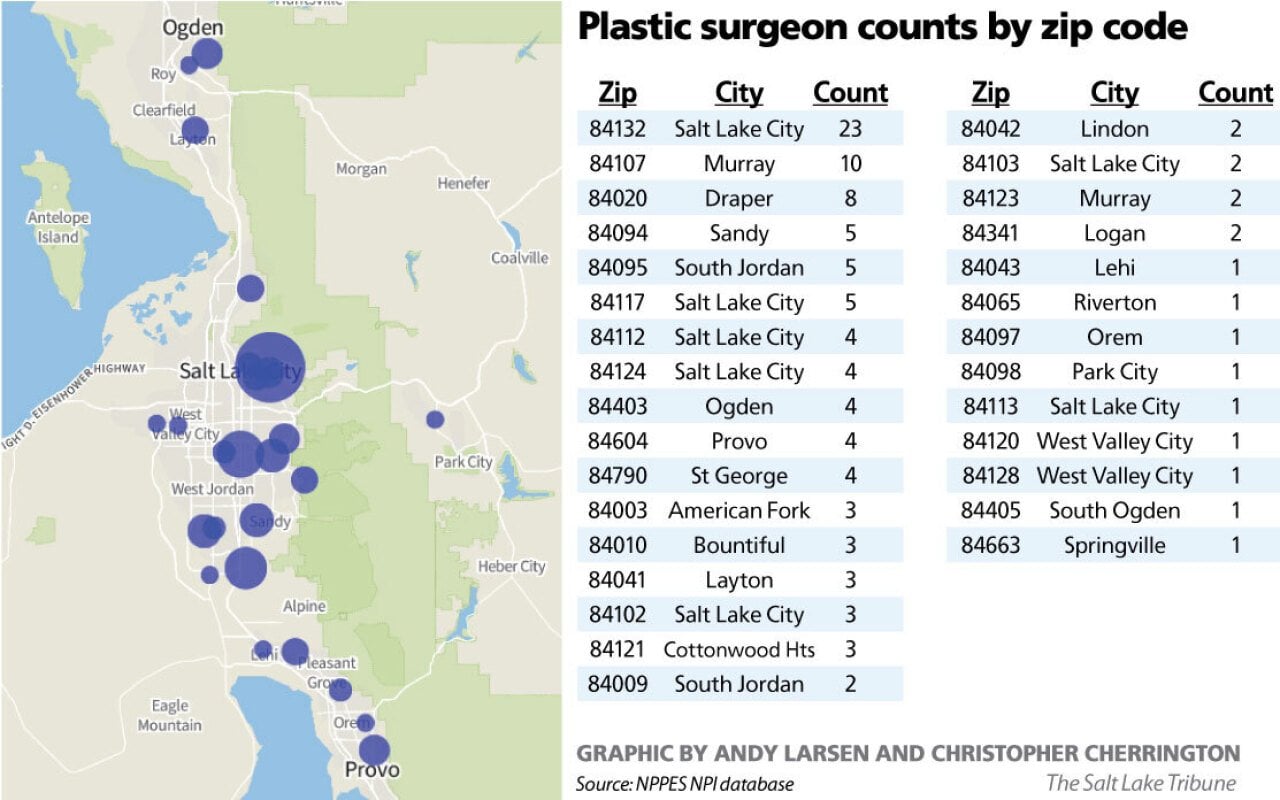
Most of those surgeons, 80 of them, are in Salt Lake County. Even on a per-capita basis, there are significantly more plastic surgeons in Salt Lake County than in any other county in the state. Twenty-three of the surgeons are affiliated with the University of Utah.
Andy Larsen and Christopher Cherrington // The Salt Lake Tribune
One caveat: Most plastic surgeries are performed on women (93%), and on people between 34 and 53 (75%). Utah does have a larger percentage of women between the ages of 25 and 54 — the Census age bracket most similar to the above — than other states. If you account for this demographic tendency, Utah ranks 20th in the nation in plastic surgeons per capita.
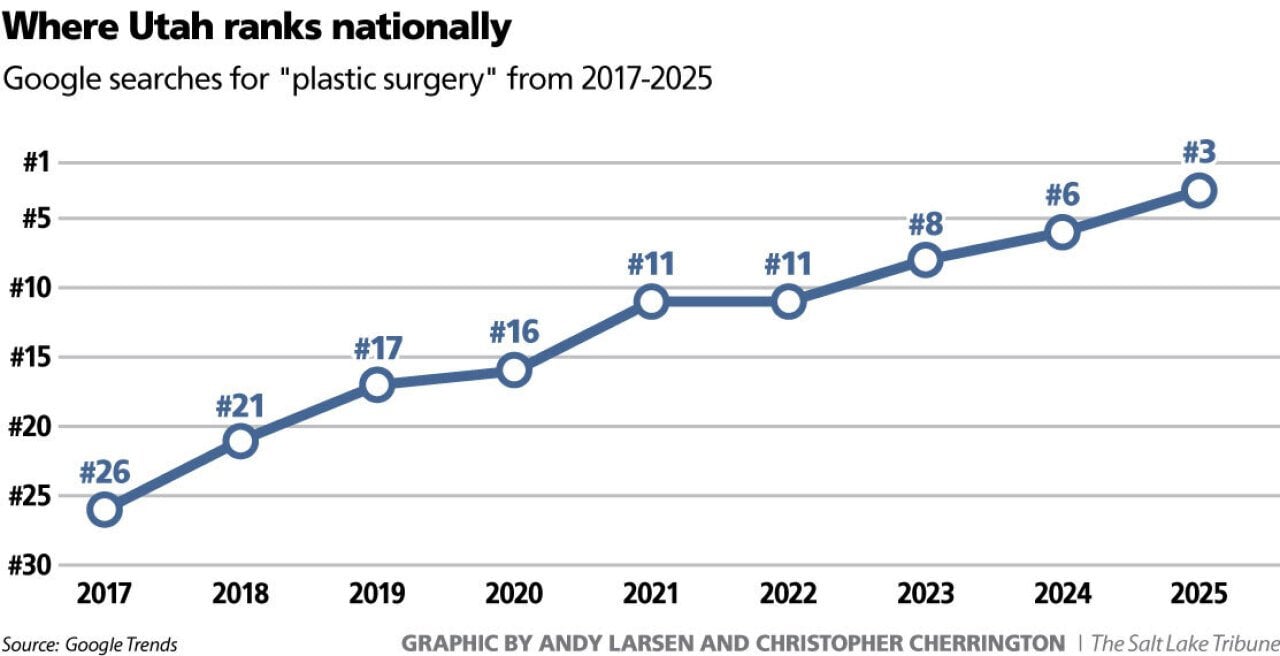
But Google search data indicates that interest in plastic surgery is growing in the state. Less than a decade ago, Utah ranked No. 26 in terms of the number of searches per capita for “plastic surgery.” In 2025, though? It ranked No. 3.
Andy Larsen and Christopher Cherrington // The Salt Lake Tribune
Utah’s cultural influences
In 2023, Brigham Young University professor and researcher Sarah Coyne and colleague Lauren Barnes looked at the crossover between body image, cosmetic surgery, and religiosity in a sample of 1,333 Latter-day Saints, aged 18 to 70, from across the nation.
According to their findings: “If you are saying that your religion is really important to you, you tend to have less cosmetic surgery,” Coyne said. “That’s odd, living in Utah, where we have a very high religious population, but then we have this certain stereotype of everyone having cosmetic surgery here.”
Nearly 14% of Latter-day Saints surveyed had major cosmetic surgery, and 20% had cosmetic enhancements. The study also found that people who believed in “costly grace” tended to have more cosmetic enhancements.
“Costly grace means this is a belief that I have to earn God’s love and grace,” Coyne said. “Now, the way that I earn that could be anything. It’s usually like I’ve got to be perfect. … Sometimes appearances are tied into that.”
Other factors contribute to Utah’s plastic surgery numbers, too.
“Perfectionism tends to be high in certain parts of our culture. [It] just kind of teaches you what you need to look like and need to be,” Coyne said. “The main reason that goes into this is that we have extremely unrealistic standards of beauty for women. Patriarchy, all of the different things, that’s why.”
Last year, the Utah Women & Leadership Project at Utah State University published a research brief on cosmetic surgery and body image among Utah women, which said the state’s “puzzling reputation for vanity and cosmetic surgery” is “fueled by a perfect storm of religious and cultural influences.”
The snapshot quotes research that has “found that homogenous societies, such as Utah, can have a contagion effect that pressures individuals into cosmetic surgery.”
Susan Madsen, the director of UWLP, said two of those homogenous characteristics in Utah are race — 89% of the state identifies as white — and religion.
“When we are around people that are like us, in terms of looks, skin, culture, religion, this competition for some reason arises,” Madsen said.
Reclaiming her body
Dr. Kevin Rose, a plastic surgeon with 25 years of experience, lists similar reasons as to why Utahns gravitate toward plastic surgery as Coyne and Madsen. He’s also noticed that his patients from Utah like to take care of themselves — particularly moms.
“So many women have a lot of children in Utah. There’s a lot of breastfeeding,” Rose said. “They just want to get their pre-baby body back.”
Trent Nelson // The Salt Lake Tribune
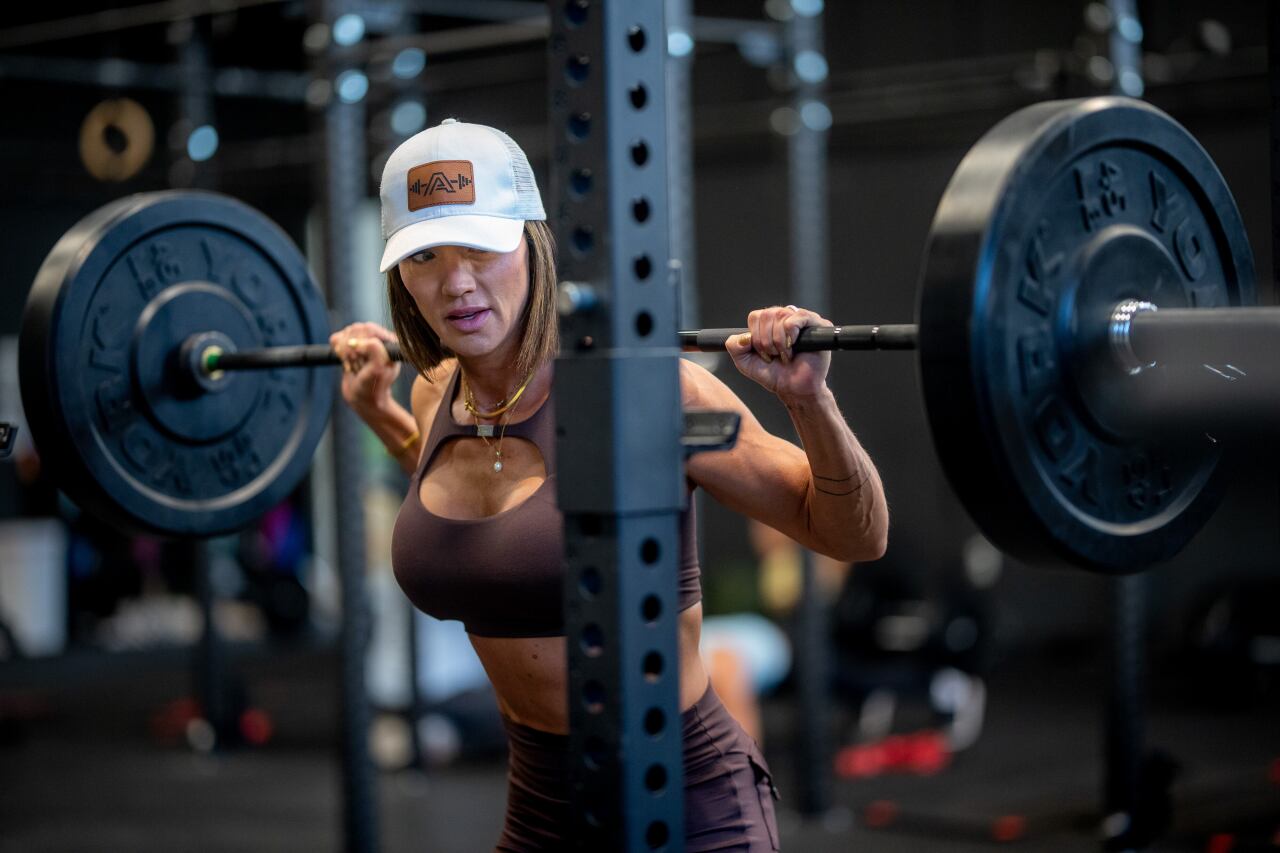
That was the case for Lehi resident Amy Williams, above, a patient of Rose’s who first saw him eight years ago for a breast augmentation — a decision she made to reclaim her body.
“I am a mom of six kids and I nursed all of my six babies, and I had absolutely no breast tissue left,” Williams said. “I wanted to restore what was lost.”
Williams is also a fitness influencer dedicated to losing weight and building muscle. She said that led her to have a “very flat chest.”
“I just felt so masculine, so I really wanted to just restore my femininity the first time around,” she said. Earlier this year, Williams did a reaugmentation with Rose since her implants had loosened from her body recomposition.
“As soon as I got it done, I was so happy with the results, I thought to myself, ‘Why didn’t I do this years ago?’” Williams said. “It completely restored my femininity and the way I felt about myself. It gave me confidence.”
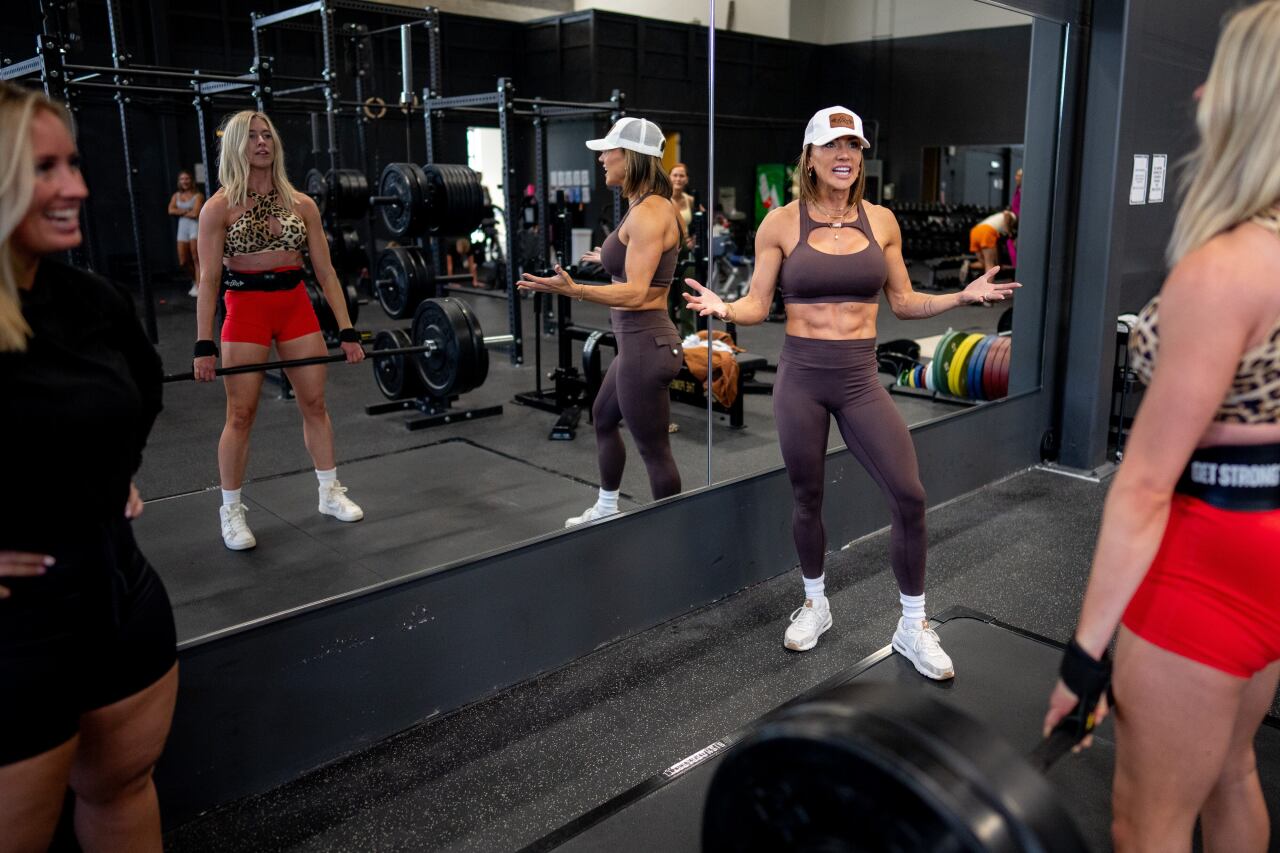
Williams hears similar stories from the women who attend her weightlifting classes.
“It is absolutely a sacrifice to give up our body for pregnancy, nursing,” Williams said. “There’s some things that just can’t be restored without intervention or without help.”
In her work, Williams said seeing women go through various surgeries like mommy makeovers, tummy tucks or breast augmentations has a lasting effect.
“They turn into a more confident, outgoing, kind person. There’s just this beauty that they have that comes from within when they feel good about themselves,” she said.
Trent Nelson // The Salt Lake Tribune
What are the trends in plastic surgery?
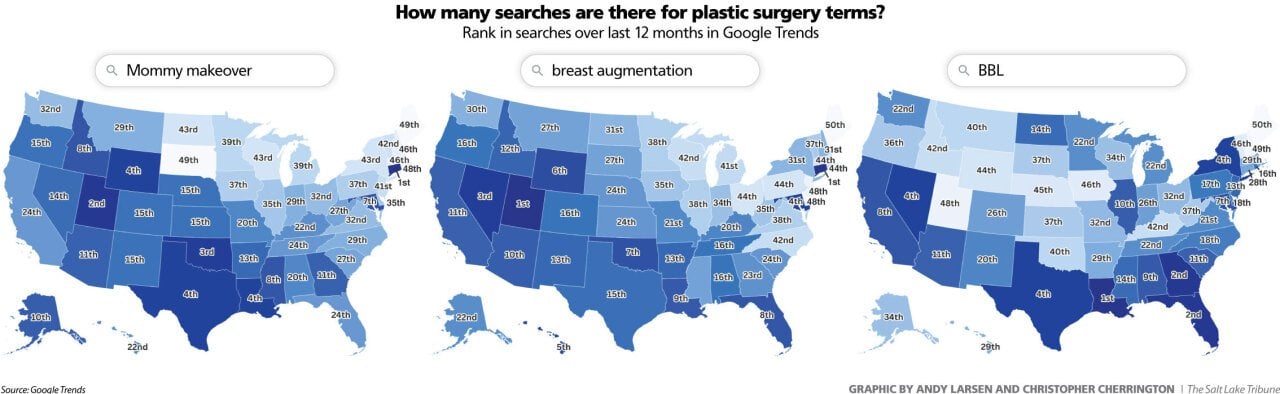
Thanks to those societal factors, the explosion in plastic surgery interest in Utah has occurred differently in Utah compared to other states. Perhaps due to Utah’s focus on families, searches for “Mommy makeovers” are very common in Utah relative to other states.
Patel, who has done body work in the past, considers Utah “the capital for mommy makeovers.”
Andy Larsen and Christopher Cherrington // The Salt Lake Tribune
In searches for “breast augmentation,” Utah ties for the No. 1 spot with Connecticut, with Nevada’s unique economy coming in third.
Twenty years ago, Rose said larger implants were more popular. But these days, most people come in and ask for more subtle and natural breast implant options. In fact, the most popular procedure he does is a breast rejuvenation procedure.
Utahns aren’t enamored with all kinds of plastic surgery, though. Brazilian butt lifts — more frequently referred to as “BBLs” are rarely searched for in Utah. Instead, it’s Louisiana that comes in No. 1 here, with fellow southern states Georgia and Florida tying for second.
Rose has observed this data firsthand.
“Utah tends to be maybe a little bit more conservative than other areas of the country in terms of what’s asked for,” he said.
For searches about facial surgeries, which are most popular in California, Utah’s ranks vary. For the search term “nose job,” Utah ranks third; for “face lift,” Utah ranks 14th; and for “neck lift,” Utah ranks 28th.
Patel was the chief of facial surgery at the University of Utah before he opened his private practice and is well-known for two procedures he designed: the hammock lift — which rejuvenates the top two-thirds of a face — and the Patel deep plane facelift — which utilizes soft tissue in the skin to prevent neck sagging.
“Most of my work these days is head and neck reconstructive and cosmetic surgery,” Patel said. “I do a lot of face and brow lifts, blephs, tumors and cancers, and broken bones and all that sort of stuff.”
He’s currently working on a book featuring 100 essays from his male and female patients. All the testimonials answer one question: Why did the individual decide to do a facelift?
“The reasons can be everything,” Patel said. “Men will say: ‘I started this company. I’m the boss. People keep on telling me, I look tired. When am I going to retire?’”
And, for women, “It’ll be a life change, either they get a divorce or a death in the family. … When ladies get in their late 40s, 50s, many women will say, ‘I became invisible,’ Patel said, “This is a phrase that I’ve heard again and again.”
Throughout his career, Patel has seen many changes in the industry.
Because of social media, he said, people are more aware of the variety of plastic surgery procedures out there, and his facelift practice has “grown enormously.” He’s also seen exponential growth in nonsurgical procedures like Botox since he first started.
Cost also plays into it. “We’re a lot cheaper than New York and LA, they charge literally eight, nine, [even] 10 times what we charge,” Patel said.
Another change: the audience for surgeries.
“[There] used to be a time when cosmetic surgery was sort of for the upper classes, people in the higher financial brackets,” Patel said. “In the last 10 years, I’ve started seeing just ordinary people, who work ordinary jobs, housewives, secretaries.”
Utahns do care deeply about the quality of their plastic surgeons, though. In general, Utah tended to rank very highly for various searches looking for reviews of surgeries, and the state ranked No. 1 for the term “best plastic surgeons.”
Rose specializes in breast and body contouring. When he moved to Utah in 2004, he remembers people questioning his decision to come to the Beehive State, wondering who would be getting plastic surgery there.
Now, the self-described “King of Cleavage” has had patients visit all the way from China.
“People come from all over because they just know that a lot of plastic surgery is done here,” Rose said. “They want to go somewhere where people are really experienced.”
So, yes, Utah is a hot spot for plastic surgery — and a growing one. Through the state’s confluence of social media and reality TV, quality doctors at a reasonable price, and even a bit of unique religious influence, there’s no doubt: Utahns’ minds are changing on the business of changing bodies.
U.S.-Iran talks stalled after Israel-Hezbollah fighting
(The Center Square) - Vice President JD Vance and negotiators in Iran have delayed peace talks and a planned formal signing of a peace agreement between the U.S. and Iran due to fighting between Israel and Hezbollah.
Overnight, at least 18 people were killed in strikes in Lebanon, according to Lebanon's health ministry. Four Israeli soldiers werealso killed by Hezbollah militants, the Israeli military said.
The fighting has brought an agreement to end hostilites between the United States and Iran to an abrupt halt. Vance and negotiators in Iran were supposed to travel to Switzerland on Friday to sign a formal memorandum of understanding.
"The plans for the upcoming technical talks have not been finalized, and the U.S. delegation has been prepared to depart at the first available opportunity," a spokesperson for the vice president said. "But the logistics of these negotiations have never been simple or predictable."
The memorandum of understanding gives negotiators 60 days to agree on a status for Iran's nuclear program and set up a $300 billion reconstruction fund for Iran.
The memorandum does not include mentions of Iran's support for terrorist proxies, including Hezbollah. The first article in the MOU calls for a ceasefire in Lebanon, specifically between Israel and Hezbollah.
Vance confirmed that the agreement between the two nations began on Thursday. Israel was not formally included in negotiations between the two nations.
"My directive is clear: Israel will not tolerate attacks on our soldiers or our territory, and it will exact a very heavy price from Hezbollah for these attacks," Israeli Prime Minister Benjamin Netanyahu wrote.
It is unclear when negotiators from the U.S. and Iran will pick back up with negotiations.
California’s billionaire tax officially heads to Nov. 3 ballot
(The Center Square) – The controversial union-backed billionaire tax in California is officially heading to the Nov. 3 ballot.
Secretary of State Shirley Weber announced the California Billionaire Tax Act exceeded the number of signatures it needed to qualify for the general election.
The initiative aims to impose a one-time 5% wealth tax on the Golden State’s billionaires to generate $100 billion in revenue. The tax would apply to assets like art, stocks and bonds. That money would be used to help backfill reductions in federal funding to K-12 schools, health services provided by Medi-Cal and aid from the Supplemental Nutrition Assistance Program, known as CalFresh in California, according to previous reporting by The Center Square.
Representatives from the advocacy group Billionaire Tax Now and the union backing the tax, Service Employees International Union – United Healthcare Workers West, did not respond to The Center Square before publication time.
However, lawmakers on both sides of the aisle spoke to The Center Square on Thursday about the tax measure advancing to the midterm election ballot in November.
“If you want a budget deficit in perpetuity, pass this,” Sen. Tony Strickland, R-Huntington Beach, told The Center Square. “What happens is, these folks are now going to Florida and everywhere else, and not only are they leaving, but they are the ones investing in a lot of these jobs. Those jobs now are fleeing California, and we’re going to lose them, dramatically, going forward.”
The Golden State’s billionaires will take their billions and create jobs in other parts of the country – not in California, Strickland added.
“The minute this passed, we would be in a budget deficit in perpetuity,” Strickland said. “If you care about funding education, if you care about funding health care, if you care about funding transportation infrastructure, you’ll vote no on this initiative, because we won’t be able to fund essential services in California.”
California’s ongoing budget deficit, which the Legislative Analyst’s Office recently projectedwould amount to $16.9 billion, is largely due to expenditures exceeding revenues under Gov. Gavin Newsom’s most recent budget proposal. That was in spite of the fact that Newsom attempted to solve the state’s budget deficit through 2028, according to previous reporting by The Center Square.
While some, like Strickland, see the potential passage of the billionaire tax making the state’s budget woes worse, there is still support for the measure.
“I agree with the proposal overall,” Sen. Sasha Renée Pérez, D-Pasadena, told The Center Square. “I agree overall with the idea that billionaires and corporations need to pay their fair share. We’ve seen inequality grow in an alarming way, and frankly, I think most Californians are sick of it.”
No one was available from Billionaire Tax Now or Service Employees International Union – United Healthcare Workers West to answer questions about the ballot measure’s progress. When asked if anyone was available to answer questions, a representative from Billionaire Tax Now sent a press release via email.
According to previous reporting by The Center Square, even the potential passage of the tax has sent some billionaires packing who previously called California home. Earlier this year, Facebook CEO Mark Zuckerberg bought a mansion in Florida. Other billionaires also relocated to other states, including Google co-founders Larry Page and Sergey Brin, Palantir Technologies and PayPal co-founder Peter Thiel and venture capitalist David Sacks.
However, a healthcare worker who advocate for the measure previously told The Center Square that if billionaires leave the state, they are only showing their own greed.
“We need to put humanity first over greed,” Debru Carthan, a radiologic technologist for Kaiser, told The Center Square in March. “This is about being our brothers’ keeper. Those who leave California – they are showing their greed. They’re showing their selfishness. And the very patients who will die are the ones who helped them make the billions that they have now.”
According to Business Insider, there are more than 200 billionaires who live in California.
Los Angeles County on track to raise sales tax to 10.25%
(The Center Square) – A measure to raise the sales tax to 10.25% - intended to temporarily inject funds into Los Angeles County’s public healthcare safety net - continues to have the necessary votes for passage.
The close contest for Measure ER pits support for public healthcare against criticism of the cost to consumers. Already, Los Angeles County is known for having one of the highest sales tax of any municipality in the nation. And the proposed 10.25% tax would actually climb toward 12% when combined with some of the cities' sales taxes.
As of Thursday, 1,012,236 yes votes (50.64%) have been counted for Measure ER. So far, 986,735 no votes (49.36%) have been counted thus far. That's according to the Los Angeles County Registrar-Recorder / County Clerk Office.
Also known as the Essential Healthcare Restoration Act, the measure is meant to last five years and generate funds to protect emergency rooms, public hospitals and community clinics from federal funding cuts to healthcare.
Howard Jarvis Taxpayers Association is opposed to the sales tax increase.
Vice President of Communications Susan Shelley said it will raise the cost of goods and services even higher.
“It will take the countywide sales tax in Los Angeles all the way up to 10.25%,” Shelley told The Center Square. “There are 88 cities in the county, and in many they have additional city sales taxes.”
The highest sales tax in L.A. County will be 11.75%
“That will be in Lancaster and Palmdale,” said Shelley. “Many other cities are going to be between 10.25% and 11.75% in L.A. County.”
Even without the passage of Measure ER, the total sales tax is 10.5% in the Los Angeles County cities of Monrovia, Montebello, Monterey Park and La Cañada Flintridge, home to NASA's Jet Propulsion Laboratory. That's according to the California Department of Tax and Fee Administration.
Consumers pay more or less for goods depending on which side they're standing on the border between counties. For example, consumers in Los Angeles County will pay 10.25% if Measure ER passes. Consumers in the Ventura County city of Simi Valley, right on the border with Los Angeles County, pay 7.25%.
Shelley called the increased Los Angeles County sales tax very regressive, adding that it will hit low-income people the hardest.
“Clothing, toothpaste, anything you buy in L.A. County is going to be a sales tax of minimum 10.25%,” said Shelley. “That is very regressive and very harmful when people are so concerned about affordability.”
Affordability was the No. 1 issue for most candidates running for local, state and federal offices. This includes people running for mayor, governor and congressional seats.
Meanwhile, Shelley warned that even though this was advertised heavily as being exclusively for healthcare, it is a general tax put on the ballot by the Los Angeles County Board of Supervisors.
“They had a spending plan that they put in the ballot measure ,but that's not binding,” said Shelley. “It just says it is their intent to spend it on the following, is how the language was written, but it's not binding.”
There is an oversight committee, but Shelley does not feel that will amount to much because the panel “can only watch them spend it” because it is a general tax that can be spent on anything.
Pointing to the measure, Shelley described that as “very deceptive,” as it was “sold to the voters as necessary to keep people from dying in the streets” of Los Angeles County.
According to Shelley, people were told trauma centers, hospitals and emergency rooms would close because of federal cuts enacted by the One Big Beautiful Bill Act.
“The federal government made changes in H.R. 1 last year that tighten the eligibility requirements for medical care that's federally reimbursed, and in doing so, all they're doing is enforcing federal law,” said Shelley. “There are no actual cuts to Medicaid. What there is, is a crackdown on various things that California's been doing in order to get more matching funds out of the federal government, and the federal government has tightened the requirements on that.”
For counties that pay for a high volume of full scope medical care for illegal immigrants, which Los Angeles County does, that is a massive financial burden, Shelley said.
That, said Shelley, is what supporters of Measure ER are describing as cuts.
Meanwhile, she suggested citizens in other counties raise the standards to make it harder to raise taxes.
“It could be a two-thirds vote everywhere to increase taxes,” said Shelley. “That would be helpful for taxpayers to increase the need for government officials who want to raise taxes to be scrupulously careful about how much they're requesting and what they're going to spend it on and then to be accountable.”
The Howard Jarvis Taxpayers Association has a measure on the ballot in November that will make it harder to raise taxes. It would not have affected Measure ER, but it would affect real estate transfer taxes and taxes that are proposed by a citizens initiative.
Supporters of the Los Angeles County sales tax hike include Louise McCarthy, president and CEO of the Community Clinic Association of Los Angeles County; healthcare unions and Los Angeles County Supervisor Holly J Mitchell.
The Center Square sought comments from McCarthy, Mitchell, SEIU Local 721, United Nurses Associations of California/Union of Health Care Professionals, Union of American Physicians and Dentists AFSCME Local 206, and LA County Federation of Labor (AFL-CIO) but did not receive a response by publication time.
EXCLUSIVE: Individual targeted in foiled UFC terror plot speaks out
(The Center Square) – One of the targets in the alleged terror plot to disrupt the Ultimate Fighting Championship event at the White House says he is not intimidated by extremist threats.
Federal intelligence agents discovered the plot and arrested five suspects they believe to be involved before the Sunday event took place. The group’s plan involved using drones bearing explosives to hit buildings near the event, prompting a mass evacuation that would steer crowds toward a group of snipers, authorities allege.
The alleged “team leader” in the group, 19-year-old Tycene Proper, had singled out specific politicians as targets due to their support of Israel, authorities allege.
One of those seven targets, all of whom are Republican lawmakers, was whistleblower advocate and West Virginia House Delegate Tristan Leavitt.
Leavitt, who did not attend the UFC fight, told The Center Square in an interview on The States that it was “very odd” to see his name included in the federal investigators’ affidavits. Though unsure why he was allegedly targeted, he assumes that his support of Israel is one factor.
“That’s become a very divisive topic, but something that I think is important for everybody to try and understand better,” Leavitt said. “When I had the chance to actually read the complaint it was interesting to see the other conspiracies these plotters were dialed into, about things like Jeffrey Epstein or data centers taking all of the available water.”
Federal agents who questioned the suspects noted in court documents that the murder plot “appears to have been motivated by their anti-government ideology,” with the conspirators mentioning hating “billionaires” and “capitalist elites.”
“I think the biggest takeaway that I had was that we have both an information problem in our country as well as a real problem with people who have policy disagreements wanting to solve those through potential violence,” Leavitt added.
The foiled terror plot follows two other major instances of politically motivated attacks or attempted attacks in 2026 alone.
A security incident at Mar-a-Lago where Secret Service agents shot and killed a suspected assassin occurred in late February, while the White House Correspondents’ Dinner in late April was interrupted by a shooter, now in custody, who also is accused of targeting President Donald Trump.
Leavitt believes that local-level conversations among people who disagree are critical to lowering the political temperature in America’s politically segmented society.
“So many people tend to get their news just from groups that agree with them. And so it makes it hard when misinformation is passed along, but especially when people aren't associating with others who have different views,” Leavitt told The Center Square. “Having those conversations with people is really critical, because we don’t do enough of that today in our society.”
In the meantime, Leavitt said he will not back down from his political stances on Israel or any other issues. He argued that doing so “lets terrorists win, frankly.”
"I’m not unaccustomed to controversy,” the lawmaker added. “I think it’s important not to change the policy stances or the speaking up or anything else. If you think something is right, I think it’s important to stand firm for those things and not be intimidated or cowed.”
Supreme Court backs gun rights for marijuana users in 9-0 decision
(The Center Square) – Gun rights advocates celebrated the U.S. Supreme Court’s decision on Thursday to allow occasional marijuana users to possess firearms.
Justices on the high court ruled unanimously to allow Ali Hemani, a man found with marijuana, cocaine and a pistol in his home to keep his Second Amendment rights. John Commerford, executive director of the National Rifle Association Institute for Legislative Action, told The Center Square it was “encouraging” to see a unanimous decision from the high court in favor of the Second Amendment.
“Any time you see the U.S. Supreme Court issue a 9-0 decision, it gets your attention,” he told The Center Square. “The U.S. government cannot deprive you of your core constitutional rights simply because you chose to be an occasional marijuana user.”
Commerford said he was particularly encouraged to see justices on the high court reference the pre-deprivation process, where an individual can get a gun confiscated before it is proven whether they broke the law. In Hemani’s case, the government argued his firearm could be confiscated as soon as he became an unlawful drug user and until he stopped using the drug unlawfully.
Justices on the high court disagreed on the ability of a pre-deprivation process to move forward. Commerford said this could indicate a willingness on the court to review cases on red flag laws, regulations that prevent individuals from obtaining a firearm if they are deemed a risk to themselves or others.
“This opinion opens up the door to multiple technical challenges in the future on a host of different issues where Second Amendment rights are taken away without adequate due process, so it's going to be very fascinating to see the legal landscape around gun policy develop,” Commerford said.
Amy Swearer, a senior legal fellow at Advancing American Freedom, said the decision has reinforced the Supreme Court’s need to review red flag laws and the pre-deprivation process as a whole.
The case reinforced a test developed after the 2022 decision, New York Rifle and Pistol Association v. Bruen, where the court determined further laws restricting Second Amendment rights needed to be supported by a historical precedent.
The government argued that founding-era laws prohibiting drunkards from certain activities in public spaces were not sufficient to support the ban on occasional marijuana users.
“The opinion reinforces that historical tradition that you need to rely on the context of the history of this country when you're enforcing constitutional rights,” Commerford said.
Swearer told The Center Square the process for analyzing historical laws has revealed that most people have been afforded a pre-deprivation process.
“It is important that in analyzing these historical laws, that is an aspect that routinely comes up, is that they were afforded some sort of pre-deprivation process, to at least some degree, even before a temporary deprivation of their rights,” Swearer told The Center Square.
While justices on the court remained unanimous in their decision, Justice Clarence Thomas argued that the federal law barring Hemani from obtaining a firearm could be seen as a violation of the Commerce Clause. He said the law allows Congress to improperly regulate items that never crossed state lines and called on the judiciary to take a deeper look into the issue.
“The Government can secure a conviction for unlawful firearm possession ‘if the firearm possessed’ by the drug user ‘had previously traveled in interstate commerce,’” Thomas wrote. “The Commerce Clause does not authorize Congress to ‘regulate or ban possession of any item that has ever been offered for sale or crossed state lines.’”
Swearer said she agreed with Thomas but did not think his arguments would be raised.
“I just don't see the court looking at this under the Commerce Clause, or at least, having anything remotely resembling a majority that would choose to look at it that way,” Swearer said.
Justices on the high court have one more Second Amendment case on the docket before the term ends. Wolford v. Lopez challenges a Hawaii law banning concealed carry owners from entering private property open to the public without express permission from the owner.
“I’m extremely confident that the Second Amendment community will be successful in Wolford,” Commerford said.





(0) comments
Welcome to the discussion.
Log In
Post a comment as Guest
Keep it Clean. Please avoid obscene, vulgar, lewd, racist or sexually-oriented language.
PLEASE TURN OFF YOUR CAPS LOCK.
Don't Threaten. Threats of harming another person will not be tolerated.
Be Truthful. Don't knowingly lie about anyone or anything.
Be Nice. No racism, sexism or any sort of -ism that is degrading to another person.
Be Proactive. Use the 'Report' link on each comment to let us know of abusive posts.
Share with Us. We'd love to hear eyewitness accounts, the history behind an article.