(The Center Square) - Many Americans do not think there is enough government regulation of artificial intelligence, according to a new poll.
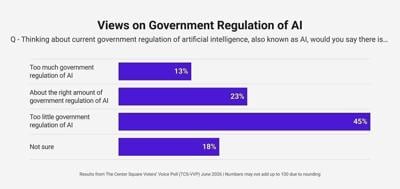
The Center Square’s Voters Voice Poll, conducted by Noble Predictive Insights, found that 45% of registered voters said there is “too little” government regulation of AI. Only 13% of voters said there was “too much” government regulation of AI and 23% said there was “about the right amount” of government regulation in AI.
The poll, conducted from June 1-4, surveyed 2,585 respondents. The sample included 915 Republicans, 1,013 Democrats and 297 true independents, which are individuals who do not lean toward either major party when asked.
As AI companies race to expand data centers across the country, many elected leaders and taxpayers have spoken out. Residents living near data centers have complained of energy problems, lack of water access, and noise pollution.
Data: The Center Square Voters’ Voice Poll (June 2026); Chart: Kate Guenther / The Center Square
Across partisan lines, there was a significant difference among Democrats and Republicans. About 37% of respondents who identified themselves as Republicans said there was “too little” government regulation of AI, compared to 53% of Democratic respondents who said the same.
About 41% of true independent respondents said there was “too little” government regulation of AI.
Older respondents were more likely to believe there is “too little” government regulation of AI. About 55% of respondents older than 65 agreed with the statement, compared to 37% of those ages 18-29 who said the same.
Mike Noble, founder of Noble Predictive Insights, said greater exposure to technology likely explains the difference among various age groups.
“It’s a classic thing of generational differences,” Noble said. “There’s a big gap between the two on their technological experience.”
Across racial backgrounds, white respondents were more likely to believe there was “too little” government regulation of AI. About 50% of white respondents believed there was “too little” regulation of AI, compared to 39% of Hispanics or Latinos and 30% of Black respondents who said the same.
Overall, 18% of respondents said they were “not sure” whether there was too much, too little or the right amount of government regulation of AI. The amount of individuals who were unsure exceeded categories in many other questions.
“There is a higher unsure rate compared to many of our other questions,” Noble said. “It’s a novelty among the electorate and many people haven’t made up their minds about it.”
Female respondents were more likely than any other demographic group to be unsure about their stance on government regulation of AI, at 23%.
“Government regulation needs to catch up to this new, fast, expanding technology,” Noble said.
Downtown Missoula Partnership announced the completion of the Beartracks Underbridge Playspace and the Caras Park Canopy replacement/pavilion repainting, and will celebrate the projects on June 24 at 12:30 p.m. in Caras Park during Out to Lunch.
(The Center Square) – The U.S. House overwhelmingly approved the revised 21st Century ROAD to Housing Act, sending the bipartisan bill to President Donald Trump’s desk for signature.
Keep it Clean. Please avoid obscene, vulgar, lewd,
racist or sexually-oriented language. PLEASE TURN OFF YOUR CAPS LOCK. Don't Threaten. Threats of harming another
person will not be tolerated. Be Truthful. Don't knowingly lie about anyone
or anything. Be Nice. No racism, sexism or any sort of -ism
that is degrading to another person. Be Proactive. Use the 'Report' link on
each comment to let us know of abusive posts. Share with Us. We'd love to hear eyewitness
accounts, the history behind an article.
A new survey was launched on Tuesday to gather feedback on parks, recreation facilities, programs and urban pathways across Helena.
According to city officials, the survey went out via mail to a limited group of residents to gather diversified feedback.
"A statistically valid survey has been mailed to a random sample of Helena households to help ensure feedback reflects the community as a whole, including residents from different neighborhoods and demographic groups," Helena officials stated.
Despite the limited mail surveys, all residents are encouraged to participate in the online version of the survey.
The city also planned a pop-up booth at the Helena Farmers Market on July 18, from 9 a.m. to 1 p.m., where community members can stop by and learn more about the project.
City of Missoula to mark Caras Park upgrades with June 24 celebration
Mark Rattner
NonStop Local Digital Journalist
MISSOULA, Mont. — The Downtown Missoula Partnership announced a community celebration for the completed Caras Park canopy project and Beartracks Underbridge Playspace on Tuesday, June 24, from 12:30-1:30 p.m. in Caras Park during Out to Lunch.
The group said the projects wrapped up two major updates in downtown gathering spaces, making the areas more welcoming for people to gather, play and connect.
The Beartracks Underbridge Playspace changed a former parking area under the bridge over the last three years, according to the Downtown Missoula Partnership. The space now includes cornhole boards, bike racks, a basketball hoop, picnic tables and table tennis.
The area also added painted ground features, colorful bridge pillars and painted dumpsters. New color-changing lights turned on nightly at 5:00 p.m.
“These projects are exactly the kind of community investments the Missoula Downtown Foundation is proud to support,” said Hailey Kern, president of the MDF Board of Directors. “From the transformation beneath the Beartracks Bridge to the renewed Caras Park canopy, these improvements create inviting spaces where people can gather, play, celebrate and experience the heart of Downtown Missoula.”
Downtown Missoula Partnership
The Caras Park project replaced the park canopy and bandshell and repainted the pavilion structure and bandshell, the partnership said. It explained the older canopy was installed in 1997 and had reached the end of its lifespan after nearly 30 years of weather exposure.
The Downtown Missoula Partnership said Caras Park will host community celebrations, concerts, markets, cultural events and family activities for decades and that the upgrades are meant to keep the space functional, safe and ready for continued public use.
More than $1.8 million came from the Missoula Downtown Foundation and donors over the last six years, along with $317,500 from Missoula Parks & Recreation with more than 150 businesses and individuals supporting the work, the partnership added.
Congress sends major housing bill to Trump's desk
(The Center Square) – The U.S. House overwhelmingly approved the revised 21st Century ROAD to Housing Act, sending the bipartisan bill to President Donald Trump’s desk for signature.
The legislation, which aims to boost housing supply and home ownership nationally, cleared the lower chamber in a 358-32 vote Tuesday evening after sailing through the Senate the night before.
House Financial Services Committee Chairman French Hill, R-Ark., who helped shape the package, called it “one of the most significant bipartisan housing reforms in recent memory.”
“This final product advances practical, bipartisan, and bicameral solutions to modernize federal housing programs, reduce regulatory burdens, streamline the development process, and help build more homes to meet that growing demand and keep the American dream within reach,” Hill told lawmakers.
At 381 pages, the long-delayed 21st Century ROAD to Housing Act largely focuses on simplifying or changing regulations that can slow new home building.
Among other regulatory reforms, the bill streamlines environmental reviews for new housing construction, raises the income eligibility for Home Investment Partnerships (HOME) project grants, and makes affordable housing construction eligible for Community Development Block Grant funding.
It also encourages community bank investments in housing by raising banks’ public welfare investment cap from 15% to 20% of their total capital and expanding access to third-party funding sources for financing mortgages and home construction loans.
To expand manufactured housing, the legislation eliminates the current requirement that all manufactured homes be built on a permanent chassis. It also authorizes a specialized grant program for areas with manufactured housing communities and updates mortgage lending standards through the Federal Housing Administration for manufactured homes.
In a slightly controversial move, the bill ties some municipalities’ Community Block Grant Development funding to the rate of their homebuilding, decreasing funding for recipients that lag on housing production and rewarding localities that accelerate it.
The legislation also incentivizes local governments to reform permitting and zoning laws in favor of housing construction by establishing a seven-year, $200 million annual competitive grant program for municipalities that significantly add to their housing supply.
While lawmakers ultimately stripped a provision that would have required large institutional investors to sell rental homes they built to individuals within seven years of construction, they included some restrictions on corporate home ownership.
Nearly 27% of all home sales in the first quarter of 2025 went to investors, both corporate and individual, according to a recent analysis by BatchData.
To help address the problem, the 21st Century ROAD to Housing Act institutes the first federal ban on large institutional investors – defined as entities that own more than 350 housing units – from buying single-family homes for the next 15 years. Manufactured housing, multifamily homes, and build-to-rent properties are exempted from the ban.
Republicans also obtained a four-year ban on the Federal Reserve issuing a Central Bank Digital Currency, though it exempts “any dollar-denominated currency that is open, permissionless, and private, and fully preserves the privacy protections of United States coins and physical currency.”
With the 2026 midterm elections approaching, the bill gives Republicans an opportunity to showcase Trump-endorsed legislation as evidence they are tackling affordability issues, which Democrats have made a pain point for the party.
The median home price in the U.S. sits above $405,000 while the median annual household income is below $84,000, according to the most recent federal statistics.
Meanwhile, the median age of first-time buyers jumped to 40 in 2025, seven years older than the median age just five years prior, according to a National Association of Realtors analysis.
“We promised the American people we would fight to make homeownership attainable again, and today we delivered,” Rep. August Pfluger, R-Texas, Chairman of the Republican Study Committee, said on social media following the House vote. “Republicans have been laser-focused on lowering costs for working families, and the 21st Century ROAD to Housing Act is a pivotal part of making that a reality.”
Hundreds of organizations have expressed support for the 21st Century ROAD to Housing Act, including the National Association of Homebuilders, the National Association of Realtors, the National Housing Conference, the National Association of Counties, and the Bipartisan Policy Center.
"The 21st Century ROAD to Housing Act passing both chambers is a milestone not just for housing policy, but for what's possible when Congress works together,” Dennis Shea, Executive Vice President of BPC’s Terwilliger Center for Housing Policy, stated. “For the families who've been priced out, squeezed out, or left behind by a broken housing market, this is a meaningful step—and it's long overdue.”
Trump is expected to sign the bill into law Wednesday at the Capitol.
(The Center Square) - Colorado’s 3rd Congressional District primaries have been defined by changes in President Donald Trump's endorsement, a late challenger and environmental concerns.
The pair of June 30 contests feature two Republicans and two Democrats, as incumbent Rep. Jeff Hurd, R-Grand Junction, looks to hold onto his seat after an endorsement by Trump. That follows the Republican president's earlier criticism of Hurd and endorsement of a different candidate in the GOP primary. The winners of the two partisan races will face each other in the Nov. 3 general election.
Candidates in the largely rural district are going head-to-head on the economy and environment. The state’s largest district geographically wraps around much of rural and mountainous western and southern Colorado.
“Congressman Jeff Hurd, of Colorado’s 3rd Congressional District, should in no way, shape, or form, be impeded from winning the District in that the Democrat alternative is a DISASTER for our Country,” said President Donald Trump in a social media post on Truth Social from March. “Therefore, I will be fully supporting Jeff’s Re-Election to the House of Representatives, giving him my Complete and Total Endorsement!”
Trump’s endorsement of the incumbent Hurd for the Republican primary coincided with the announcement of Republican primary challenger Hope Scheppelman’s exit from the election. It came as a sharp turn from a month earlier when Trump had berated Hurd and endorsed Scheppelman to unseat the freshman congressman.
“[Hurd is] more interested in protecting Foreign Countries that have been ripping us off for decades than he is the United States of America,” Trump said in a February Truth Social social media post, calling the freshman congressman a RINO (Republican in name only). The post had itself reversed an even earlier endorsement of Hurd from late 2025, citing Hurd’s lack of support for Trump’s tariffs.
Scheppleman did not respond to questions from The Center Square about her withdrawal from the campaign. Hurd also did not respond to a request for comment, but said in a Marchsocial media poston X that he was grateful for the president's endorsement.
Following Trump’s endorsement of Hurd, former state Rep. Ron Hanks launched a last-minute campaign bid in April. Hanks and Hurd previously ran against each other for the Republican district primary in 2024, which Hurd won to replace Rep. Lauren Boebert. Hanks did not respond to a request for comment by The Center Square but has echoed criticism of Hurd for dissent against Trump.
Amid the endorsement whirlwind surrounding the Republican primary is a policy argument focused on the economy and environment.
According to his campaign site, Hurd supports the expansion of oil and gas in the state along with competitively priced renewable energy to bring down energy costs. He also has said he would fight to prioritize the state’s Colorado River water rights amid ongoing negotiations between western states over the valuable water source.
Hurd’s Republican and Democratic challengers have criticized his support for Trump’s One Big Beautiful Bill Act, which critics say are increasing healthcare costs for Americans.
“I will not vote for another Big Beautiful Bill if something similar is brought forward,” Hanks said in a statement critical of Hurd.
While Hanks has repeatedly criticized Hurd for breaking with Trump’s leadership, he has stated that in addition to his opposition to the One Big Beautiful Bill, he would oppose the U.S.-Israel conflict with Iran. He blamed the conflict started by Trump for high gas prices and inflation.
Across the aisle, the district’s Democratic primary features Alex Kelloff and Dwayne Romero. Kelloff is a businessman who cofounded skiing brand Armada Skis, while Romero is an Army veteran and former city council member in Aspen.
Kelloff told The Center Square that the two largest issues the state was facing were the cost of living and the rule of law, particularly Congress’ ability to act as a balance of power to the President.
He said he would be open-minded to legislation that would ban institutional investors from buying up large numbers of single-family homes. He also advocated for the end of the conflict with Iran and the reopening of the Strait of Hormuz.
“Protecting our public lands and water are critically important in this district because public lands make up so much of the landscape here,” said Kelloff. “Water is so critically important to our agricultural industries as well as outdoor recreation, which are the two largest economic drivers [for the district].”
Kelloff added that while Colorado River water rights negotiations are not currently decided by the federal government, he would support a third-party moderator to find a solution to the issue if it came to that point.
Romero did not respond to a request for comment by The Center Square.
Hurd has received over $3.2 million in total campaign receipts, while Hanks has received just over $20,000 since his campaign began in April, including over $9,000 in self-made loans.
Romero has received nearly $700,000 to his campaign, which included $350,000 in loans by the candidate, while Kelloff had filed over $1.2 million in total campaign receipts.
(The Center Square) – Another company has redomiciled in Texas, again leaving Delaware, continuing a trend known as DEXIT, or “DEXIT to Texas.”
After operating in Texas for 10 years, Axiom Space has redomiciled its legal headquarters in Texas.
A leader in commercial human space exploration, Axiom Space says the move aligns its legal home with its operational headquarters in Houston, where it has been operating since 2016.
“Texas has demonstrated, consistently and deliberately, that it wants innovative companies to thrive here and has built the policy and regulatory framework accordingly,” Axiom Space CEO and president Dr. Jonathan Cirtain said in a statement. “For Axiom Space, establishing Texas as both our operational and legal home puts us squarely in a state that understands our mission, supports our industry, and shares in what we are working to achieve.”
Axiom Space and Gov. Greg Abbott made the announcement after Abbott and Cirtain met on Monday.
"Texas has been the launchpad of spaceflight since its inception,” Abbott said in a statement. "We welcome Axiom Space's decision to make Texas its legal residence and look forward to the progress they will achieve in our state. Those who reach for the stars do so from the great state of Texas."
“Texas is actively transforming into the nerve center of the new space economy,” Axiom Space said. “The state has made bold financial and infrastructural commitments, building a business environment designed to turn ambition into reality.” It also adds that the company “is a growing contributor to the state's economy and workforce, employing approximately 700 people, the majority of whom are in Texas.”
“The company's Houston footprint reflects its mission at every level,” it says. This includes its Assembly Integration and Test Facility, built at the Houston Spaceport, a federally licensed commercial spaceport at Ellington Airport. This is where Axiom Station modules will complete final assembly and integration before ascending to orbit. Its footprint also includes its Space Station Development Facility and its spacesuit lab also in the Houston area.
Axiom Space credits it’s redomicile to Abbott’s and the state legislature’s commitment to advancing Texas space policy, state regulatory policies and business friendly environment.
In 2023, the state legislature established the Space Exploration & Aeronautics Research Fund (SEARF) appropriating $150 million toward grants to facilitate research, infrastructure, and technology development. It also allocated $200 million to the Texas A&M Space Institute, a multi-tenant facility designed to advance lunar and Mars systems. In 2025, another $300 million in grants was approved.
The legislature also established the Texas Space Commission to oversee SEARF, which Axiom Space says created “a powerful gravitational pull for companies committed to long-term growth in space and to delivering the benefits of that growth back to Earth.”
Axiom Space was awarded a $5.5 million SEARF grant to “advance its orbital computing capabilities, expanding Axiom Space's role from hardware builder to comprehensive space infrastructure provider and bringing the processing power of orbit to bear on problems that matter on the ground.”
Axiom Space has launched four private astronaut missions to the International Space Station (ISS), flown 14 astronauts representing 11 countries and conducted more than 160 experiments and dozens of on-orbit outreach events, it says. Axiom Station, the commercial successor to the ISS, will provide a permanent platform where more countries can participate, conduct research, test technologies, and develop capabilities leveraging the microgravity environment, it says.
In response to the latest DEXIT announcement, Texans for Lawsuit Reform CEO Ryan Patrick told The Center Square, “Today, we’re celebrating the fact that if you want to get to space, you’ll have to go through Texas. Axiom Space has already recognized the Lone Star State for its strong business environment and its ability to thrive in this fast-growing, high-wage industry. By reincorporating to align with its base of operations in Houston, Axiom Space can now focus on innovation and expansion.
“What’s also clear is that the status quo is being dismantled in real time by the companies that want to grow jobs and expand prosperity for their employees and shareholders. Delaware, you’ve got a problem.”
Texas is home to more than 150,000 aerospace workers. NASA's Johnson Space Center located roughly 30 miles south of Houston generates more than $9.8 billion in annual economic output.
McNabb: Trump administration's moves on Title IX show care, compassion
(The Center Square) – More work is to be done, including getting a win at the U.S. Supreme Court.
Still, two years into the second term of Republican President Donald Trump, reclaiming Title IX in the spirit as President Richard Nixon signed it 54 years ago to the day on Tuesday remains a challenge accepted by supporters across the nation. North Carolinian Payton McNabb says the administration has backed up their words.
“I think there's still a lot to be done, and I think that the way that they've been moving through this, they obviously care,” McNabb told host Greg Bishop on Tuesday’s edition of The States by The Center Square. “Since Day 1, I mean, they campaigned on it. And then seriously actually followed through, which was encouraging to see.
“I think we're moving in a great speed, and of course, there's still a lot to be done. I think that they're willing to step up and do that.”
Title IX at 54 years, Illinois digital currency tax, Georgia election overhaul, FEMA disaster funding gaps, and Virginia's 183% legislative pay raise.
On Sept. 1, 2022, at Highlands High School, the trajectory of McNabb’s life forever changed. The state public school athletic association, then led by Commissioner Que Tucker, permitted boys to petition to play in girls sports. One of them spiked a volleyball into the head of McNabb, ending the three-sport career of the Hiwassee Dam High athlete.
Today, she still battles medical issues. Her struggles, she says, are “because of one guy” and adults who were enablers.
Rather than pity or cowardice, or worse still silence, McNabb has risen to successes that – particularly in the summer of ’22 – could never have been imagined. She’s been across the country to state legislatures pushing for protection of women’s spaces and sports, she’s testified in Congress, twice been a guest of Trump for landmark occasions, and she’s grown genuine friendships with other advocates like former college swimmers Riley Gaines and Paula Scanlan.
Her story is tragic, her response resilient.
And it’s in a movement with powerhouse names like author J.K. Rowling, tennis legend Martina Navratilova, and Jen Sey, the former front office titan at Levi’s who eventually left and began her own athletic apparel company XX-XY Athletics. The January day at the U.S. Supreme Court included emotional conversations from TV personality Sage Steele, Education Secretary Linda McMahon, Alabama Sen. Tommy Tuberville and Michigan Rep. Lisa McClain.
“I think with the Department of Education under the Trump administration – they have done an incredible job at cracking down on these different stories and giving them a platform and standing up for girls who really felt helpless and like they were crying out for help the last few years and no one was there,” McNabb said on The States.
She said the Biden administration was “actively working against women and we were regressing all this progress that we've made throughout the years by opening it up to everybody and taking away everything that women have fought for and fought to have. It was really disheartening to see the last administration open it up like that and kind of make it seem like they were fighting against us, because that's exactly what it was. I felt like I wasn't protected at all. And you know, there are countless women who felt the same way I did.”
The Supreme Court in January heard the cases known as Little v. Hecox and West Virginia v. B.P.J., respectively.
Lindsay Hecox, now 24, didn’t make the women’s track and cross country teams at Boise State. Idaho law, a first of its kind in 2020, says athletes from elementary school through college are to participate on respective male or female teams based on “original birth certificate issued at the time of birth.”
B.P.J., 15-year-old high school student, has identified as female since third grade, using medicine to resist male puberty. West Virginia law, enacted in 2021, is like Idaho in using birth certificate at time of birth.
At stake in the decision of the justices is legal precedent for civil rights, gender identity and school operations.
In a press conference after the arguments, John Bursch of the Alliance for Defending Freedom said, “It means a lot that the other side has to tell the court not to define sex in order to win this case.”
The Supreme Court has identified Thursday as an opinion day.
Title IX says, “No person in the United States shall, on the basis of sex, be excluded from participation in, be denied the benefits of, or be subjected to discrimination under any education program or activity receiving federal financial assistance.”
The price tag is an estimated $111 billion in gross program costs being paid by the taxpayer – at the federal level. State and local money adds to the total, and varies.
The Education Department in the Biden administration attempted to change those 37 words with 1,561 pages of rewrite. Trump said no on his first day.
McNabb is hopeful for victory at the highest court, even if perplexed the cases have wound up there.
“It's what gave me the opportunities that I had, and let me be able to follow my dreams,” McNabb told Bishop, explaining the personal impact of Title IX. “But it isn't just about celebrating female athletes, it's about protecting the opportunities that make those achievements possible because the next generation deserves a fair shot that the last five decades of women got to have.
“They deserve a fair shot, and that's exactly what Title IX was created to protect. So I love Women's Sports Week. I think that the little girls lacing up their cleats, stepping onto the court, diving into the pool with big dreams – those dreams matter. And the opportunities created by Title IX changed countless lives, and we have a responsibility to protect them, so that every girl can compete fairly, safely, and with confidence.”
Antifa members convicted in Texas ICE attack sentenced to lengthy prison terms
(The Center Square) – An Antifa member was sentenced to 100 years in prison Tuesday following a guilty verdict in a plot to target an Immigration and Customs Enforcement detention center in Texas nearly a year ago. Several others also received lengthy prison sentences from the same attack.
Eight individuals were found guilty on terrorism-related charges in March, the first in the nation after President Donald Trump designated Antifa a domestic terror organization.
Benjamin Song, who was identified as the group’s leader, received the harshest punishment of 100 years in prison. Maricela Rueda was sentenced to 70 years in prison; Savanna Batten, Zachary Evetts, Autumn Hill, Meagan Morris, and Elizabeth Soto received 50-year prison sentences; and Daniel Rolando Sanchez-Estrada received 30 years.
A ninth member, Ines Soto, who was also found guilty, is scheduled to be sentenced July 1.
The group was accused of being a part of the North Texas Antifa Cell. They were found guilty of rioting, using weapons and explosives, providing material support to terrorists, obstruction, and attempted murder, the U.S. Attorney’s Office for the Northern District of Texas said.
The group was convicted of the attempted murder of an Alvarado, Texas, police officer and correctional officers at the Prairieland ICE Detention Center occurring on July 4, 2025.
The convictions came after a 12-day trial beginning Feb. 23, which included 45 witnesses and more than 210 exhibits.
The first conviction and sentences of its kind came less than a year after The Center Square asked the president if he would designate Antifa a domestic terror organization following the rise of left-wing political violence. In response, the president officially designated the group a terror organization a week later.
Several Antifa cells in Europe have since been designated foreign terror organizations.
The ICE Prairieland Detention Facility in Alvarado was attacked in an ambush shooting on July 4, resulting in one officer being shot and injured.
Homeland Security noted at the time of the indictment that “nearly a dozen violent assailants equipped with tactical gear and weapons” attacked the facility, which occurred days before another attack where a Border Patrol official in McAllen, Texas, was also shot and injured.
An additional seven were charged, while pleading guilty last year to one count of providing material support to terrorists. The group includes: Seth Sikes, Nathan Baumann, Joy Gibson, Susan Kent, Rebecca Morgan, Lynette Sharp and John Thomas.
At the time of the convictions, then U.S. Attorney General Pam Bondi said the verdicts are just the beginning as the Trump administration continues to pursue accused Antifa members.
“Antifa is a domestic terrorist organization that has been allowed to flourish in Democrat-led cities – not under President Trump,” said Bondi. “Today’s verdict on terrorism charges will not be the last as the Trump administration systematically dismantles Antifa and finally halts their violence on America’s streets.”
FBI Director Kash Patel, who initially announced the indictment in October, underscored the bureau's commitment to tracking down Antifa cells.
Mizzou volleyball faces some stiff tests in 2026 schedule
Jace Denison, Columbia Missourian
The 2026 Mizzou volleyball schedule has been finalized and tickets are available for purchase.
After finishing 17-11 overall and 8-7 in SEC play last year, the team signed three transfers and a handful of notable incoming freshmen this offseason.
The Tigers will begin the season with a pair of exhibitions, first against Drake at home on Aug. 15 and then vs. Tulsa in Springfield on Aug. 20. The Mizzou Invitational will follow on Aug. 28-30, as the Tigers take on Western Illinois, Towson and Idaho to begin the regular season.
On Sep. 1, As part of the SEC/Big Ten Challenge, Mizzou will host the Oregon Ducks. The match will be the third meeting between the teams and first since 1998. In the second match of the challenge, on Sep. 6, the Tigers will head to Wrigley Field in Chicago to play Nebraska, which went undefeated until the regional final of the NCAA Tournament last season, finishing 33-1.
The Tigers also will head to Louisville for a match with the Cardinals in the SEC/ACC Challenge. The Tigers have not beaten the Cardinals since 1984, and have lost six straight since that match.
Mizzou will be tested in conference matchups, starting with Vanderbilt on Sep. 27 and ending with Arkansas on Nov. 15.
Last season, the Tigers started and finished poorly in SEC play. They went 1-4 to start conference play before the team hit its peak between Oct. 12 and 31, winning seven straight games, six of which featured conference opponents.
Despite the turnaround, Mizzou would drop another four of five games to end the season, with the final loss coming in the second round of the SEC Tournament. Seeded No. 6 in the tournament, the Tigers were stunned by No. 14 Ole Miss, their playoff hopes ending there.
Last year’s champions, the Texas A&M Aggies, will be the ultimate test for Mizzou. They will travel to play the final match at Hearnes Center next season, with that game scheduled for Nov. 8.
Mizzou sustained significant losses after last season, as Tyrah Ariail and Regan Haith left, vacating the middle blocker spots. Maya Sands and Janet DeMarrais graduated as well and elite setter Marina Crownover transferred to Oregon.
The Tigers have signed three transfers this offseason. Ainoah Cruz, Lauren Larkin and Tanyuel Welch will add experience and help mold the incoming freshmen while filling in gaps. Ceylin Kuyan, a Turkish outside hitter, adds depth as a standout freshman signee.
Tickets for home games and the Nebraska game at Wrigley Field can be purchased through Mizzou Athletics. Season tickets also are available for purchase.
Court unanimously rules against homeowners seeking fair market value after tax sale
(The Center Square) – In a 9-0 decision Tuesday, the U.S. Supreme Court ruled a Michigan family was not entitled to compensation based on the fair market value of a home sold in a tax foreclosure, saying such a requirement would impose “unprecedented burdens” on both local governments and taxpayers.
“Under Pung’s rule, a tax sale would often net the government a loss, paid out to the delinquent taxpayer himself, rendering tax sales infeasible as a debt-collection mechanism,” according to the court’s summary of the case.
In 2012, the Pung family of Isabella County, Michigan, owed about $2,200 in property taxes – an amount Micahel Pung disputed and his attorneys said was “improperly imposed.”
The county seized the home anyway to recoup the disputed debt, selling it at public auction for about $76,000, despite the property having an estimated fair market value of roughly $194,000.
Initially, the county kept all of the money from the sale, but the Pung family sued, and a district court ruled that the county owed the family the surplus proceeds, or the difference between the sale price and their debt.
The county relinquished the surplus proceeds to the Pung family, but the Pungs argued that the county had still violated the Fifth and Eighth Amendments.
The Fifth Amendment contains a clause called the Takings Clause, which prohibits the government from taking private property without offering “just compensation” to its owners. The Eighth Amendment contains the Excessive Fines Clause, barring the government from imposing excessive monetary penalties in connection with civil or criminal offenses.
Pung attorneys at the Pacific Legal Foundation argued that the surplus proceeds failed as “just compensation” and that seizing property whose value far exceeds the debt owed and compensating its owners based on “depressed auction sale price rather than the property’s fair market value” amounts to an excessive fine.
“While the government has the option to forcibly sell private property to collect unpaid taxes, it must act reasonably,” said Christina Martin, a senior attorney at the foundation, in an earlier interview with The Center Square. “It has to avoid unnecessary tax sales, which means it should never be forcibly auctioning homes to collect relatively tiny debts or improperly imposed debts.”
“Our nation’s history and this court’s precedent thus establish the principle that when the government seizes and sells property to collect a debt, the owner is entitled to the surplus sale proceeds – nothing less, and nothing more,” wrote Justice Samuel Alito in the court’s majority opinion. “The baseline for measuring just compensation in the tax-sale context is therefore the sale price, not the property’s hypothetical fair market value, at least when the sale is fairly conducted in light of our country’s history of tax sales.”
Likewise, the plaintiff’s Eighth Amendment was found to lack “historical or precedential support.”
However, the court did leave open the possibility that the county may have engaged in unfair practices when it seized and auctioned the Pungs’ home. It vacated a lower court’s judgment on that matter and said the U.S. 6th Circuit Court of Appeals could decide whether to hear the plaintiff’s procedural arguments.
“What Isabella County did to the Pungs was wrong, and, on my initial view, likely unconstitutional,” Justice Clarence Thomas wrote in a concurring opinion, cited by the foundation. Justice Neil Gorsuch agreed.
Former Mizzou QB Chase Daniel set to join 'SEC Nation'
Dylan Heinrich, Columbia Missourian
Former Mizzou star quarterback Chase Daniel will have a new broadcasting role for the ESPN/ABC family for the 2026 season, joining "SEC Nation" on SEC Network.
He will replace Jordan Rodgers, who is moving into an “elevated role” for ESPN/ABC.
Daniel will also serve as the analyst for the college football Thursday night game on ESPN alongside Matt Barrie. The news was first reported by Ryan Glasspiegel of Front Office Sports.
Daniel first joined ESPN in 2025 as both a college football and NFL analyst. Prior to that, he co-hosted “The Facility” on FS1 alongside Emmanuel Acho, James Jones and LeSean McCoy before it was canceled as part of a network shakeup.
During his time at Mizzou, Daniel totaled more than 12,500 passing yards and 100 touchdowns. As a junior in 2007, the quarterback finished as a Heisman Trophy finalist and the Big 12 Offensive Player of the Year after throwing for 4,306 yards and 33 touchdowns. He helped the Tigers reach back-to-back Big 12 Championship games.
Daniel played 13 years in the NFL following his stint at Mizzou with seven different teams. He was the backup to Drew Brees when the Saints won Super Bowl 44. Daniel spent three years back in Missouri with the Kansas City Chiefs (2013-15). He eventually wrapped up his career with the Chargers in 2022.
The quarterback will appear on campuses throughout the conference on "SEC Nation" alongside Barrie as the new host — replacing Laura Rutledge — and fellow analysts Paul Finebaum, Tim Tebow and Roman Harper. "SEC Nation" is available to watch on SEC Network from 9-11 a.m. every Saturday during the college football season.




(0) comments
Welcome to the discussion.
Log In
Post a comment as Guest
Keep it Clean. Please avoid obscene, vulgar, lewd, racist or sexually-oriented language.
PLEASE TURN OFF YOUR CAPS LOCK.
Don't Threaten. Threats of harming another person will not be tolerated.
Be Truthful. Don't knowingly lie about anyone or anything.
Be Nice. No racism, sexism or any sort of -ism that is degrading to another person.
Be Proactive. Use the 'Report' link on each comment to let us know of abusive posts.
Share with Us. We'd love to hear eyewitness accounts, the history behind an article.