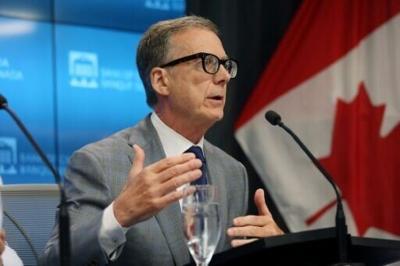
Canada's central bank held its key lending rate at 2.25 percent on Wednesday, but warned it may need to act if inflation caused by the Middle East war persists.
The fallout from the US‑Israeli strikes on Iran has sent energy prices soaring. The impacts in Canada, a net oil exporter, have been more muted than in other regions, but prices at the pump are shooting up.
The Bank of Canada said it would continue "looking through the war's immediate impact on inflation," and would not raise rates in response to temporary oil price shocks.
But it added that it "will not let higher energy prices become persistent inflation," and said it was "ready to respond as needed."
Bank of Canada Governor Tiff Macklem told reporters: "The higher oil prices go, and the longer they're higher, the more likely it is that we'll have to raise rates."
But, he added, the bank's baseline forecast is that oil prices will come down. He said the bank will be closely watching to see if elevated energy costs trigger higher prices on other goods.
- Tariff uncertainty -
The rate pause marks the fourth consecutive hold for Canada's central bank, which has previously said it wants to stay on the sidelines for as long as possible while uncertainty hovers over the key forces shaping the economy.
Prior to the Middle East war, the main source of uncertainty was the future trading relationship with the United States.
President Donald Trump's sector-specific tariffs have hurt crucial parts of Canada's economy, particularly the auto, steel and aluminum sectors.
But more than 85 percent of cross-border trade has remained tariff-free thanks to the existing North American free trade agreement.
Revision talks on that deal are set to intensify. Trump has said the agreement is "irrelevant" to the United States.
His top trade officials have made clear that Washington wants substantial changes to the agreement that Trump signed and praised during his first term.
Canadian Prime Minister Mark Carney has said the United States will not dictate the terms of a new agreement.
Macklem said "uncertainty is unusually elevated," and that a deterioration in trade relations with the United States could force a rate cut.
"Monetary policy may need to be nimble. If the United States imposes significant new trade restrictions on Canada, we may need to cut the policy rate further to support economic growth," he told reporters in Ottawa.
CIBC said in a note that the central bank faces a "two-way risk" — an economy facing inflation pressure because of the war while also confronting "sluggish growth" that could soften further if trade with the United States faces additional levies.
bs/dw
Keep reading
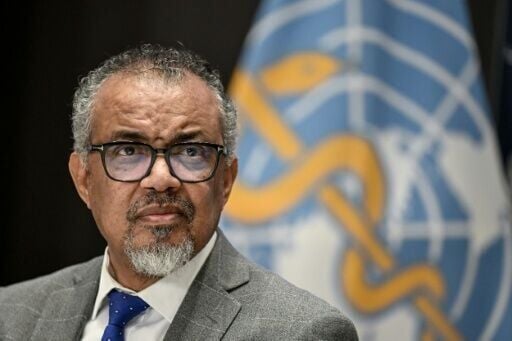
The United States has still not paid off its membership fee arrears at the World Health Organization, the WHO chief said Wednesday, with Washington's intention to leave conditional on paying up.

Plumes of black smoke towered over the southern Russian town of Tuapse on Wednesday where residents wore face masks to shield themselves from polluted air after multiple Ukrainian drone strikes on a major oil refinery in the coastal town.

Two Jewish men were stabbed Wednesday in north London, an attack police declared a "terrorist incident" and which follows a series of arson attacks targeting Jewish sites.







(0) comments
Welcome to the discussion.
Log In
Post a comment as Guest
Keep it Clean. Please avoid obscene, vulgar, lewd, racist or sexually-oriented language.
PLEASE TURN OFF YOUR CAPS LOCK.
Don't Threaten. Threats of harming another person will not be tolerated.
Be Truthful. Don't knowingly lie about anyone or anything.
Be Nice. No racism, sexism or any sort of -ism that is degrading to another person.
Be Proactive. Use the 'Report' link on each comment to let us know of abusive posts.
Share with Us. We'd love to hear eyewitness accounts, the history behind an article.