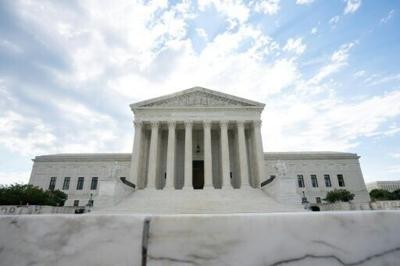
The US Supreme Court heard arguments on Monday about law enforcement's use of "geofence warrants" -- the collection of smartphone location data about everyone who was near a particular place at a specific time.
The justices are considering whether the use of such warrants constitutes an unconstitutional violation of privacy.
The case was brought by Okello Chatrie, who was identified as a suspect in a 2019 Virginia bank robbery after a search of the Google location history on his phone.
Chatrie, who was armed with a gun and holding a cellphone and made off with $195,000, was eventually convicted and is serving a 12-year prison sentence.
Adam Unikowsky, who is representing Chatrie, told the justices that geofence warrants violate the US Constitution's Fourth Amendment, which protects against unreasonable search and seizures.
"The warrant authorized the government to direct Google to search every single person's account to find those people who were within the geofence," Unikowsky said.
The government is defending the use of geofence warrants and arguing that a smartphone user can always choose to turn off location services.
"I take the point that you can flip it off," Unikowsky said. "I just don't agree that one should have to flip off one's location history as well as other cloud services to avoid government surveillance."
Deputy Solicitor General Eric Feigin, representing the Justice Department, told the court that banning the use of geofence warrants "would impede the investigation of kidnappings, robberies, shootings and other crimes."
"Petitioner here is asking for an unprecedented transformation of the Fourth Amendment into an impregnable fortress around records of his public movements that he affirmatively consented to allow Google to create, maintain and use," Feigin said.
Geofence warrants were notably used to identify supporters of President Donald Trump who stormed the US Capitol on January 6, 2021 in a bid to block congressional certification of Democrat Joe Biden's presidential election victory.
Google no longer stores location history data on its servers and deleted all such data as of last year. Other technology companies continue to collect location data, however.
The Supreme Court is expected to rule in the case in June or early July.
cl/sms
Keep reading

An Indian billionaire's son offered on Tuesday to take hippos descended from those introduced to Colombia by drug kingpin Pablo Escobar, rather than have the animals killed.

Comedian Jimmy Kimmel hit back on Monday at Donald Trump's call for him to lose his job over a joke about First Lady Melania Trump days before an alleged attempt to assassinate the US president.

A 21-year-old man went on trial in Austria on Tuesday over a plot to attack a Taylor Swift concert, which led to shows by the US megastar in the Alpine nation to be scrapped in 2024.





(0) comments
Welcome to the discussion.
Log In
Post a comment as Guest
Keep it Clean. Please avoid obscene, vulgar, lewd, racist or sexually-oriented language.
PLEASE TURN OFF YOUR CAPS LOCK.
Don't Threaten. Threats of harming another person will not be tolerated.
Be Truthful. Don't knowingly lie about anyone or anything.
Be Nice. No racism, sexism or any sort of -ism that is degrading to another person.
Be Proactive. Use the 'Report' link on each comment to let us know of abusive posts.
Share with Us. We'd love to hear eyewitness accounts, the history behind an article.