US economic growth rebounded less than expected in the first quarter as consumer spending cooled, while inflation surged in March with fallout from the Middle East war beginning to bite, government data showed Thursday.
Even as the world's biggest economy appears to remain resilient, analysts warn of its reliance on an AI investment boom -- and consumers are showing fatigue that could intensify as the energy shock from the war worsens.
Gross domestic product rose at an annual rate of 2.0 percent in the January to March period, according to an advance estimate released by the Commerce Department.
This was significantly higher than the 0.5 percent figure in the final three months of 2025, but still below the 2.2 percent expansion that economists predicted.
White House spokesman Kush Desai was quick to laud the growth rate, saying it was "driven by an astonishing surge in business investment." He touted President Donald Trump's agenda of tax cuts and deregulation.
But Navy Federal Credit Union chief economist Heather Long called it "a split-screen economy" where companies and investors involved in artificial intelligence are flourishing while middle- and moderate-income households grapple with cost hikes.
Steeper costs are expected to weigh on households and create steep political risks for Trump's Republican Party heading into the November midterm elections.
- 'Big warning sign' -
An uptick in government spending and investment boosted the GDP figure, but this was "partly offset by a deceleration in consumer spending," the Commerce Department said.
Long estimates that "nearly half of the larger tax refunds have already gone to pay for higher gas prices for many families," although it remains encouraging that layoffs are low.
"But it's a big warning sign that consumption has slowed to just 1.6 percent in the first quarter," she said in a note.
A separate Commerce Department report on Thursday showed that the Federal Reserve's preferred inflation gauge surged in March as energy costs skyrocketed over the war.
The personal consumption expenditures (PCE) price index jumped 3.5 percent from a year ago, up notably from 2.8 percent in February.
Excluding food and energy, the index rose 3.2 percent from a year prior.
Energy costs have soared since US-Israeli strikes targeting Iran on February 28 triggered Tehran's retaliation in virtually blocking off the Strait of Hormuz.
The waterway is a key route of transit for energy and fertilizers, sending global costs up.
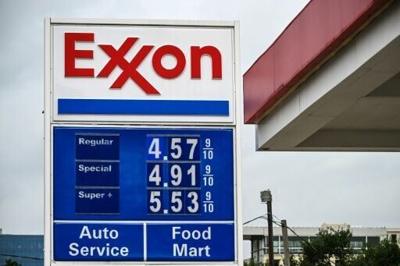
This has caused prices at US gasoline stations to spike, with the average price of a gallon (3.78 liters) of regular gasoline hitting $4.30 according to data from the AAA motor club.
- 'Anemic' outside AI -
"The big picture is that growth already was sluggish ahead of the energy shock, with the economy's underlying momentum anemic outside the continued surge in AI-related capital expenditure," said Oliver Allen, senior US economist at Pantheon Macroeconomics.
While there was a jump in government spending, boosting GDP growth, this was "entirely due to a sharp rebound in federal government spending following the shutdown in the fourth quarter," he said.
Allen added that consumer spending in the first three months this year was also weaker than its average pace over the past four quarters.
"The subdued labor market, depressed confidence, meager real income growth, and exhaustion of pandemic-era excess savings all are starting to weigh on households," he warned.
Chris Zaccarelli, chief investment officer at Northlight Asset Management, expects the US economy can withstand short-term global shocks.
"But we are becoming more concerned that the global economy is going to have a much more difficult time weathering the upcoming storm," Zaccarelli added.
bys/sms
Keep reading

The United States on Thursday slapped sanctions on the Democratic Republic of Congo's long-serving former president Joseph Kabila, backing allegations he has assisted Rwandan-linked rebels who have seized vast parts of his country.

The international jury of the upcoming Venice Biennale Art Exhibition resigned Thursday in a row over the organisation's decision to allow Russia to participate in this year's event.

FIFA President Gianni Infantino reiterated that Iran will play their World Cup games in the United States as scheduled on Thursday as he kicked off the global football body's summit in Vancouver.





(0) comments
Welcome to the discussion.
Log In
Post a comment as Guest
Keep it Clean. Please avoid obscene, vulgar, lewd, racist or sexually-oriented language.
PLEASE TURN OFF YOUR CAPS LOCK.
Don't Threaten. Threats of harming another person will not be tolerated.
Be Truthful. Don't knowingly lie about anyone or anything.
Be Nice. No racism, sexism or any sort of -ism that is degrading to another person.
Be Proactive. Use the 'Report' link on each comment to let us know of abusive posts.
Share with Us. We'd love to hear eyewitness accounts, the history behind an article.