Ukrainians on Friday were wary of Russia's pledge to pause fighting for an Orthodox Easter ceasefire -- first proposed by Kyiv -- this weekend.
The Kremlin said it had ordered a temporary truce to be in effect from Saturday afternoon until the end of Sunday, a 32-hour period during which Russia would stop fighting "in all directions".
Ukrainian President Volodymyr Zelensky -- who has repeatedly called for a ceasefire in the four-year war -- said Kyiv was willing to reciprocate.
But in Kyiv there was scepticism over whether Moscow would keep to its promise for a rare respite in a war that has killed hundreds of thousands and decimated eastern Ukraine since Russia invaded in February 2022.
"No one believes in these fairytales anymore," Yevgeniy Lamakh, an IT specialist, told AFP in central Kyiv.
"The Russian military lie a lot, usually, as history shows. And in general, they say one thing, but in fact do something completely different," the 29-year-old said.
The truce -- according to Moscow -- will start on 4:00 pm (1300 GMT) on Saturday.
"Well then do it, if you want to do it!" snorted Dmytro Sova, a 42-year-old actor, speaking to AFP in Kyiv.
"Even today... Shaheds, missiles are flying at Ukraine. Well, come on then, start the ceasefire," Sova said.
Ukraine's air force said Russia fired 128 drones in its latest overnight attack.
Russia has fired long-range drones -- usually hundreds -- at Ukraine every single day since May 10, 2025, according to Ukraine's data.
- 'Pessimist' -
Moscow has rejected calls for a longer-term unconditional ceasefire, something that Kyiv has called for, saying it is instead pushing for a final peace settlement.
But negotiations between two sides, brokered by the United States, have stalled over the fate of Ukraine's eastern regions, partly occupied by Russia and that Moscow wants Kyiv to cede.
Ukraine has frequently ruled it out, saying such move would only embolden Russia and leave it vulnerable to fresh attack.
"They need to be pressured so that they simply sit down at the negotiating table, withdraw their troops from our country and leave forever," Sova said.
The mood in Kyiv contrasted with the streets of Moscow, where locals were optimistic it could be the first step towards a broader agreement.
"I'm only for peace, that's all I can say. Thanks to Putin, maybe things will keep going well from here on," Elena, a 58-year-old hairdresser told AFP.
A view echoed by pensioner Lyubov Pavlenko who called the ceasefire "wonderful" news.
"I'm in favour of peace on Earth. And I want this whole war, of course, to end as soon as possible," the 59-year-old said.
Russia announced a similar truce with Ukraine over Orthodox Easter last year.
Back then, both sides accused each other of violating the ceasefire hundreds of times -- a fact that makes Yuriy Dunai, a 46-year-old Kyiv resident, a "pessimist" as to this latest attempt at halting the war.
"They were not observed a single time. It seems to me that it is not worth expecting a miracle," he told AFP.
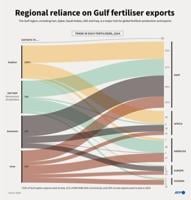
Even as Gulf tanker traffic slowly resumes, the road back to normal food production will be long and arduous, given the war's impact on fertiliser supplies, the UN has warned.
Keep it Clean. Please avoid obscene, vulgar, lewd,
racist or sexually-oriented language. PLEASE TURN OFF YOUR CAPS LOCK. Don't Threaten. Threats of harming another
person will not be tolerated. Be Truthful. Don't knowingly lie about anyone
or anything. Be Nice. No racism, sexism or any sort of -ism
that is degrading to another person. Be Proactive. Use the 'Report' link on
each comment to let us know of abusive posts. Share with Us. We'd love to hear eyewitness
accounts, the history behind an article.
China's top diplomat told his North Korean counterpart on Thursday that Beijing was willing to step up exchanges and cooperation, Chinese state media reported, following their meeting in Pyongyang.
War's impact on fertilisers stirs food producer fears
Catherine HOURS AFP
Even as Gulf tanker traffic slowly resumes, the road back to normal food production will be long and arduous, given the war's impact on fertiliser supplies, the UN has warned.
With factories shuttered and soaring gas prices driving up production costs around the world, fertiliser prices have risen across the board and are unlikely to fall back easily.
"If the Strait of Hormuz reopened immediately, i.e. not only a ceasefire but vessels moving, the impact would be significantly positive -- but incomplete and uneven," the Food and Agriculture Organization's chief economist Maximo Torero told AFP.
"The FAO is clear that damage has already been done."
According to Argus Media, the price of urea from the Middle East has, for example, risen by 70 percent in a matter of weeks.
Gulf countries are major exporters of nitrogen fertilisers like urea -- which provides plants with nitrogen to aid green leafy growth -- as well as ammonia and phosphate.
Italy notably called last week for a "humanitarian corridor" in the Strait of Hormuz for fertiliser as Torero warned that if high prices continue, farmers would face a stark choice: "Farm the same with fewer inputs, plant less, or switch to less intensive fertiliser crops," which would reduce food supply well into 2027.
- Lasting blow to supplies -
Torero warned the bottleneck in marine traffic since the conflict began on February 28 meant even if Hormuz were to reopen immediately "infrastructure damage is not fully reversible in the short term."
According to Kpler data, around 1.9 million tonnes of fertiliser are trapped on 41 vessels, equal to 12 percent of all produce shipped out of the strait in 2024.
On March 2, the ammonia plant at the Ras Laffan refinery in Qatar was attacked. Plants have also suspended or reduced production in the UAE, Saudi Arabia, Iran, Jordan and Qatar, whose Qafco complex accounted for 14 percent of global trade in urea.
Overall, about one third of urea trade has been choked off, says the FAO.
In India and Bangladesh, nitrogen fertiliser plants have slowed down, unable to cope with the soaring cost of the gas required to operate.
- Price breaks -
Even if production and shipping resumes in the Gulf, prices for nitrogen fertilisers will fall slowly and unevenly, warned Torero.
"Unlike oil, the fertiliser sector does not have internationally coordinated strategic reserves, making supply disruptions more difficult to manage.
"Repair timelines are measured in months, not days."
Purchasers have also been hit by the fact that many pre-war contracts governing prices have been suspended as producers cite "force majeure," forcing reliance on higher spot market prices.
The FAO forecasts global fertiliser prices could average 15–20 percent higher in the first half 2026.
"A meaningful decline would likely take four to eight weeks after reopening, as production ramps up and shipping reschedules," says Torero. "Prices are unlikely to return to February 2026 levels before the third quarter of 2026, if at all this year."
- Too late for some -
He added many crop planting decisions have already been missed with the Northern Hemisphere already in planting seasons, meaning those yields will not be recovered.
"It's too late" in India, Bangladesh, Pakistan, Sri Lanka, Sudan, Kenya, Somalia, Turkey, and Jordan, all heavily reliant on Gulf fertilizers. But perhaps not for second harvests in Asia if fertilizers arrive within 4 to 6 weeks."
He explained that "the time between a fertiliser shock and a harvest failure is measured in months. The time between a harvest failure and a food price surge is measured in months more. We are already inside that window."
- "Ripple effect" -
Prices spiked following previous disruptions during the financial crisis of 2008 and the Russian invasion of Ukraine in 2022.
"I think what makes this one potentially more critical is the number of production hubs that are involved and countries that are involved," says Sarah Marlow, global editor for fertiliser at Argus Media.
"And then the ripple effect has spread out from the Gulf to other countries, which have also been affected by a lack of raw materials, a lack of gas."
cho/sb/cw/gv
Funny old world: the week's offbeat news
AFP AFP
From outlaw ostriches to China's meaty rewards for slimming. Your weekly roundup of offbeat stories from around the world.
- Fat lot of beef -
A Chinese city has found a mouthwatering way of encouraging people to lose a few pounds... by giving them three times as much free prime beef as the weight they lose.
With obesity tripling as the appetite for the better things in life grows, China could soon rival the United States for overweight adults.
If the trend continues, seven out of 10 will have crossed the line by 2030.
"When you see delicious food, it's hard to resist," Haihua Zheng told AFP. He is one of more than 1,000 people who have signed up for the Trade Fat for Beef scheme in Wuxi, eastern China.
Slimmers in Yunnan in the southwest have a similar Flab for Potatoes programme. And if they really shrink their waistlines, they can even upgrade to chicken.
Supermarket chain Yonghui has got in on the act, with in-store weigh-ins to win free beef, crayfish or kiwi fruit.
- Big bird roadrunners -
Something strange is happening to ostriches in Asia. One escaped from a Thai cat cafe in the resort town of Pattaya and ran for miles down the middle lane of a motorway, passing out cars.
"Who lost an ostrich on the road? Come get him. He runs so fast," said bemused motorist Chairat Sompong as he filmed him.
The flightless birds are not easy to catch, with a top speed of around 70 kilometres (43 miles) per hour.
But the runaway, named B1, was finally cornered 15 kilometres from its pen.
The next day another ostrich went walkabout in the Chinese capital Beijing after escaping from a family, sprinting off down a highway chased by police.
After a plucky bid to give officers the bird, the ostrich was finally nabbed.
- Plumbing the depths... of space -
Fans of the "Sesame Street" saga "Pigs in Space" will know that sexism is not confined to Planet Earth. So it was that when the $23-million toilet on NASA's Artemis II lunar spaceship broke down, it was the sole woman on board who got to fix it.
"I'm proud to call myself a space plumber," said astronaut Christina Koch, trying to make the best of a bad job.
A bunged up loo is a serious business with four people sharing a space no bigger than the inside of a camper van.
The cramped toilet is so noisy they have to protect their ears, and works on a suction system. Solids, however, go into disposable bags to be brought back to Earth.
Which is why there was a few titters when Canadian Prime Minister Mark Carney called to ask Canadian astronaut Jeremy Hansen if his "preference is for maple syrup over Nutella on your pancakes in the morning" after a pot of chocolate-coloured material was seen floating through the capsule.
- Moving house, twice -
An Australian couple have been forced to move their house after it was placed on the wrong plot.
Five months after Melanie and David Moor moved into their new pre-fabricated house in rural Victoria, they got the bad news that it should have been put next door.
"We got the call from the council to say it was on the wrong block -- and we actually owned the block next door," Melanie told AFP.
So they had to take a deep breath and spend a small fortune on moving the house about 100 metres (330 feet) by truck to the right plot.
- That seals it -
And finally traffic in the same state was diverted around a slumbering seal Friday when it decided to take a nap on a road.
The dozy pinniped known locally as Sammy was spotted snoozing near the seaside town of Dromana.
"You don't know where he will pop up next," local Laura Ellen told AFP.
"He usually sleeps all day," she said.
burs-fg/ach
ICE has detained 6,200+ kids in Trump’s second term, up 10x since Biden left office
Anna Flagg for The Marshall Project
ICE has detained 6,200+ kids in Trump’s second term, up 10x since Biden left office
Immigration and Customs Enforcement has detained over 6,200 children during President Donald Trump’s second term, according to recently released numbers analyzed by The Marshall Project. People under the age of 18 have often been held with their families in what detained families and their advocates have called harmful conditions, including poor medical care, inadequate access to education and inedible food.
“Every American should be shocked that we're incarcerating thousands of children,” Leecia Welch, chief legal counsel at Children's Rights, an organization providing legal support for children in detention, said. “It just adds up to an incredible amount of trauma.”
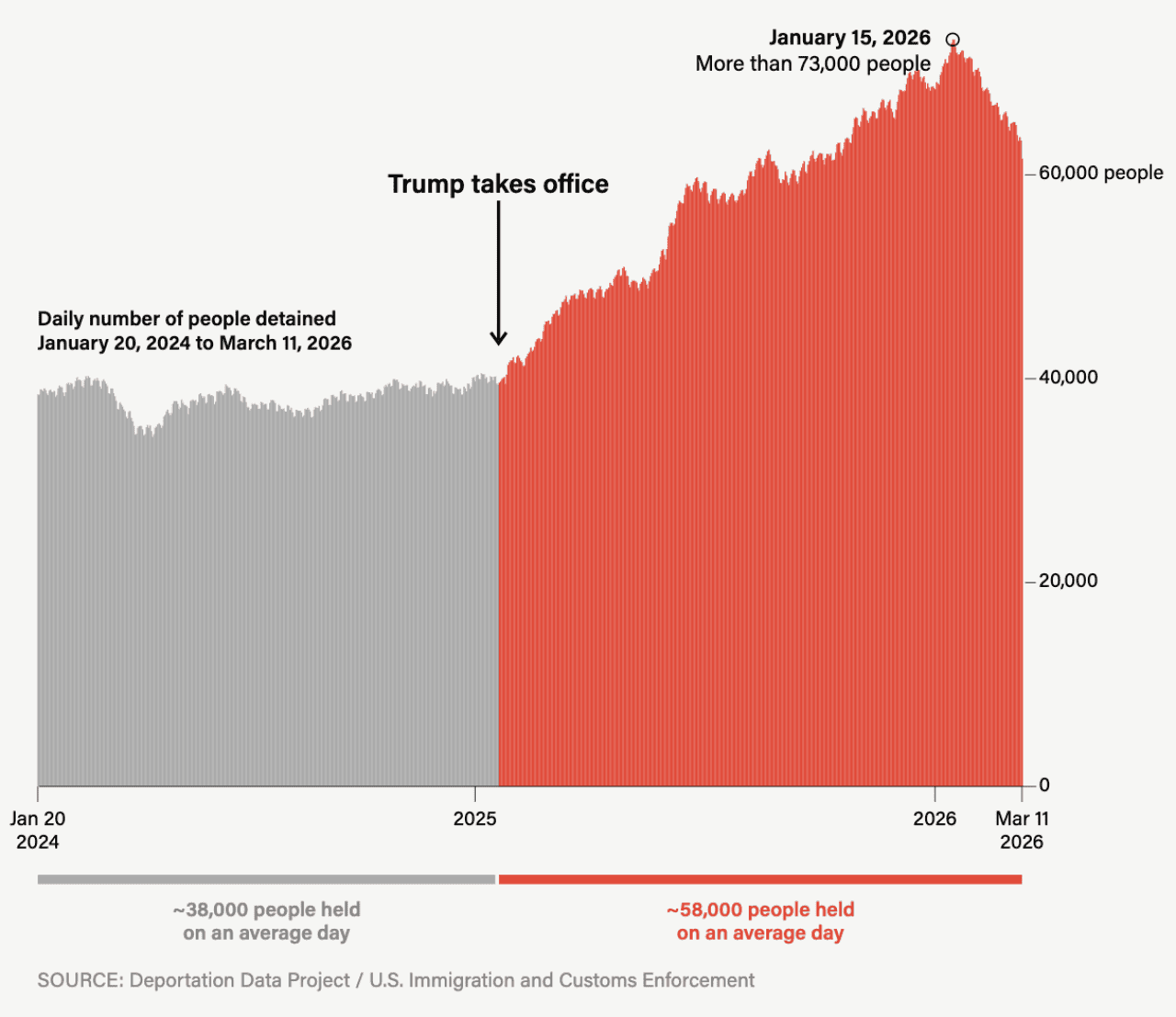
U.S. immigration authorities have long held children in detention, but to varying degrees across administrations. President Joe Biden ended family detention in 2021 and, by the final year of his presidency, ICE was holding a daily average of 24 children in custody. But after Trump revived the policy last year, the number jumped tenfold, to 226 children incarcerated on the average day since he came back into office.
This data was obtained from ICE by the Deportation Data Project, a group of academics and lawyers who collect federal immigration data through public records requests and share it with the public.
The Marshall Project, SOURCE: Deportation Data Project / U.S. Immigration and Customs Enforcement
About a month into President Trump’s second term, the number of children held by ICE each began growing to a peak of more than 550 in January of this year, then declined sharply, to fewer than 90 in mid-March. Data after that relative low point has not yet been made available. Despite the drop, lawyers for detained children told The Marshall Project conditions remain bleak, with their clients frequently suffering mental and medical distress.
Welch said she does not know why the government has shrunk the population of detained children and insisted it’s important to remember that no one knows if this is a temporary or long-term trend. “We have billions of dollars going to this apprehension apparatus, right? So, there's really no telling what's going to happen next,” Welch said.
In Trump’s annual budget request to Congress, released April 3, his administration requested funding for “up to 30,000 family unit beds.” Congress ultimately holds the power to enact or reject that budget, but it signals the administration’s goals for continuing family detention.
Elora Mukherjee, director of the Immigrants’ Rights Clinic at Columbia Law School, has represented over 70 families in detention. She said holding families for weeks, or for months, remains a national crisis, even with the recently declining numbers. “Every day I'm getting calls from families in detention saying, ‘We need help. We need help. Can you help us?’" Mukherjee said.
“No innocent child should ever be imprisoned,” said Rep. Joaquin Castro in response to The Marshall Project’s analysis of the newly released detention data. “The Trump administration’s cruel mass deportation campaign is ripping away childhoods and inflicting trauma that these young people will carry for their entire lives. It’s wrong and must end.”
In an emailed statement, an ICE spokesperson said, “being in detention is a choice” and encouraged people to take advantage of a government program that pays people money to leave the U.S. voluntarily through a process they call self-deportation. Immigration lawyers have asserted that efforts to push self-deportation are misleading.
The conditions for minors in immigration detention are dictated by the terms of a 1997 court agreement in a class action lawsuit called the Flores settlement. In a recent court filing, detainee advocates argued that the conditions at the Dilley Immigration Processing Center — a privately run facility in Dilley, Texas, where nearly half of the children detained during the Trump era have been held — are violating the terms of that settlement. “Families consistently report their children are hungry, exhausted, perpetually sick, and despondent from the conditions of confinement,” they wrote.
Parents reported finding worms and mold in food and foul-smelling water. In one court filing, a parent said, “Babies are getting thin because they can only really eat pieces of bread.”
Families at Dilley have raised more than 700 complaints over medical care with lawyers, according to court filings. In one instance, a baby received poor care before being sent to the hospital with dangerously low oxygen levels. Families have reported children in mental distress: a 2-year-old who hit himself, potty-trained children who began wetting themselves, and a 13-year-old who was put into isolation after attempting suicide.
The courts have set a 20-day limit on how long children can be detained. However, the new data shows that since Trump retook office, ICE has detained more than 1,600 children for longer than 20 days.
Medical experts, including the American Academy of Pediatrics, have said that any time in detention can cause trauma and long-term mental health risks. The longer a child is in detention, the more trauma they are likely to endure. “This is cruelty against children and reflects an executive branch that is utterly failing to abide by the rule of law in a space where children could not be more vulnerable,” Mukherjee said.
Court filings from the government paint a very different picture of family detention. They report “no evidence was ever identified indicating that residents were served food containing worms,” and only noted discolored vegetables. Court filings from the government also deny accusations of poor medical care and state that a site visit by a medical coordinator revealed no deficiencies.
A government filing asserts that, between November and February, no detainees had required “hospitalization or emergency room referral.” Even so, The Marshall Project obtained 911 calls from the Dilley facility indicating multiple transfers to the hospital. ICE did not respond to questions about those inconsistencies.
The trauma did not end for many children and their families following detention. Over 3,600 children have been deported from detention since the start of the second Trump administration. In interviews with The Marshall Project, families said they were given little or no notice about deportation, leaving them scrambling to arrange housing, work, and schooling for children. Some, who had lived in the United States for years, left behind essential medical supplies, pets, and cars. They left immigration detention, sometimes going to an unfamiliar country for the children, with little more than the clothes on their backs.
At least 1,500 children detained by ICE were released into the United States, often as their immigration cases continued to unfold. While most families were relieved to be released, they said that the process could also be difficult.
Staff at a shelter in Laredo, Texas, told The Marshall Project that families were dropped there after their detention at Dilley, sometimes thousands of miles away from their homes, with little money for travel expenses. “They are tired. They are tired. They are tired,” the Rev. Mike Smith, who runs the shelter, said in February. “You’ll see tears later, once they become aware that it’s safe.”
The number of children in detention peaked in January and declined through mid-March, which is when the data ends, and is roughly similar to ebbs and flows in adult detention, though the shifts in the population of children under 18 are more pronounced.
The Marshall Project, SOURCE: Deportation Data Project / U.S. Immigration and Customs Enforcement
In recent months, the conditions of detained children have received significant attention. Lawmakers, like Rep. Joaquin Castro, have made high-profile trips to Dilley. A group of celebrities that included Mark Ruffalo and America Ferrera signed a petition to close the Dilley facility, and children’s entertainment star Ms. Rachel has spoken out on behalf of detained children.
However, if the Trump administration prevails in its current legal efforts, those conditions have the potential to deteriorate. The federal government has been fighting in court to terminate the Flores settlement, which would mean the loss of key protections, like limits on how long children can be held in detention.
In a statement, an ICE spokesperson charged that “the Flores consent decree has been a tool of the left that is antithetical to the law and wastes valuable U.S. taxpayer funded resources.”
Mukherjee said if the government no longer has to comply with Flores, it could be catastrophic for the people she represents and lead to a ballooning number of children behind bars. “Without Flores, children under this administration would likely be detained indefinitely, until their immigration proceedings end, which could take months, or more likely years, and they would be held in far worse conditions than they're in now,” she said.
Thais fete new year with family despite fuel price spike
Pasika KHERNAMNUOY AFP
Soaring fuel prices are driving up costs for Thais travelling home for the holidays, but the chance to spend the new year with loved ones is a price worth paying, they say.
"There aren't many opportunities to go home during festivals like this," said 24-year-old army cadet Korawich Changpat at Bangkok's Mo Chit Two bus station, despite his inflated fare back to central Chaiyaphum province.
"First of all, I'll go see my mother. Looking this handsome in my uniform, I must go pay my respects to her," he told AFP.
Thailand is gearing up for its biggest annual holiday, Songkran, which will run from April 13-15.
It celebrates the Buddhist new year with water-splashing festivities that spill out into the streets, representing renewal and rejuvenation.
The run-up began late Friday as Thais clocked off in the capital and clamoured to motor back to their family homes out in the provinces.
At Mo Chit Two bus station, AFP journalists saw thronging queues for coaches as night fell after a scorching day.
Thousands of passengers lugged bulging suitcases, colourful woven plastic bags and taped cardboard boxes, weaving past ticket counters and boarding gates.
The biggest state-run bus company Bor Kor Sor has said it expects up to 180,000 passengers daily in the four days running up to Songkran -- a rise of nearly 80 percent on last year.
The price of some fuel types has surged more than a third since the United States and Israel launched attacks on Iran in late February, prompting Tehran to effectively close the crucial Strait of Hormuz.
The resulting fuel squeeze has pushed Thai travellers towards cheaper, more cramped public transport.
It will get them home nonetheless.
"The war has pushed fuel prices up, so travel costs have increased," said 29-year-old migrant factory worker Ken, who goes by only one name.
He and his partner Bee, 28, moved to the capital to earn cash.
But the family and their baby face an inflated cost to get back home to Thailand's northern reaches for Songkran.
"I miss my mother," said Bee before departing to reunite with family.
- Looming hardships -
Around 20 percent of the world's seaborne oil trade passes through the Strait of Hormuz, according to the International Energy Agency, 80 percent of it bound for Asian markets.
The United States and Iran have agreed a two-week ceasefire with plans to reopen the strait.
But even if the fragile truce holds, analysts predict the global oil industry will take months to recover.
In Thailand, snaking queues have formed at pumping stations, and some in rural areas have run dry.
Even as the truce began on Wednesday, Bangkok said it was considering shutting petrol stations overnight after Songkran to preserve supply.
The prospect of upcoming hardships make the festival a more pointed moment of celebration.
"Since it's the festival season, I want to go back and spend time with my family," said nurse Suthida Thanachartnamatthong.
"The war has quite an impact on me," added the 23-year-old -- complaining even her short commute to work has spiked more than 10 percent during the war.
But as she prepared to depart for northern Chiang Mai, the hurdles to a homecoming did not faze the healthcare worker.
"Happy Thai new year!" she exclaimed.
pk-jts/mjw
On Iran truce, all sides want bigger China role, but does China?
Shaun TANDON AFP
For decades, the United States has cast itself as the guarantor of stability in the Middle East, allying militarily with Gulf Arab states as well as Israel and brushing aside global rival China's aspirations for a greater role.
The US-Israeli attack on Iran shattered the veneer of a US-led order in the Gulf: Tehran has not been deterred by the US military presence but in fact attacked oil-rich and once proudly safe Arab monarchies because of it.
China, at least to some extent, helped to halt the conflict. But paradoxically, Beijing is not taking a victory lap, reflecting what experts say is its calculation that it has much to risk from greater involvement and that it gains from the post-war situation, in which the United States appears weakened but still committed to Gulf security.
President Donald Trump, speaking to AFP, credited China with pushing Iran to accept the two-week ceasefire, barely an hour before a deadline was to expire on his genocidal threat to destroy all of Iranian civilization.
The account was confirmed by a senior Pakistani official source who said that China "stepped in and convinced Iran" just as hopes were fading.
But China's own statements have been circumspect, saying it backs the ceasefire but hardly trumpeting its own diplomacy.
Yun Sun, director of the China program of the Washington-based Stimson Center, said China's reticence was out of character and suspected Iran may have strategically tried to emphasize Beijing's power of persuasion.
"Iran has singled out China as a potential security guarantor so there is an incentive on the part of Iran in presenting the optics of China playing an oversized role, in the hope that China would then be accountable for the implementation of the ceasefire," she said.
"China doesn't provide security guarantees and how do you even try to guarantee something with President Trump? It would just create problems for China down the road," she said.
Vice President JD Vance will open talks Saturday with Iran in Pakistan, which has close relations with China and has also been aggressively courting Trump, in part as it seeks support against India.
Liu Pengyu, spokesman for the Chinese Embassy in Washington, said China "welcomes all efforts conducive to peace and supports Pakistan in actively undertaking mediation."
"As a responsible major power, China will continue to play a constructive role and make efforts to de-escalate tensions and quell the conflict," he said.
- Major economic interests -
China, the world's second largest economy, imports about half of its oil needs from the Middle East but has reduced reliance by embracing renewable energy.
China is the biggest defier of years of unilateral US sanctions on Iranian oil. China now stands to benefit after Iran exerted control over the Strait of Hormuz, the narrow gateway for tankers into and out of the Gulf.
In 2023, Iran and Saudi Arabia restored diplomatic ties in a meeting in Beijing, although the United States, then led by President Joe Biden, downplayed China's role.
"China's strategy in the Middle East has been masterful. It has dominated business and never fired a single bullet, but with the changes in the region it knows it needs a political element," a diplomat from a Middle East country said.
Lyle Morris, a senior fellow at the Asia Society Policy Institute's Center for China Analysis, said Trump may also want to give credit to China to sweeten the mood and press other demands when he visits Beijing next month.
But Morris said that China in the end had fewer interests at play than the United States, Iran, Israel or Gulf states.
"China's not a primary actor here," Morris said. "Ultimately, it's a supporting role, just by the nature of their capacity and their stakes in the conflict."
- Not challenging US order -
China, despite railing against US dominance, has little history of military deployments outside of Asia and is unlikely to seek to replace the US security presence in the Middle East.
For China, it is more important to keep forces near the South China Sea and Taiwan, the self-ruling democracy it claims, said Henry Tugendhat, a fellow at the Washington Institute for Near East Policy who studies China's role in the region.
"At the end of the day, China's greatest interest in the region is simply stability for the economic relations it seeks to foster with the region," he said.
"So it may yet accept a return to US security guarantees as their least bad option but that also depends on what's negotiated by all parties at the conclusion of this conflict."
sct/dw
Fire off I-90 in Missoula County contained, burn warning issued
MISSOULA COUNTY, Mont. – Frenchtown rural and Superior volunteer firefighters responded to a wildland fire off I-90 near mile marker 65 on Thursday.
The Frenchtown Rural Fire District shared a report about the fire and said crews were able to contain it before it spread to nearby forest lands.
“Even with the recent rains and green up we have to remain vigilant,” the fire district wrote.
The fire district asked the community to be careful burning over the weekend, citing erratic winds from forecasted thunderstorms. It added that people should check the US National Weather Service before burning.
“Thank you Superior Vol. Fire Department for all the help and lets all stay safe out there!!!" the fire district wrote.
Ukrainians sceptical as Kremlin orders Easter truce
AFP AFP
Ukrainians on Friday were wary of Russia's pledge to pause fighting for an Orthodox Easter ceasefire -- first proposed by Kyiv -- this weekend.
The Kremlin said it had ordered a temporary truce to be in effect from Saturday afternoon until the end of Sunday, a 32-hour period during which Russia would stop fighting "in all directions".
Ukrainian President Volodymyr Zelensky -- who has repeatedly called for a ceasefire in the four-year war -- said Kyiv was willing to reciprocate.
But in Kyiv there was scepticism over whether Moscow would keep to its promise for a rare respite in a war that has killed hundreds of thousands and decimated eastern Ukraine since Russia invaded in February 2022.
"No one believes in these fairytales anymore," Yevgeniy Lamakh, an IT specialist, told AFP in central Kyiv.
"The Russian military lie a lot, usually, as history shows. And in general, they say one thing, but in fact do something completely different," the 29-year-old said.
The truce -- according to Moscow -- will start on 4:00 pm (1300 GMT) on Saturday.
"Well then do it, if you want to do it!" snorted Dmytro Sova, a 42-year-old actor, speaking to AFP in Kyiv.
"Even today... Shaheds, missiles are flying at Ukraine. Well, come on then, start the ceasefire," Sova said.
Ukraine's air force said Russia fired 128 drones in its latest overnight attack.
Russia has fired long-range drones -- usually hundreds -- at Ukraine every single day since May 10, 2025, according to Ukraine's data.
- 'Pessimist' -
Moscow has rejected calls for a longer-term unconditional ceasefire, something that Kyiv has called for, saying it is instead pushing for a final peace settlement.
But negotiations between two sides, brokered by the United States, have stalled over the fate of Ukraine's eastern regions, partly occupied by Russia and that Moscow wants Kyiv to cede.
Ukraine has frequently ruled it out, saying such move would only embolden Russia and leave it vulnerable to fresh attack.
"They need to be pressured so that they simply sit down at the negotiating table, withdraw their troops from our country and leave forever," Sova said.
The mood in Kyiv contrasted with the streets of Moscow, where locals were optimistic it could be the first step towards a broader agreement.
"I'm only for peace, that's all I can say. Thanks to Putin, maybe things will keep going well from here on," Elena, a 58-year-old hairdresser told AFP.
A view echoed by pensioner Lyubov Pavlenko who called the ceasefire "wonderful" news.
"I'm in favour of peace on Earth. And I want this whole war, of course, to end as soon as possible," the 59-year-old said.
Russia announced a similar truce with Ukraine over Orthodox Easter last year.
Back then, both sides accused each other of violating the ceasefire hundreds of times -- a fact that makes Yuriy Dunai, a 46-year-old Kyiv resident, a "pessimist" as to this latest attempt at halting the war.
"They were not observed a single time. It seems to me that it is not worth expecting a miracle," he told AFP.
burs-mmp/jc/giv
Pay fears grow for US security workers in shutdown
Thousands of US homeland security employees are facing growing uncertainty over their pay after being told Friday's check could be their last until a record-long partial government shutdown is ended.
A memo from the federal government warned staff that without congressional action, funding gaps could halt future checks, US media reported, deepening anxiety among workers already strained by weeks of disruption.
The warning appeared to apply broadly across the Department of Homeland Security (DHS), though confusion quickly emerged over whether Transportation Security Administration officers -- who screen passengers at US airports -- would be affected.
The DHS is one of the largest government agencies, employing more than 260,000 people across a wide range of roles including airport security, border enforcement, disaster response and cybersecurity.
President Donald Trump ordered the department to find funds to compensate essential workers required to stay on the job, allowing some back pay to be issued in recent weeks. But officials say those stopgap measures may not be sustainable if the shutdown drags on.
Union representatives say mixed messaging has left employees unsure whether they can rely on upcoming paychecks.
"There is a feeling of increasing anxiety and uncertainty," a spokesperson for the American Federation of Government Employees told politics news outlet The Hill.
The shutdown, which enters its eighth week on Saturday, stems from a standoff in Congress over immigration enforcement and border security funding, with Democrats seeking new limits on federal agencies and Republicans pushing to secure longer-term financing.
The impasse means tens of thousands of federal workers have either been sent home or are working without guaranteed pay, with some relying on loans, food banks or second jobs to make ends meet.
At the TSA, the strain has already disrupted operations. Absences surged at major airports earlier in the shutdown, and hundreds of officers have resigned since February, according to officials.
DHS workers have been informed in a memo from department heads that they are slated to receive a check on Friday for back pay up until April 4.
But they were warned not to expect further pay until Congress restores DHS funding.
Authorities warn that continued uncertainty could trigger further staffing shortages, potentially disrupting travel in the coming months, including during major events such as the FIFA World Cup.
Congress is set to return from recess next week, when lawmakers will face renewed pressure to reach a deal.
Republican leaders are weighing a party-line funding package for parts of DHS, though divisions within the party and uncertainty over White House support could complicate efforts to end the shutdown quickly.
ft/ksb
Hungary rivals rally crowds in closing strait of election campaign
Andras ROSTOVANYI with Peter MURPHY in Debrecen AFP
Crowds of flag-waving Hungarians have been cheering on their candidates for an election on Sunday, as Prime Minister Viktor Orban and challenger Peter Magyar hold frantic last-minute rallies.
"We came out here because we have faith in Peter Magyar, and we've had enough of the old system," Attila Jozsa told AFP at the opposition leader's rally in the city of Gyor, 120 kilometres (75 miles) west of Budapest, on Thursday.
"We believe there will be some kind of change across the whole country," added the 55-year-old electrician, who used to vote for Orban's Fidesz party.
Around 20,000 people, including many youngsters, packed a square in Gyor, according to an AFP photographer.
"Where is the money?" supporters of Magyar's party, Tisza, thundered in unison, referring to accusations against local Fidesz politicians over millions of euros of public funds that have gone missing.
Magyar has campaigned on pledges to offer better public services and fight alleged graft by the government of Orban, who has been in power since 2010.
"Give change a chance," Magyar appealed to voters in Gyor.
Opinion polls show a clear lead for Tisza.
Before the rally, many gathered lined up to have a quick chat with Tisza candidates to get their autographs and bought Hungarian flags, or Tisza-branded souvenirs and clothing from pop-up vendors as music blared.
One woman held a placard saying "there's no time for fear" and a child brought pictures he had drawn of Magyar.
- 'Really bad for Hungary' -
Also on Thursday, around 2,000 Orban supporters gathered in Hungary's second largest city Debrecen, as the nationalist leader appealed to them to "not put everything at risk" and to "protect what we have achieved".
"It would be really bad for Hungary if Tisza win," said Attila Szoke, a 55-year-old taxi driver, who worked in London for 22 years but returned home in 2022.
"I don't trust Magyar, from one day to the next he turned and stabbed Fidesz in the back," he said, referring to the opposition's ties with Fidesz -- he was formerly married to former justice minister Judit Varga.
Debrecen has long been a Fidesz stronghold but the city is projected to swing to Tisza on Sunday.
A flag draped on a balcony overlooking the rally read "Tisza is surging", a slogan of Magyar's party, referring to the river Tisza, the same as the party's acronym.
Counter-protesters met cheers for Orban with chants of "filthy Fidesz" and "Russians go home", a reference to Orban's ties to Russian President Vladimir Putin.
- 'Bid goodbye' -
Hundreds of predominantly young Tisza supporters mingled in the crowd, with one telling AFP he came along to "bid goodbye" to Orban.
"I would consider returning to Hungary if Orban is kicked out," said Laszlo Udvarhelyi, a 35-year-old sales accountant from Debrecen who lives in Frankfurt.
Both camps have accused the other of seeking to benefit from foreign interference.
Orban, the closest ally of US President Donald Trump in the EU, hosted US Vice President JD Vance this week.
He has also maintained ties with Russia despite its invasion of Ukraine and frequently clashes with Brussels.
"It's far more important that Hungary belongs to Western Europe, not to Russia," said 17-year-old Kolos, who did not want to give his full name for fear of reprisals, holding an EU flag at the Tisza rally in Gyor.
"Even though Fidesz and the government portray the European Union today as Hungary's greatest enemy, that is simply not the case," he said, describing the EU as the "guarantor of democracy in Hungary".
ros-pmu/jza/jxb
Swede goes on trial for pressuring wife to sell sex
Johannes LEDEL AFP
A Swedish man suspected of exploiting his "vulnerable" wife to have sex with scores of men for payment, went on trial on Friday for aggravated pimping, rape and assault.
The 62-year-old Swedish suspect, who denies the charges, was arrested in October after his wife reported him to police in the north of the country. He has been in custody ever since.
The man, who is reportedly a former Hell's Angel with a tattoo around his eye, appeared in court wearing a grey chequered shirt and appeared calm as prosecutor Ida Annerstedt read out the charges.
According to the prosecutor, he had for years made money from pressuring his wife "to perform and submit to sexual acts".
"He is charged with aggravated pimping. He has facilitated an operation in which his partner and later wife have sold sex," Annerstedt told AFP during a break in the proceedings.
The wife was not present in the courtroom but was following the proceedings via a video link, where only her lawyer was shown so that she remained anonymous.
After the charges were read out, the trial continued behind closed doors.
- 'Ruthless exploitation' -
The man is accused of creating online adverts, setting up meetings, keeping guard and pressuring the woman to perform sexual acts online in order to attract more clients.
The prosecutor, who also claims the man created and supported a drug addiction for the woman, has labelled it "ruthless exploitation".
"I maintain that he has exploited her situation in that she has been under the influence of drugs, she has been under the influence of alcohol, and she has had a serious fear of him," Annerstedt told AFP, noting that the charges included assaults and threats.
When reading out the charges, Annerstedt said the defendant had threatened to kill the plaintiff if she left him.
The plaintiff was warned not to make him mad, because then "the monster would be released," Annerstedt told the court.
The accused was believed to have profited over 500,000 kronor ($53,700), according to the prosecutor.
Martina Michaelsdotter, the accused's lawyer, told AFP that her client denied the charges against him.
Under Sweden's law on prostitution, selling sex is not illegal. But paying for sex or facilitating its sale is against the law.
In addition to being charged with aggravated pimping and four assaults, the suspect is charged with eight rapes and four attempted rapes.
The rape charges include one incident when the suspect allegedly compelled his wife to have sex with a particular client and several where he made her perform sexual acts on herself for online videos.
Such offences are classed as rape under Swedish law because the victim had not given consent.
The case has caused shock in Sweden and comparisons have been made with France's Gisele Pelicot, whose husband was convicted in 2024 of drugging her and letting scores of men rape her while unconscious.
- 120 buyers -
Prosecutor Annerstedt previously told AFP the woman had, to "some extent", "agreed to sell sex" but had objected to doing so with certain people or under certain circumstances.
"She had certain boundaries. There are situations where he didn't respect those boundaries and steamrollered her after she said 'no'," Annerstedt told AFP.
The offences allegedly occurred between August 11, 2022, and October 21, 2025.
Annerstedt said that 120 buyers had been identified and that so far 26 had been charged, but she noted they had only been charged with buying sex as they were not under the impression the woman was participating unwillingly.
Public broadcaster SVT reported, citing police investigations, that many of the buyers were under the impression they were chatting with the woman when booking meetings and discussing prices, while the prosecutor argues they were in fact talking to the man.
Some buyers had also allegedly paid by performing services, with one repairing a generator in the couple's recreational vehicle and another by doing a horoscope, according to the broadcaster.
The trial started out dealing with the charges against the husband, but other accused would be called at later dates.
Martina Michaelsdotter, the accused's lawyer, told AFP that her client disputed the charges against him.
"He acknowledges that, to some extent, he has been involved in the plaintiff's business," she said, adding that that this involvement had been in accordance with the plaintiff's instructions and wishes.
"If one were to put a label on that role, I'd say it has been partly administrative and, for example, involved providing support with technical matters," Michaelsdotter said.
"There has been no form of coercion or threat, no violence. He has not in any way caused her either psychological or physical suffering, or made her dependent on either alcohol or drugs," the lawyer said.
The defendant did plead guilty to minor doping charge, related to steroids found in his possession.













(0) comments
Welcome to the discussion.
Log In
Post a comment as Guest
Keep it Clean. Please avoid obscene, vulgar, lewd, racist or sexually-oriented language.
PLEASE TURN OFF YOUR CAPS LOCK.
Don't Threaten. Threats of harming another person will not be tolerated.
Be Truthful. Don't knowingly lie about anyone or anything.
Be Nice. No racism, sexism or any sort of -ism that is degrading to another person.
Be Proactive. Use the 'Report' link on each comment to let us know of abusive posts.
Share with Us. We'd love to hear eyewitness accounts, the history behind an article.