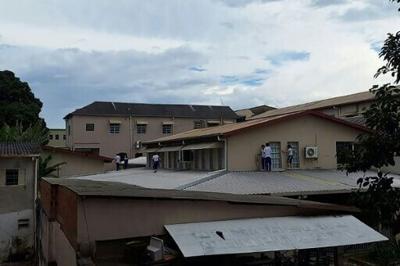
Students of Instituto Sao Jose school in northeast Brazil take shelter on the roof during a rampage by a teen shooter, who killed two staff memers and injured two other people, including a 11-year-old girl
Students of Instituto Sao Jose school in northeast Brazil take shelter on the roof during a rampage by a teen shooter, who killed two staff memers and injured two other people, including a 11-year-old girl
A teenager shot dead two staff members and injured two other people, including an 11-year-old girl, on Tuesday in the latest school shooting to rock Brazil.
A 13-year-old boy was arrested over the attack at Sao Jose Institute, a junior high school in Rio Branco, capital of northwestern Acre state, the local government said.
The injured girl was shot in the leg.
The teenager, who is a student at the school, entered the building and fired several shots in a hallway leading to the principal's office, Lieutenant Colonel Felipe Russo of the Acre military police department told reporters.
He surrendered to police after the attack.
His stepfather, who owns the .380-caliber pistol used in the attack, was also arrested.
Police have identified other students who may have cooperated with the attacker, Russo added.
Eduardo Rodrigues Cavalcante, a receptionist at a hotel adjacent to the school, described scenes of terror, as some students tried to jump over a wall separating the school from the hotel.
"The wall is six meters high, and only one person managed to jump over and take refuge here in the hotel. The other people were left on the school roof trying to escape," the 19-year-old receptionist said, adding that he heard "gunshots and a lot of screaming."
Images released by a local media outlet showed a woman being evacuated on a stretcher and scenes of heartbreak outside the school, with people crying and hugging each other.
"In the face of this tragedy, the state expresses its deepest condolences to the families of the victims, the school community of the Sao Jose Institute, and all education professionals affected by this event," the state government said.
It added that classes had been suspended for three days at all schools in the state and that psychological support teams had been mobilized to assist students and teachers.
Brazil has seen a sharp increase in attacks on educational institutions in recent years.
In September 2025, two teenagers were shot and killed, and three others were wounded at a school in the northeastern state of Ceara.
In October 2023, a shooting at a school in Sao Paulo left a 17-year-old student dead and three others wounded.
Shortly beforehand, a teenager was killed and three others were wounded in a knife attack as they left a school in the southeastern state of Minas Gerais.
In April of the same year, a 25-year-old man entered a daycare center in the southern state of Santa Catarina and killed four children between the ages of 3 and 7 with an axe.
(The Center Square) – President Donald Trump's administration signaled Friday it intends to appeal a federal trade court's ruling striking down his 10% global tariff as unlawful, while simultaneously pressing ahead with a separate round of import taxes that could take effect as early as July.
(The Center Square) – The North Dakota Supreme Court ruled this week that Greenpeace International cannot keep pursuing most of its lawsuit against Energy Transfer in the Netherlands as the pipeline company’s case moves forward in North Dakota.
Keep it Clean. Please avoid obscene, vulgar, lewd,
racist or sexually-oriented language. PLEASE TURN OFF YOUR CAPS LOCK. Don't Threaten. Threats of harming another
person will not be tolerated. Be Truthful. Don't knowingly lie about anyone
or anything. Be Nice. No racism, sexism or any sort of -ism
that is degrading to another person. Be Proactive. Use the 'Report' link on
each comment to let us know of abusive posts. Share with Us. We'd love to hear eyewitness
accounts, the history behind an article.
World officials pushed Monday for faster action to reduce methane emissions from the fossil fuel sector, arguing it would both help slow climate change and boost energy security as the Middle East war chokes off supply.
Alex Zanardi, the Italian Formula One driver who became a Paralympic cycling champion after losing both legs in an accident, has died aged 59, his family announced Saturday.
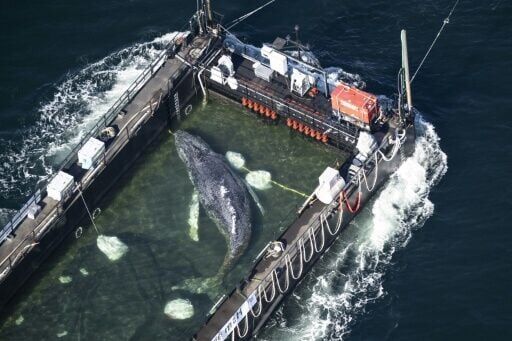
A humpback whale that had been struggling to survive after beaching near the German coast was Saturday released into the North Sea off Denmark after being transported in a barge, a member of a rescue mission said.
Court strikes tariff, Trump moves ahead with replacement
(The Center Square) – President Donald Trump's administration signaled Friday it intends to appeal a federal trade court's ruling striking down his 10% global tariff as unlawful, while simultaneously pressing ahead with a separate round of import taxes that could take effect as early as July.
American businesses have paid $166 billion in tariffs under the International Emergency Economic Powers Act. Those tariffs, which the Supreme Court struck down in February, are in the process of being refunded to the importers who paid them. An additional $8 billion was collected from the Section 122 tariff, which was struck down Thursday, according to We Pay the Tariffs, a coalition of nearly 1,200 small businesses that opposes tariffs. The Yale Budget Lab, a nonpartisan policy research center, estimated the Section 122 tariffs would cost the average U.S. household between $600 and $800 per year.
A Federal Reserve Bank of New York report, the Kiel Institute for the World Economy, and a Duke University study all concluded that Americans are paying nearly the entire cost of tariffs, not foreign countries as the White House has maintained.
"President Trump has lawfully used the tariff authorities granted to him by Congress to address our balance of payments crisis," White House spokesman Kush Desai told The Center Square on Friday. "The Trump administration is reviewing legal options and maintains confidence in ultimately prevailing."
Trump's U.S. Trade Representative, Jamieson Greer, said Friday the administration expects to prevail on appeal.
"They essentially said that Congress passed a law that can't be used, which we all know in the legal community, that's not how law should be interpreted," Greer told Fox Business Network's "Mornings with Maria" show. "They should be interpreted to be used. So we're confident that on appeal we'll be successful."
The Court of International Trade's decision on Thursday only applied to two small businesses and the state of Washington. That means the government is still collecting the tariffs on all other importers.
Michael Lowell, partner and chair at Reed Smith's Global Regulatory Enforcement Group, said the narrow ruling leaves the next move to the administration.
"Without a universal injunction, the ball's really in the government's court on what comes next," he said. "It's almost certainly an appeal to the Federal Circuit court of appeals."
The lone dissenting judge, Timothy Stanceu, argued the majority invented a measurement standard and warned that under the majority's logic, a federal statistics agency could repeal a law simply by changing how it measures economic data.
Phillip Magness, a senior fellow at the Independent Institute, said Trump's path ahead is "becoming increasingly difficult."
"The Supreme Court has already ruled against the administration in the IEEPA tariff case, and the Court of International Trade is showing growing impatience over delays in refunding unlawfully collected tariffs," he said.
While the expected appeal plays out in the courts, the administration has been building its next tariff vehicle. Greer's office launched Section 301 investigations on March 11 against 16 economies, including most of the United States' top trade partners. Hearings on those investigations ended Friday. Treasury Secretary Scott Bessent said in April the new tariff regime could go into effect in July.
Section 301 of the Trade Act of 1974 allows the president to impose tariffs after the U.S. Trade Representative investigates and finds that a foreign country's trade practices are unfair or discriminatory. Greer cited what he called structural overproduction that displaces U.S. manufacturing.
Critics say the administration is stretching the law again. Magness said in March that Greer was offering "a tautological redefinition" of unfair trade practices that "basically treats any exportation of any good to the United States for almost any reason as if it is evidence of an 'unfair' trading practice."
Alfredo Carrillo Obregon, a policy analyst at the Cato Institute, said the Section 122 tariffs "were always meant to be a bridge" to future tariff actions.
"We can expect more tariff announcements in the coming months," he said.
That's something small businesses can't afford, said Dan Anthony, executive director of We Pay the Tariffs.
"Small businesses cannot afford a repeat of the IEEPA refund headaches now playing out," he said.
With midterm elections approaching, public skepticism of the administration's tariff agenda is growing. The Center Square Voters' Voice Poll conducted in March found that 42% of voters believe American consumers primarily pay for tariffs, while just 12% say foreign countries bear the burden.
Magness previously told The Center Square the political costs may become more visible as the Midterm election nears.
"Not all have made the connection yet that tariffs are tantamount to a tax increase on affected goods," he said. "I suspect this connection will become more pronounced as the election approaches."
North Dakota Supreme Court sides with Energy Transfer in Greenpeace fight over Dutch lawsuit
(The Center Square) – The North Dakota Supreme Court ruled this week that Greenpeace International cannot keep pursuing most of its lawsuit against Energy Transfer in the Netherlands as the pipeline company’s case moves forward in North Dakota.
The dispute stems from litigation surrounding disruptive protests against the Dakota Access Pipeline.
Energy Transfer sued Greenpeace International, along with Greenpeace USA and Greenpeace Fund. Energy Transfer accused the groups of helping organize illegal efforts to stop pipeline construction and damage the company’s reputation.
Last year, a Morton County jury sided with Energy Transfer on most claims and initially awarded the company $667 million. A judge later reduced the judgment to $345 million.
Before that trial started, Greenpeace International filed a separate lawsuit against Energy Transfer in Amsterdam under a European Union law designed to protect groups facing lawsuits tied to protest activity and free speech.
Energy Transfer argued the Dutch lawsuit was an attempt to undermine the North Dakota case and avoid accountability from the jury verdict.
The North Dakota Supreme Court agreed in a 4-1 ruling.
Justice Jerod Tufte wrote in the majority opinion that Greenpeace International’s case in the Netherlands directly conflicted with findings that the Morton County jury had already made.
Greenpeace International wants the Amsterdam court to declare that Energy Transfer’s lawsuit is “manifestly unfounded and abusive,” according to the ruling.
Tufte wrote that such a finding would require the Dutch court to conclude Greenpeace International “did not engage in unlawful conduct, did not cause Energy Transfer’s losses, and did not act with malice.”
The justice said that the position clashes with the jury’s verdict in North Dakota.
He also said the overseas lawsuit was “an attack on a fundamental policy of this state.”
Additionally, the opinion suggested the timing of Greenpeace International’s lawsuit mattered because it was filed shortly before the North Dakota trial began.
“The only apparent purpose of filing a duplicative foreign action on the eve of trial is to create a vehicle for collaterally attacking the anticipated verdict,” Tufte wrote.
The ruling overturns a previous decision by Southwest Judicial District Judge James Gion, who had declined to stop Greenpeace International from continuing the Amsterdam lawsuit.
Chief Justice Lisa Fair McEvers dissented.
She argued that insufficient evidence exists showing Gion made a legal error and said the Dutch case did not relitigate the same issues decided in North Dakota.
“While there are some similarities, the types of actions differ,” Fair McEvers wrote.
Energy Transfer praised the ruling Thursday.
“Energy Transfer appreciates the North Dakota Supreme Court’s careful decision,” Trey Cox, a partner at Gibson Dunn and lead counsel for Energy Transfer, said in a statement provided to The Center Square.
“We have always believed that North Dakota’s courts, laws, and juries cannot be collaterally attacked in a foreign forum,” Cox added.
He said the ruling “protects the authority of the North Dakota judicial system and the jury’s unanimous verdict from an improper end-run abroad.”
Craig Stevens, spokesman for the GAIN coalition and former senior advisor to U.S. Energy Secretary Sam Bodman, said in a statement provided to The Center Square: “This decision reinforces that judgments reached in U.S. courts must be respected and cannot be challenged through parallel cases overseas. By drawing that line, it strengthens confidence in our legal system and protects the ability to build and operate critical infrastructure. This is a win for U.S. energy security, ensuring projects like the Dakota Access Pipeline can continue to support millions of Americans without being undermined by foreign interference.”
Greenpeace International indicated it may keep pursuing legal action in the Netherlands despite the ruling.
“This ruling does not enable Energy Transfer to escape accountability under Dutch and EU law for their back-to-back abusive court proceedings in the U.S.,” Greenpeace International Senior Legal Counsel Daniel Simons said in a statement.
The Greenpeace groups involved in the North Dakota lawsuit have also requested a new trial.
The rise of extreme weather and how it’s impacting power outages and fire watch needs
Alex Van Drunen for National Firewatch
The rise of extreme weather and how it’s impacting power outages and fire watch needs
Record-breaking heat is hitting the Southwest, with temperatures shattering historical benchmarks. As spring intensifies, atmospheric instability drives a volatile spring storm season across the central and southern United States.
Extreme weather threatens more than comfort or convenience. It dismantles the electrical infrastructure that powers fire detection, suppression and alarm systems. Power-dependent fire safety measures go dark as the grid goes offline, leaving properties vulnerable. Here are insights from National Firewatch on how climate patterns and power outages cause on-site fire risk.
Key Takeaways
Extreme weather translates into fire safety vulnerabilities through several critical links:
Weather volatility: Supercharged storms exceed the thresholds the electrical infrastructure was designed to handle. This intensity causes widespread and prolonged power outages.
Fire safety systems: Fire alarms, smoke detectors, sprinkler pumps and emergency communication systems stop functioning when the grid goes offline.
Fire hazards: Downed power lines become active ignition sources, while facilities lose the ability to detect or suppress fires electronically.
Manual fire watch: During system failures, trained human monitors provide the only viable countermeasure for fire safety and regulatory compliance.
The Impacts of Extreme Weather
A warmer atmosphere holds more moisture and energy, altering weather patterns. Each degree of warming allows air to hold roughly 7% more water vapor, acting as fuel for intense storms.
Most of our country’s power infrastructure was engineered for the climate conditions of decades past, not for today’s changing weather. Grid infrastructure now operates at the edge of its tolerance limits during destructive weather events.
Intense weather manifests in forms that directly threaten grid stability:
Intense thunderstorms: Clusters of powerful storms produce damaging winds, lightning strikes and heavy rainfall that can persist for hours across wide regions.
Derechos and straight-line winds: Fast-moving windstorms generate sustained hurricane-force gusts capable of snapping utility poles and toppling transmission towers.
Flash and river flooding: Flooding substations and underground electrical equipment cause cascading failures and extensive repair work.
Heat domes and temperature extremes: Prolonged periods of excessive heat cause power lines to sag and drive electricity demand for cooling.
Drought conditions: Extended dry periods weaken tree root systems, making vegetation more susceptible to toppling onto power lines during moderate winds.
Climate scientists anticipate a forward-looking threat amplifier that compounds these risks. According to the NOAA El Niño Watch, there’s a 62% chance of El Niño conditions emerging by summer, which can intensify drought in some regions while triggering destructive storm outbreaks in others.
How Severe Weather Knocks the Power Grid Offline
Understanding the mechanisms of weather-related grid failures helps facility managers expect vulnerabilities and plan accordingly. Three primary pathways account for most outages during extreme weather events.
1. High Winds, Storm Clusters and Derechos
Physical force from high winds represents the most common cause of weather-related power outages. Thunderstorms routinely produce gusts exceeding 60 mph, strong enough to snap tree limbs and hurl debris into power lines. Multiple intense storms tracking across the same region in quick succession can leave hundreds of thousands of customers without electricity for days through cumulative damage.
Derechos — a widespread, long-lived windstorm associated with rapidly moving thunderstorm clusters — represent an extreme manifestation of wind-driven grid failure. These rare but devastating events produce sustained winds of at least 58 mph across paths stretching 240 miles or more. May through August sees 70% of all derecho occurrences.
When one of these systems tracks through populated areas, the damage to electrical infrastructure can be catastrophic, knocking down thousands of utility poles and leaving entire metropolitan regions in the dark.
2. Flooding, Substations and Cascading Outages
Heavy rainfall and flooding pose unique threats to electrical infrastructure. Substations with high-voltage transmission lines connecting to lower-voltage distribution networks often include ground-level equipment that is vulnerable to inundation. Automatic safety systems trigger shutdowns as floodwaters reach sensitive components, preventing electrocution hazards and equipment damage.
For example, in 2012, Hurricane Sandy provided a stark illustration of grid failure driven by flooding in New York City. The record storm surge knocked out the Con Edison East 13th Street Substation, plunging lower Manhattan into darkness for days. This shows how a single flooded substation can cascade into widespread outages affecting hospitals, high-rise buildings and emergency services.
Unlike wind damage that utilities can often repair within hours, flood-related electrical failures require extensive drying, testing and equipment replacement before power can be safely restored. Extended restoration timelines like these create prolonged periods when buildings must operate without technology-based fire safety systems.
3. Heat Waves and Demand-Driven Blackouts
Extreme heat threatens grid stability through two distinct mechanisms. First, high temperatures cause power lines to expand and sag physically. Utilities must de-energize transmission lines that droop too close to vegetation or structures, preventing fires but resulting in intentional outages. Second, heat drives record electricity demand as millions of air conditioning units strain to cool buildings, pushing the grid toward its maximum capacity.
Heat records underscore the growing severity of this threat. On March 18 and 19, 2026, multiple locations across the Southwest recorded temperatures that would have been virtually impossible without climate change. Heat waves now occur earlier than expected and at record-breaking temperatures. This can catch unprepared utilities and facility managers off guard during a time when power demand would traditionally be moderate.
Courtesy of National Firewatch
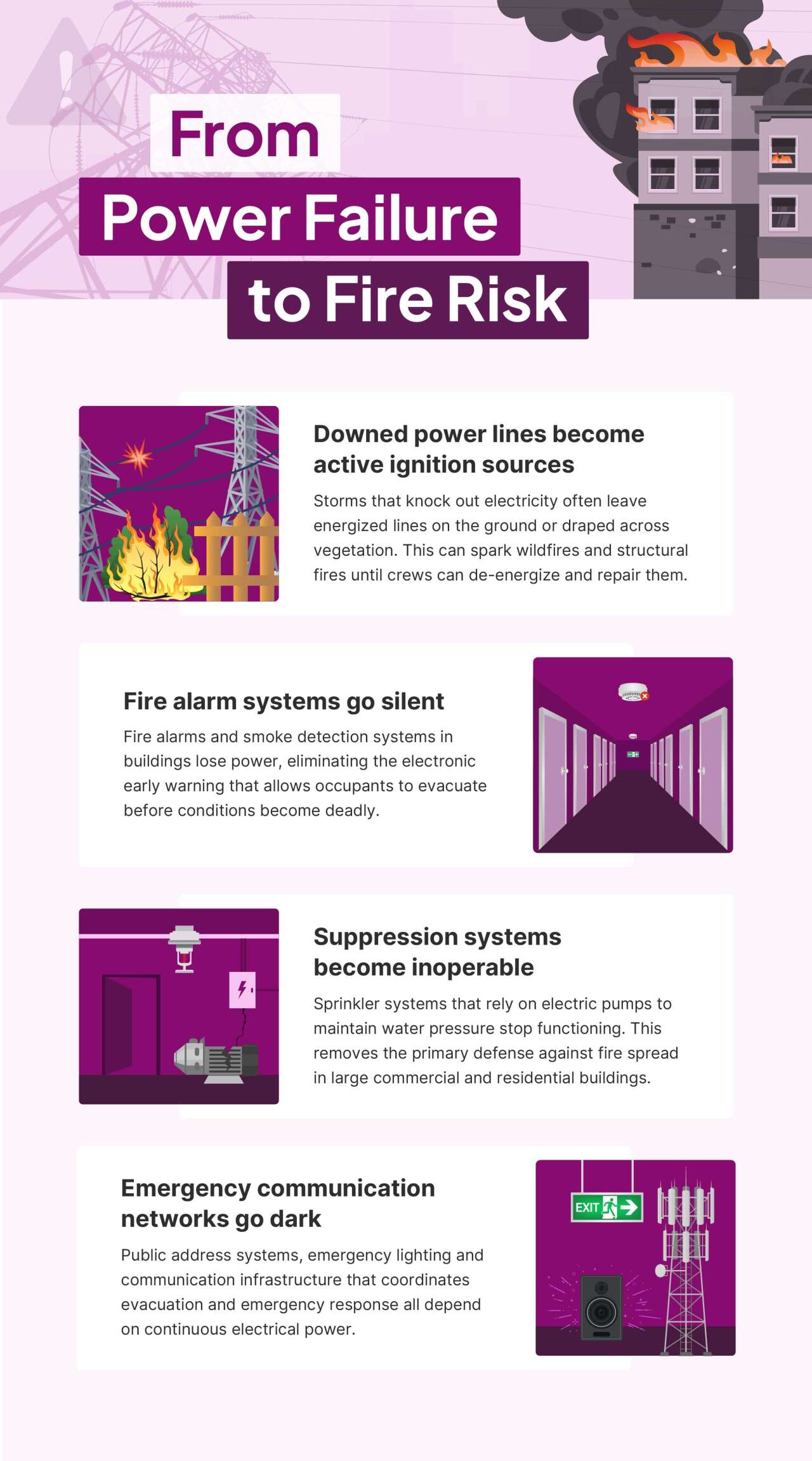
From Power Failure to Fire Risk
A power outage systematically dismantles the fire safety infrastructure that modern facilities depend on. Immediate fire safety crises emerge from downstream effects:
Downed power lines become active ignition sources: Storms that knock out electricity often leave energized lines on the ground or draped across vegetation. This can spark wildfires and structural fires until crews can de-energize and repair them.
Fire alarm systems go silent: Fire alarms and smoke detection systems in buildings lose power, eliminating the electronic early warning that allows occupants to evacuate before conditions become deadly.
Suppression systems become inoperable: Sprinkler systems that rely on electric pumps to maintain water pressure stop functioning. This removes the primary defense against fire spread in large commercial and residential buildings.
Emergency communication networks go dark: Public address systems, emergency lighting and communication infrastructure that coordinates evacuation and emergency response all depend on continuous electrical power.
This convergence of failures shows why preparing for fire watch during extreme weather has become a critical planning priority. Fire risks comparable to buildings constructed before modern safety codes existed now threaten facilities when all power-dependent fire safety measures fail simultaneously.
The Eight-Week Outlook
Late March through May marks the peak period for weather-related grid failures across much of the U.S. Official meteorological data, combined with known seasonal patterns, in this forecast, provides facility managers with a forward-looking risk assessment.
Late March to Early April
An upper-level ridge producing record-challenging heat across the western U.S. is increasing electricity demand and fire-weather risk. It’s also speeding up early-season snowmelt in the western mountains. Power demand surges, which drive this early-season heat wave, stress grid capacity when utilities would traditionally have comfortable reserve margins.
Facility managers in the southwestern states face a dangerous combination of elevated fire risk and strained grid capacity. Dry conditions and high temperatures turn vegetation into tinder, while the electrical infrastructure that powers fire suppression systems operates near its limits. Early-season heat also accelerates snowmelt in mountain ranges, which can later contribute to flooding downstream as runoff overwhelms river systems designed for more gradual spring thaws.
Peak Risk in April
April historically brings elevated risk for intense thunderstorms, high winds and tornadoes. Across the Mississippi Valley and Gulf Coast states, billion-dollar weather disasters are increasingly common. Violent storm clusters account for a significant part of the economic damage.
Winter-to-summer atmospheric transitions create instability during this seasonal weather peak, fueling explosive thunderstorm development. Resulting storms can knock out power across multistate regions, leaving properties without electronic fire protection for extended periods. Facility managers in these regions should be proactive, with fire watch contingency plans in place before storm season peaks.
Late April to May
Heat domes can expand into late April and May, straining electrical grids and rapidly drying out vegetation. Driving temperatures above normal for weeks at a time, these persistent high-pressure systems trap heat near the surface.
Extreme heat from climate change is increasingly threatening U.S. energy supply and reliability. By 2050, billions of dollars in economic value and up to 18% of U.S. generating capacity could be exposed to heat risk. Electrical infrastructure strain during heat dome events creates a vicious cycle. Increased cooling demand pushes the grid toward failure, while those failures disable the cooling systems and fire suppression equipment that buildings need most.
Dangerous fire weather conditions also come from heat domes, combining high temperatures with low humidity and persistent winds. Fire danger escalates rapidly when these atmospheric patterns settle over regions experiencing drought. A single spark from damaged electrical equipment or a lightning strike can ignite vegetation that burns with exceptional intensity under these conditions.
May and Tornado Alley
May through early June marks the statistical peak for tornado activity in the central Plains. Significant risk of grid damage from destructive storms arrives during this period, with tornadoes often accompanied by large hail, damaging straight-line winds and flash flooding.
Challenges from heat and violent thunderstorms that facility managers already face become compounded by the tornado threat. A single tornado can destroy transmission infrastructure across a miles-long path, while intense thunderstorms that spawn tornadoes knock out power across much wider areas through wind damage and lightning strikes. Entire regions can remain without power after the most intense tornado outbreaks, leaving facilities reliant on backup fire safety measures for extended periods.
Why Fire Watch Becomes Essential When the Power Goes Out
Power-dependent fire safety systems become inoperable during outages, making manual human monitoring the only viable countermeasure. Professional fire watch services address specific vulnerabilities:
Inoperable fire detection: Electronic systems require continuous electrical power to function. Buildings lose the ability to detect fires in their early stages and suppress them before they spread as that power goes offline.
Heightened fire hazards: Power outages often occur during intense weather events and create more fire risks, including downed power lines, lightning strikes and disrupted emergency services responding to multiple simultaneous incidents. Regular fire watch drills, scenario-based grid-outage risk assessments and staff cross-training all enhance resilience.
Regulatory and compliance: The National Fire Protection Association (NFPA) standards require a fire watch during periods when electronic fire protection systems are impaired or out of service. Maintaining compliance during extended outages protects you from regulatory penalties.
Critical need for human vigilance: Trained fire watch guards provide continuous, 24/7 monitoring to detect fires early. This ensures emergency services can be contacted immediately and that compliance with fire codes is maintained during outages of any duration.
As outages become more common, regulators may tighten compliance windows and require digital logs of fire watch patrols. Fire watch personnel operate independently of electrical infrastructure, using visual patrols, communication equipment with backup power and direct coordination with emergency services to maintain fire safety when technology-based systems stop functioning. Continuing to function regardless of grid status, weather conditions or infrastructure damage, this human element provides a layer of protection.
A New Era of Preparedness
Extreme weather drives power failures, which disable the electronic systems that facilities depend on to detect and suppress fires. Relying solely on technology that requires uninterrupted electricity is no longer a sufficient safety strategy.
Manual fire watch has become a fundamental part of resilient property management. As such, professional fire watch services are crucial for commercial properties and emergency scenarios, including residential facilities, hot worksites, construction zones and special events. Trained guards deliver continuous, 24/7 monitoring that operates independently of the grid, ensuring early fire detection and compliance with OSHA and NFPA standards during system outages.
Preparedness must evolve as climate patterns intensify and grid vulnerabilities multiply. Fire watch may have once been a reactive measure reserved for emergencies, but now it’s a proactive safeguard that belongs in every modern facility safety plan.
Apollo, Gemini sightings revealed in first UAP file drop
(The Center Square) – The long-anticipated Unidentified Anomalous Phenomena (UAP) or Unidentified Flying Object (UFO) files have been released by the federal government, showing images and descriptions of unexplained objects.
The first batch of declassified files was released Friday morning at the direction of President Donald Trump, in the “interest of total transparency.”
The files include a mixture of video, audio, photos, transcripts and drawings of UAPs dating back to the 1940s, including sightings from Gemini and Apollo astronauts.
While the Department of War and the White House touted transparency in the release of the files, they refused to confirm whether the objects witnessed were evidence of alien life, instead allowing the American people to “ultimately make up their own minds about the information contained” in the files.
Among the files released were videos of UAPs filmed around the world, some over the ocean and on land, resembling spheres and flying at high speeds. However, some of these videos were made public prior to Friday’s release.
Included in the tranche of files were images and transcripts from the Gemini and Apollo space programs, beginning with Gemini 7.
The flight crew of Gemini 7, astronauts Frank Borman and James Lovell, reported to mission control in Houston during their December 1965 flight, spotting what they called “a bogey” and seeing “hundreds” and “trillions” of particles about “three or four miles” from the spacecraft as it orbited the Earth.
During the Apollo 12 mission, in November 1969, the second mission to land on the moon, astronauts observed what they described as particles and flashes of light “sailing off in space,” while “escaping the moon.”
During the Apollo 17 mission in December 1972, which marked the final Apollo mission to the moon, astronauts reported once again observing what they described as “particles” or “fragments” that appeared very bright. The astronauts claimed the particles or fragments were seen “tumbling” and “drifting by” as the spacecraft maneuvered.
“There’s a whole bunce of big ones on my window down there – just bright. It looks like the Fourth of July out of [Ronald Evans] window,” Lunar Module Pilot Harrison “Jack” Schmitt told mission control.
“Yes. Now you can see some of them in shape. They’re very jagged, angular fragments that are tumbling,” Evans, the command module pilot, told mission control.
In addition to the transcripts from the Apollo 17 astronauts, the files included photos taken from the lunar surface, capturing what appears to be three dots in a triangular shape over the orbit of the moon. The astronauts captured several other images containing oddly shaped figures over the moon.
Following the release of the files, posted on his Truth Social account, reiterating his administration’s commitment to “maximum transparency,” while taking a swipe at previous administrations for keeping the files secret.
“It was my honor to direct my administration to identify and provide government files related to alien and extraterrestrial life, unidentified aerial phenomena, and unidentified flying objects. Whereas previous administrations have failed to be transparent on this subject, with these new documents and videos, the people can decide for themselves, ‘What the hell is going on?’ Have fun and enjoy,” Trump wrote.
It’s unclear when the public can expect the next tranche of files to be released.
BREAKING: GOP turns to Congress after Minnesota Dems block Omar subpoena
(The Center Square) – Minnesota House Republicans want help from U.S. congressional oversight leaders after Democrats on a state committee blocked an effort to subpoena U.S. Rep. Ilhan Omar over communications tied to the Feeding Our Future fraud investigation.
Rep. Kristin Robbins, R-Maple Grove and chair of the Minnesota House Fraud Prevention and State Oversight Committee, announced Friday she has asked congressional leaders to assist in securing the records.
Robbins sent letters to U.S. Rep. James Comer, chairman of the House Oversight Committee, and U.S. Sen. Ted Cruz, chairman of the Senate Judiciary Subcommittee on Federal Courts, Oversight, Agency Action, and Federal Rights.
The move comes days after Democrats on the state committee voted against authorizing a subpoena for Omar’s communications connected to the Feeding Our Future investigation. All five Republican committee members supported the motion, while three DFL members opposed it, leaving Republicans just short of the six votes required.
“Minnesota House Democrats chose to protect Rep. Omar rather than support our effort to get the truth,” Robbins said in a statement Friday. “Without at least one Democrat vote in support of the motion to subpoena these communications, we cannot get the two-thirds majority required to compel Rep. Omar produce the documents.”
Republicans on the committee have repeatedly sought testimony and records from Omar related to trial exhibits introduced in the federal criminal case U.S. v. Bock. Robbins said Omar’s office has not responded to multiple requests, including an April 22 letter requesting records by May 5.
“We have been ghosted,” Robbins said during Tuesday’s hearing. “We have been absolutely ignored by a sitting member of Congress.”
The committee’s Republican members have focused heavily on Omar’s sponsorship of the federal MEALS Act in 2020, legislation they argue loosened oversight requirements in federal child nutrition programs during the COVID-19 pandemic.
“Rep. Omar had some role, whether inadvertent or not,” Robbins said Tuesday. “She passed the MEALS Act in March of 2020, and that took the guardrails off the federal school nutrition program, which created the conditions for Feeding Our Future.”
Federal prosecutors have described the Feeding Our Future case as one of the largest pandemic-era fraud schemes in the country, alleging more than $250 million intended for child nutrition programs was fraudulently claimed through fake meal reimbursements.
Robbins said the committee became interested in Omar’s involvement after learning of communications between her office and individuals later convicted in the scheme. She also pointed to a 2020 video in which Omar promoted meal distribution efforts at Safari Restaurant, a Minneapolis site prosecutors later identified as a major participant in the fraud.
Democrats on the committee pushed back against the effort. Rep. Dave Pinto, DFL-St. Paul, questioned the timing of the subpoena.
“We know the president and federal administration have got no hesitation going after political enemies and investigating them in all sorts of ways,” Pinto said. “If there’s any sort of wrongdoing by Congresswoman Omar—and if there’s no wrongdoing by Congresswoman Omar – I have no doubt the Trump Administration will do all it can with all the resources it has.”
Rep. Isaac Schultz, R-Elmdale Township, argued the subpoena effort was part of a broader push to understand fraud in Minnesota government programs.
“Feeding Our Future is one part of the picture as it relates to what we know is to come in the fraud we’ve seen in Medicaid,” Schultz said. “Now, we have this opportunity to use our tools here in the House of Representatives to issue this subpoena to gain a greater understanding.”
Robbins said Friday she hopes action from the congressional oversight committees will help Republicans obtain the records.
“I hope the federal oversight committees will be able to help us get the facts about Representative Omar’s involvement in the case,” Robbins said. “If she has nothing to hide, she should testify before our committee and produce the trial exhibits.”
Omar’s office did not respond to requests for comment from The Center Square.
U.S. economy adds 115,000 jobs in April
(The Center Square) – The U.S. economy added 115,000 jobs in April, about double what economists had forecast, while the unemployment rate held steady at 4.3%, the Bureau of Labor Statistics reported Friday.
Health care led job gains, adding 37,000 positions, followed by transportation and warehousing, which gained 30,000 jobs, and retail trade, which added 22,000. Federal government employment continued to shrink, falling 9,000 in April. Since October 2024, the federal workforce has declined by 348,000, a drop of 11.5%.
White House spokesman Kush Desai called the report a sign of economic strength.
"The April jobs report smashing expectations thanks to robust private-sector growth is yet another sign that the American economy remains on a solid trajectory under President Trump," he said.
March's payroll figure was revised upward to 185,000, stronger than the 178,000 initially reported. So far in 2026, the economy has averaged 76,000 new jobs per month, up sharply from an average of 10,000 per month in 2025.
Average hourly earnings rose 3.6% over the past year, a figure that may be outpaced by inflation.
Heather Long, chief economist at Navy Federal Credit Union, noted the dynamic Friday.
"The bad news = Inflation is about to eat up wage gains. Wage growth: 3.6% in past year --> That's likely to be eaten up by April inflation of ~4%."
The labor force participation rate edged down to 61.8%, its lowest level since late 2021.
The report comes as the U.S. wages a military campaign against Iran that has pushed gasoline prices to a national average of $4.55 a gallon, up from $3.15 a year ago, according to AAA.
Bill Adams, chief U.S. economist at Fifth Third Commercial Bank, said the drop signals an emerging challenge for employers.
"Assuming the U.S. economy navigates the downside risks from the Iran War, it will likely confront a shortage of jobseekers by late this year," he said.
The number of workers employed part-time for economic reasons – those who wanted full-time work but couldn't find it – rose by 445,000 to 4.9 million in April.
The next employment report, covering May, is scheduled for release June 5.
Justice Department agrees to appearance waiver for Comey
(The Center Square) – Former FBI Director James Comey on Thursday requested his appearance in a North Carolina federal court be canceled, and the U.S. Department of Justice gave support.
Comey, resident of Virginia, has already surrendered and appeared before a judge in his home state. He is facing two federal counts of threats against the president and has been scheduled for a Monday appearance in downtown Greenville.
Comey’s expected filing on Friday of a waiver of appearance will cancel the Monday court date, said District Judge Louise Wood Flanagan. A protest previously planned by 50501, an organization unified against second-term Republican President Donald Trump, is not listed in its respective events’ log.
In May 2025, prosecutors say, Comey posted to social media seashells on the Outer Banks arranged to spell out 86 47 – a commonly interpreted reference for eliminating something (86) and the numerical count (47) of presidents.
Comey was FBI director in the administration of former two-term Democratic President Barack Obama, serving from July 29, 2013, to May 9, 2017, when Trump fired him. His Senate confirmation was 93-1.
Comey was infamously investigating Trump ties to the Russian government when he was let go.
Comey was deputy attorney general to John Ashcroft during the administration of former two-term Republican President George W. Bush. His career outside of politics includes law professor at Columbia, and time with Lockheed Martin and Bridgewater Associates.
Boone County drops felony charge against Mizzou linebacker JJ Bush
Dylan Heinrich, Columbia Missourian
Boone County Prosecuting Attorney Roger Johnson announced that a pair of criminal charges against Mizzou football freshman JJ Bush were dropped Wednesday. He confirmed the information to KOMU 8 News.
Bush faced a Class D felony charge of aggravated fleeing a stop or detention of a motor vehicle and a Class B misdemeanor of careless and imprudent driving after the arresting officer observed Bush traveling “approximately 80 mph” on Monday on East Broadway. He was arrested before being bonded out later Tuesday.
While the charges were dropped, Johnson told KOMU that he expects the charges to be refiled in some capacity.
Bush was suspended from the Tigers indefinitely following the arrest. The four-star linebacker is originally from Theodore, Alabama.
Court strikes down Trump's backup tariffs as unlawful
(The Center Square) – A federal trade court struck down President Donald Trump's latest global tariff Thursday, ruling that the import taxes were unauthorized by law and ordering refunds for the businesses that brought the case.
The U.S. Court of International Trade ruled 2-1 that Trump overstepped his authority by invoking a never-before-used 1974 trade law to impose a 10% global import duty, continuing a pattern of courts rejecting the president's attempts to unilaterally raise taxes on imported goods without explicit congressional authorization.
The Liberty Justice Center said it was the fourth major legal defeat for Trump's tariff agenda since he took office.
Trump invoked the 1974 law hours after the Supreme Court's February ruling, but the court found he misapplied it, relying on trade and current account deficits rather than the specific balance-of-payments measures Congress had in mind when it wrote the statute five decades ago.
The court found that Trump's proclamation failed to identify the specific type of economic crisis the law requires, ruling that his reliance on trade and current account deficits did not satisfy the 1974 statute's terms.
"The President enjoys no inherent authority to impose tariffs during peacetime," the court wrote, citing the Supreme Court's February ruling that struck down Trump's previous tariffs.
"The United States has a trade deficit, not a balance-of-payments deficit, and does not have international payments problems," said Jeffrey Schwab, senior counsel at the Liberty Justice Center, which represented small businesses in the case. "The president cannot impose these tariffs under Section 122."
The Liberty Justice Center filed the lawsuit on behalf of Burlap & Barrel, a New York-based online spice retailer, and Basic Fun, a Florida-based toy company, the two companies together are facing more than $750,000 in tariff costs over the 150-day period covered by the law. A coalition of Democrat-led states filed a separate challenge, but most were dismissed by the court for lack of standing.
"This ruling is a major victory for small businesses like ours that depend on fair and predictable trade policy," said Ethan Frisch, co-founder and co-CEO of Burlap & Barrel. "This decision is an important win for American companies that rely on global manufacturing to deliver safe and affordable products," said Jay Foreman, CEO of Basic Fun.
American businesses have paid about $8 billion in Section 122 tariffs since March, on top of $166 billion collected under Trump's previous tariff regime before the Supreme Court struck it down, according to the We Pay the Tariffs coalition. The ruling entitles the three plaintiffs to refunds of duties already paid, but the coalition warned the process could prove difficult, noting that IEEPA refunds launched last month are already being absorbed by tariff-related debts for many businesses.
The ruling is likely to be appealed. A dissenting judge argued the majority invented a measurement standard from statistical tables in legislative history and ruled on grounds neither party had raised, giving the administration procedural arguments to pursue on appeal.
Trump is also moving forward with trade investigations under Section 301 of the Trade Act of 1974, which could form the legal basis for a new round of tariffs.
The White House did not immediately respond to a request for comment.
As midterm elections approach, voters are increasingly skeptical of Trump's tariff agenda. A Center Square Voters' Voice poll found that 42% of voters say American consumers primarily pay the cost of tariffs, while just 12% believe foreign countries bear the burden.
Total presidential tariffs paid since March 2025 have reached $283 billion, according to trade data.
One last time at home: Mizzou to face Vanderbilt in penultimate conference series
Amber Winkler, Columbia Missourian
The Tigers traveled back to Columbia with their tails between their legs after an underwhelming series against No. 5 Georgia that saw Mizzou baseball get swept. The team was run-ruled in the final two games.
Now returned to the familiar confines of Taylor Stadium, the Tigers will face Vanderbilt for their home finale of the 2026 campaign this weekend.
Being situated at the bottom of the Southeastern Conference, there is not much the Tigers can gain from this series in reality. They can, however, play spoiler for the Commodores, who sit at No. 68 nationally in RPI. They would need to move up in the ranking to be likely to secure a spot in the NCAA Tournament.
The main thing holding the Commodores back is their pitching. They have just one qualified pitcher in Connor Fennell, who has a 5.48 ERA across 12 starts. He ranks sixth in the conference in innings pitched (67⅓) and eighth in strikeouts (82).
Vanderbilt's Game 2 and Game 3 starters were listed at TBA for the series.
The Commodores have three players batting above .300 on their roster, with Brodie Johnston (.347) and Braden Holcomb (.345) atop the conference. The duo has combined for 27 home runs and 88 RBI in the 2026 campaign.
Last weekend did not go in Vanderbilt's favor. The Commodores were swept by No. 19 Alabama.
One last time at Taylor
The Tigers have won one SEC game at home in the last two seasons. They will have the final chance to add to that total this weekend.
They have proven that they can keep games close, but have not been able to get over the final hump of winning. Mizzou has lost six SEC games by two runs or less this season.
Starting pitchers Josh McDevitt and Brady Kehlenbrink have been a large part of the reason why Mizzou has been able to stay close.
McDevitt has a 3.84 ERA and tossed a gem against No. 5 Georgia last weekend despite the loss. Kehlenbrink has had his share of struggles but provided a few quality starts this season.
Keyler Gonzalez will have the first pitch for Game 3 in his second start for Mizzou. His outing last weekend against Georgia's top-ranked offense did not go well, giving up six runs in just 2⅓ innings.
His prior outings told of a very different pitcher. Gonzalez tossed six scoreless innings against Missouri State and five scoreless innings against Arkansas.
The Tigers offense is highlighted by Jase Woita and Blaize Ward, who are the only two Mizzou batters hitting above .300. Woita leads the team in nearly every offensive category. He had 11 home runs and 44 RBI.
But Kam Durnin also demands mention. He swatted three home runs against Georgia, with two in the series finale for his first multi-homer game as a Tiger.
The first pitch of the three-game series will be at 6 p.m. Friday with Kehlenbrink matched up against Fennell on the mound.





(0) comments
Welcome to the discussion.
Log In
Post a comment as Guest
Keep it Clean. Please avoid obscene, vulgar, lewd, racist or sexually-oriented language.
PLEASE TURN OFF YOUR CAPS LOCK.
Don't Threaten. Threats of harming another person will not be tolerated.
Be Truthful. Don't knowingly lie about anyone or anything.
Be Nice. No racism, sexism or any sort of -ism that is degrading to another person.
Be Proactive. Use the 'Report' link on each comment to let us know of abusive posts.
Share with Us. We'd love to hear eyewitness accounts, the history behind an article.