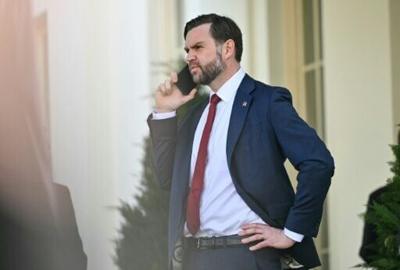
It was a war JD Vance never wanted. Now the US vice president has been tasked with ending it.
Vance heads to Pakistan this week with orders from President Donald Trump to turn the shaky Iran ceasefire into a lasting peace deal.
For the 41-year-old Vance, who has kept a notably low profile during the Middle East conflict, it will be one of the biggest moments of his career.
But the man widely regarded as a leading contender in the 2028 US presidential election will face huge challenges too when talks begin Saturday in Islamabad.
"I cannot think of a case where the vice president ran formal negotiations like this," Aaron Wolf Mannes, a lecturer at the University of Maryland School of Public Policy and an expert on the American vice presidency's role in foreign policy, told AFP.
"This is high risk, high reward."
Vance built his political brand as an avowed anti-interventionist who wanted to keep America out of any more foreign wars, like in Iraq where he served as a US Marine.
That has made for a difficult balancing act after Trump launched the Iran war on February 28.
Vance has publicly backed the conflict but has kept out of the limelight. When the ceasefire was announced, Vance happened to be far away in Hungary, supporting Prime Minister Viktor Orban's electoral campaign.
The New York Times reported this week that in discussions behind closed doors in the weeks before the war, Vance argued against military action, saying it could cause regional chaos and split Trump's MAGA coalition.
But Vance now suddenly finds himself as Trump's diplomatic closer for an Iran deal.
"My key role was, I sat on the phone a lot," Vance told reporters as he left Hungary this week. "I answered a lot of phone calls. I made a lot of phone calls. And again, I'm happy about where we are."
Announcing the Islamabad talks this week, White House Press Secretary Karoline Leavitt said Vance played a "very significant and a key role in this since the very beginning."
- Not always diplomatic -
Vance will be accompanied by special envoy Steve Witkoff and Trump's son-in-law Jared Kushner as he becomes the first US vice president to visit Pakistan since Joe Biden in 2011.
The White House said Vance, Secretary of State Marco Rubio, Witkoff and Kushner "have always been collaborating on these issues."
"The President is optimistic that a deal can be reached that can lead to lasting peace in the Middle East," Principal Deputy Press Secretary Anna Kelly said in a statement to AFP.
One theory is that the Iranians may view Vance as a more likely partner for diplomacy given his widely reported opposition to the war, and general doubts about US interventionism.
After Tehran expressed fury over Israel's continued attacks on Lebanese cities despite the ceasefire deal, Vance appeared to take a softer tone, saying there may have been a "legitimate misunderstanding" from Iran that Lebanon would be included.
He hasn't always been so diplomatic.
A long-term skeptic of support for Ukraine, Vance notoriously kicked off the Oval Office row between Trump and President Volodymyr Zelensky in February 2025.
And for the ambitious Vance, a soon-to-be father of four and Catholic convert, politics is always in the background.
Since Trump's return to power, Vance has been unusually prominent in a tough job that is simultaneously one heartbeat away from the presidency yet also, in the words of one former veep, "not worth a bucket of warm spit."
His crucial role in the Iran talks comes against the backdrop of a looming potential battle with Rubio to be the Republican heir to Trump in two years' time.
"If he can get something that papers it over without dealing with real issues, that's probably enough," said Mannes.
"But if nothing good comes of this, it raises questions about his competence, which is not going to help him electorally. And of course Rubio's right there as a potential rival for 2028."
dk-sct/des
Keep reading

Pakistan is due to host talks between Iran and the United States in a bid to turn a fragile two-week ceasefire into a lasting end to a war that has roiled global energy markets.

When the US-Israeli war with Iran began at the end of February, it was widely assumed that Moscow would be one of the conflict's key winners.

China's President Xi Jinping met Taiwan's opposition party leader Cheng Li-wun in Beijing on Friday, telling the visiting delegation he had "full confidence" that Taiwanese and Chinese people would be united.





(0) comments
Welcome to the discussion.
Log In
Post a comment as Guest
Keep it Clean. Please avoid obscene, vulgar, lewd, racist or sexually-oriented language.
PLEASE TURN OFF YOUR CAPS LOCK.
Don't Threaten. Threats of harming another person will not be tolerated.
Be Truthful. Don't knowingly lie about anyone or anything.
Be Nice. No racism, sexism or any sort of -ism that is degrading to another person.
Be Proactive. Use the 'Report' link on each comment to let us know of abusive posts.
Share with Us. We'd love to hear eyewitness accounts, the history behind an article.