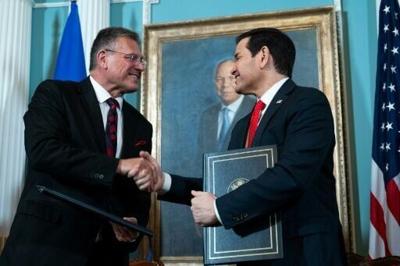
The European Union and United States signed an agreement Friday to coordinate on the supply of critical minerals needed for key industries including defense, as China's dominance becomes a growing concern.
The pact marks a rare embrace by President Donald Trump's administration of the role of the EU, which it often berates as it instead champions right-wing populists within Europe.
Flexing its muscle at times of tension, Beijing has restricted exports of critical minerals needed for products including semiconductors, electric vehicle batteries and weapons systems.
"The overconcentration of these resources, the fact that they're dominated by one or two places, is an unacceptable risk," US Secretary of State Marco Rubio said as he signed a memorandum of understanding with EU trade chief Maros Sefcovic.
Sefcovic told a separate press briefing that the agreement "formalizes our partnership across the entire value chain, from exploration and extraction to processing, refining, recycling and recovery."
- Cost of dependency -
On concerns that China could retaliate against a potential critical minerals deal involving multiple parties, Sefcovic said: "For us, it's really a matter of economic security. It's a matter of overcoming dependencies."
From recent experience, "we know how dependencies could be expensive, and we have a huge price tag for being dependent on the sources of our fossil fuels," he added.
"We simply want to learn from that experience and have a much more diversified portfolio of suppliers," Sefcovic said.
Rubio noted that the United States and the EU combined are "the largest customers and users" of critical minerals.
"We have to make sure that these supplies and these minerals are available for our futures and in ways that are not monopolized in one place or concentrated heavily in one place," Rubio added.
An action plan said that the EU and United States would explore setting minimum prices on critical minerals -- effectively preventing China or other outside powers from flooding the market with inexpensive exports.
They will also look at coordinating any subsidies and stockpiles of critical minerals, and could coordinate joint standards to ease trade across the Western world, and together invest in research.
The US Trade Representative's office said this plan will be the main mechanism to "coordinate trade policies and measures on critical minerals supply chains with a view to concluding a binding plurilateral agreement on trade."
The Trump administration has previously called for a preferential trade zone among allies on critical minerals.
Washington has also unveiled critical minerals action plans with Mexico and Japan, alongside a supply framework with Australia and others.
bys-sct/md
Keep reading

The latest developments in the Middle East war:
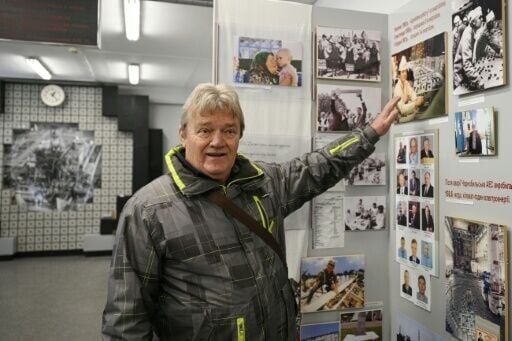
Nikolay Solovyov was on shift the night of April 26, 1986 when the Chernobyl nuclear power plant exploded. Instead of fleeing, he chose to fight his "first war" against radiation.
AI developers are ramping up efforts to win over the hearts and minds of officials in Europe and the United States, hoping to sway governments as they weigh high-stake regulatory frameworks for the ever more powerful technology.




(0) comments
Welcome to the discussion.
Log In
Post a comment as Guest
Keep it Clean. Please avoid obscene, vulgar, lewd, racist or sexually-oriented language.
PLEASE TURN OFF YOUR CAPS LOCK.
Don't Threaten. Threats of harming another person will not be tolerated.
Be Truthful. Don't knowingly lie about anyone or anything.
Be Nice. No racism, sexism or any sort of -ism that is degrading to another person.
Be Proactive. Use the 'Report' link on each comment to let us know of abusive posts.
Share with Us. We'd love to hear eyewitness accounts, the history behind an article.