(The Center Square ) – A former Bahamian national security minister running for parliament faces growing scrutiny ahead of next week’s general election over his ties to a boat captain accused of attempting to smuggle cocaine into the United States.
Marvin Dames, a candidate with the Free National Movement party,acknowledgedentering into a business arrangement with Bahamian boat captain Malcolm Goodman in 2024. Authorities later arrested Goodman near Florida and charged him after they say they discovered about 200 kilograms of cocaine aboard a vessel.
The Bahamas will hold its general election on Tuesday, May 12.
Federal authorities charged Goodman with possession with intent to distribute a controlled substance and importation of a controlled substance. Goodman could reportedly face life in prison if convicted.
Questions surrounding the case have intensified because of Dames’ previous role overseeing national security and drug interdiction efforts in the Bahamas. Critics also raised concerns about the vesselallegedly tiedto Reel Xperience Charters, a company connected to Dames.
Dames hasdeniedwrongdoing and denied knowledge of any alleged drug trafficking activity. However, critics say he has not fully explained the structure of the business relationship or the oversight surrounding the vessel.
The controversy has sparked concerns about U.S.-Bahamas relations because the island nation relies heavily on American tourism, trade and security cooperation.
The Bahamas currently benefits from visa-free travel to the United States for many citizens, along with U.S. customs pre-clearance operations inside the country. Those agreements help fuel tourism, which drives a major share of the Bahamian economy.
The Bahamas welcomed roughly 11.2 million visitors in 2024, according to tourism figures cited by political observers. About 85%reportedlycame from the United States.
The Trump administration has pushed an aggressive anti-narcotics and anti-smuggling posture throughout the region, especially involving trafficking routes into Florida and the southeastern United States.
Critics in the media have sharply attacked Dames over the controversy.
“When Mount Moriah nominated former National Security Minister Marvin Dames as its candidate, it handed Bahamian voters something more uncomfortable than a ballot choice,”Miami Independentwrotein May 2026. “It handed them a liability.”
The outlet also wrote that “a major party has nominated a former National Security Minister — the man previously responsible for drug interdiction policy — whose acknowledged business partner was just caught moving $4 million worth of cocaine toward Florida.”
A February 2026 letter published byBahamas Pressargued Dames deserved a formal investigation.
“What is most interesting is the fact that a vessel registered in the Bahamas and owned by Marvin Dames was permitted to sail through the country for hours and into the US undetected!” the lettersaid.
The controversy adds to previous allegations involving Dames during his time in government.
In 2025,Our Newsreported that Bahamian National Security Minister Wayne Munroe accused Dames of signing andawardingcontracts to himself.The Bahamas HeraldalsocriticizedDames in 2024 over separate corruption allegations.
Dames has not been charged in the cocaine smuggling case.
(The Center Square) – The nation’s largest pro-life organization filed an amicus brief Thursday in the U.S. Supreme Court asserting the impossibility of ensuring informed consent without an in-person doctor’s visit as it relates to the abortion pill, since anyone can order the drug online.
(The Center Square) – More than four years into the war between Russia and Ukraine, President Donald Trump has announced a three-day ceasefire between the two countries.
(The Center Square) - Let’s Go Washington on Friday announced they have received their initiative ballot titles from the office of Washington State Attorney General Nick Brown, as the group prepares to launch a signature gathering campaign aimed at repealing the new income tax.
Keep it Clean. Please avoid obscene, vulgar, lewd,
racist or sexually-oriented language. PLEASE TURN OFF YOUR CAPS LOCK. Don't Threaten. Threats of harming another
person will not be tolerated. Be Truthful. Don't knowingly lie about anyone
or anything. Be Nice. No racism, sexism or any sort of -ism
that is degrading to another person. Be Proactive. Use the 'Report' link on
each comment to let us know of abusive posts. Share with Us. We'd love to hear eyewitness
accounts, the history behind an article.
World officials pushed Monday for faster action to reduce methane emissions from the fossil fuel sector, arguing it would both help slow climate change and boost energy security as the Middle East war chokes off supply.
Alex Zanardi, the Italian Formula One driver who became a Paralympic cycling champion after losing both legs in an accident, has died aged 59, his family announced Saturday.
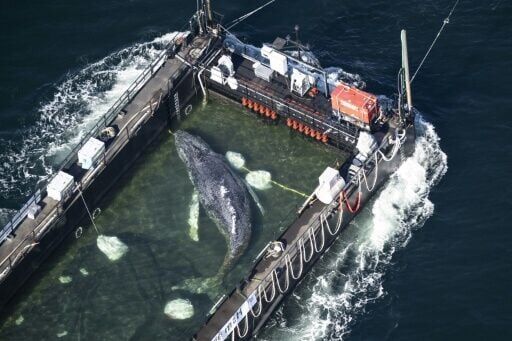
A humpback whale that had been struggling to survive after beaching near the German coast was Saturday released into the North Sea off Denmark after being transported in a barge, a member of a rescue mission said.
Pro-life org: Informed consent for abortion pill impossible without doctor visit
(The Center Square) – The nation’s largest pro-life organization filed an amicus brief Thursday in the U.S. Supreme Court asserting the impossibility of ensuring informed consent without an in-person doctor’s visit as it relates to the abortion pill, since anyone can order the drug online.
President of Susan B. Anthony Pro-Life America Marjorie Dannenfelser told The Center Square that her organization’s brief “highlights how impossible it is to ensure the right to informed consent in this unregulated Wild West environment” surrounding the abortion pill.
Dannenfelser said that “anyone – male or female, adult or minor, pregnant or not pregnant – can order these inherently dangerous drugs online,anonymously, have them shipped anywhere in the country, and even stockpile them.”
“For years, the abortion industry has planned on mail-order abortion drugs to do an end run around pro-life protections as a backstop when Roe v. Wade was reversed,” Dannenefelser said.
“The Biden-Harris administration was all too happy to abet them, using Covid as an excuse to get rid of basic safeguards like in-person doctor visits,” Dannenfelser said.
“Abortion drugs are the sole product of the manufacturers filing to block these safeguards from being reinstated, and they want to keep their profits rolling in,” Dannenfelser said.
“Never mind the harm that women likeRosalie Markezichand their babies suffer every day as a direct result of FDA policy that prevents states like Louisiana from enforcing pro-life laws,” Dannenefelser said.
In its amicus brief, SBA asks the Supreme Court “to reject abortion drug manufacturers’ bid to block in-person medical evaluations from beingreinstated pending appeal,” according to anSBA release.
The brief states that informed consent cannot be obtained “without in-person care to adequately screen for coercion and potential severe health risks to individual women,” the release said.
“Twoseparate,independent studiesalso found more than 1 in 10 women experience at least one severe adverse event, such as hemorrhaging, infection or sepsis,” the release said, and that “women have diedafter taking abortion drugs.”
SBA said in the release that “peer-reviewed researchfound three quarters of ER visits within 30 days after abortion drug use were coded as severe or critical.”
SBA stated that “public opinion is firmly on the side of commonsense health and safety standards” and that “diverse pollsconsistently find Americans strongly oppose mail-order abortion drugs and want to reinstate in-person medical evaluations, including majorities of Independents, Democrats and liberal voters.”
As The Center Square has reported,various pollshave shown that 70% of American voters think a doctor’s visit for the abortion pill should be required, withone of the pollshaving surveyed a majority of pro-choice voters.
“By failing to require in-person contact between prescribers and their patients, FDA’s 2023 REMS cannot ensure that vulnerable women and adolescents are protected from coercive partners and predators – further eroding the ability of women to make independent, voluntary decisions to use mifepristone,” SBA’s brief stated.
Dannenfelser told The Center Square: “We’re proud to stand with23 states, as well as113 members of Congressspearheaded by Sen. Bill Cassidy of Louisiana and Republican leaders in the House and Senate, in asking the Supreme Court to deny the abortion industry petition and ensure that the cases ofcoercion, violent abuse, poisoning, severe injuryanddeathwe’ve documented do not continue to grow while this case continues."
Trump announces three-day ceasefire, prisoner swap between Russia, Ukraine
(The Center Square) – More than four years into the war between Russia and Ukraine, President Donald Trump has announced a three-day ceasefire between the two countries.
The ceasefire will go into effect May 9-11, marking the anniversary of Victory in Europe Day during World War II.
“This ceasefire will include suspension of all kinetic activity, and also a prison swap of 1,000 prisoners from each country. This request was made directly by me, and I very much appreciate [the] agreement by President Vladimir Putin and President Volodymyr Zelenskyy,” Trump posted on Truth Social Friday afternoon. “Hopefully, it is the beginning of the end of a very long, deadly, and hard fought war. Talks are continuing on ending this major conflict, the biggest since World War II, and we are getting closer and closer every day.”
It is estimated that the number of casualties (killed, injured and missing) on both sides could be as high as two million since the war began in February 2022, according to the Center for Strategic and International Studies.
Since taking office for the second time, Trump has worked to bring an end to the deadly war, meeting with Putin and Zelenskyy, the latter multiple times.
The president has expressed his frustration over ending the war, with Putin pulling away each time Trump believed a deal could be reached between the two Eastern European countries.
WATCH: Let's Go Washington launching initiative to repeal income tax
(The Center Square) - Let’s Go Washington on Friday announced they have received their initiative ballot titles from the office of Washington State Attorney General Nick Brown, as the group prepares to launch a signature gathering campaign aimed at repealing the new income tax.
ESSB 6346, signed into law by Governor Bob Ferguson just over a month ago, applies a 9.9% tax on income above one million dollars or combined household income above that threshold starting with 2028 earnings.
On April 10, LGW filed close to a dozen initiatives aimed at repealing the so-called "millionaire’s tax." Each of those was given a title by the AG’s office on Thursday, so now it’s a matter of deciding which to move forward.
“We expect Pacifica Law to play their political games and challenge the titles at the last moment, so we’re keeping our options open," LGW’s Hallie Balch told The Center Square on Friday.
"But people can preregister for sheets to receive the petitions as quickly as possible when we have the title we’re going with."
On May 4, the Washington State Supreme Court denied LGW’s appeal of a ruling from Secretary of State Steve Hobbs who rejected the group’s referendum attempt.
Hobbs cited the fact state lawmakers attached a “necessity clause” to the bill, stating that despite the fact the tax doesn’t start until first payments begin in 2029, it is necessary for the immediate support of state government.
That left LGW with mounting an initiative campaign and taking the issue directly to voters or the legislature, even as a legal challenge proceeds, which could take well over a year to play out.
LGW Spokesman Darren Littell told The Center Square they have been overwhelmed with people contacting them about wanting to help gather signatures for an initiative to repeal the income tax.
“It’s truly unprecedented every day when we go out and talk to people," he said.
"We hear more and more stories of folks that are concerned that this is going to affect them, and that this tax is going to be expanded, and they already have plans to move out,” Littell said.
“They’re asking how can I help? How can I sign up? What can I do? We’ve got thousands of people who have signed up to receive petitions, which is more than we've ever had before in any of the other initiative signing campaigns we've done. So, we're pretty excited about the enthusiasm out there, and we're going to continue to build on it.”
Washington voters have rejected an income tax 10 times before, and the Washington State Supreme Court has also repeatedly ruled that income is “property”, such that it must be taxed uniformly, precluding a tax on only high-income earners.
Gov. Ferguson and Senator Jamie Pedersen, the sponsor of the income tax bill, have repeatedly stated that the people should have the right to vote on the income tax, however the legislation was crafted to preclude voters from a referendum.
In emails obtained exclusively by The Center Square, Sen. Pedersen coordinated with the AG's office to craft a bill with a “necessity clause”, such that it would not be subject to a voter referendum.
The AG’s office maintains there was nothing unusual about the coordination as lawmakers often seek legal advice on legislation.
Initiative decisions
“We are still trying to decide 100% between doing initiatives to legislature versus to the people," said Littell.
"But by getting back the ballot titles, we're going to be able to start collecting signatures here very, very soon, and we're excited about that,” he added.
If the organization runs an initiative to the voters, instead of the legislature, lawmakers couldn’t touch the issue for at least two years.
“If it goes to the people and is voted on in the fall, then it would be locked in for two years where nobody could touch it or do anything with it," Littell said.
"If it goes to the legislature, they would have to consider it, but as we've seen recently, they don't seem to hold a lot of reverence for the Constitution, so they could do whatever they want with it, apparently."
"And if they don't do anything with it, then it would go to the ballot in 2027,” she said.
Invest in WA Now, one of the main advocacy groups behind the income tax emailed The Center Square upon learning that LGW had secured ballot titles for its repeal effort.
“Polling shows Washingtonians overwhelmingly support fixing Washington’s upside down tax code, with 60% supporting the Millionaires Tax to fund education and health care," said the email from Invest in WA Now.
"This data is backed up by the landslide rejection of Brian Heywood’s I-2109, with 64% of voters choosing to maintain the capital gains tax on extraordinary profits in 2024 and by an independent pollshowing 61% support the Millionaires Tax.”
Littell said Invest in WA Now wants to convince people that the income tax will only apply to the super-rich and be a benefit to most Washingtonians, but he suggests people see through that.
For an initiative to qualify for the November ballot, Let’s Go Washington would need to gather over 300,000 signatures by July 2. The group has said they would seek to gather closer to 400,000 signatures, to help ensure success following potential signature or petition challenges.
Had the group been allowed to proceed with a referendum to recall the tax, it would only have needed half the number of signatures to put the issue to voters.
Court strikes tariff, Trump moves ahead with replacement
(The Center Square) – President Donald Trump's administration signaled Friday it intends to appeal a federal trade court's ruling striking down his 10% global tariff as unlawful, while simultaneously pressing ahead with a separate round of import taxes that could take effect as early as July.
American businesses have paid $166 billion in tariffs under the International Emergency Economic Powers Act. Those tariffs, which the Supreme Court struck down in February, are in the process of being refunded to the importers who paid them. An additional $8 billion was collected from the Section 122 tariff, which was struck down Thursday, according to We Pay the Tariffs, a coalition of nearly 1,200 small businesses that opposes tariffs. The Yale Budget Lab, a nonpartisan policy research center, estimated the Section 122 tariffs would cost the average U.S. household between $600 and $800 per year.
A Federal Reserve Bank of New York report, the Kiel Institute for the World Economy, and a Duke University study all concluded that Americans are paying nearly the entire cost of tariffs, not foreign countries as the White House has maintained.
"President Trump has lawfully used the tariff authorities granted to him by Congress to address our balance of payments crisis," White House spokesman Kush Desai told The Center Square on Friday. "The Trump administration is reviewing legal options and maintains confidence in ultimately prevailing."
Trump's U.S. Trade Representative, Jamieson Greer, said Friday the administration expects to prevail on appeal.
"They essentially said that Congress passed a law that can't be used, which we all know in the legal community, that's not how law should be interpreted," Greer told Fox Business Network's "Mornings with Maria" show. "They should be interpreted to be used. So we're confident that on appeal we'll be successful."
The Court of International Trade's decision on Thursday only applied to two small businesses and the state of Washington. That means the government is still collecting the tariffs on all other importers.
Michael Lowell, partner and chair at Reed Smith's Global Regulatory Enforcement Group, said the narrow ruling leaves the next move to the administration.
"Without a universal injunction, the ball's really in the government's court on what comes next," he said. "It's almost certainly an appeal to the Federal Circuit court of appeals."
The lone dissenting judge, Timothy Stanceu, argued the majority invented a measurement standard and warned that under the majority's logic, a federal statistics agency could repeal a law simply by changing how it measures economic data.
Phillip Magness, a senior fellow at the Independent Institute, said Trump's path ahead is "becoming increasingly difficult."
"The Supreme Court has already ruled against the administration in the IEEPA tariff case, and the Court of International Trade is showing growing impatience over delays in refunding unlawfully collected tariffs," he said.
While the expected appeal plays out in the courts, the administration has been building its next tariff vehicle. Greer's office launched Section 301 investigations on March 11 against 16 economies, including most of the United States' top trade partners. Hearings on those investigations ended Friday. Treasury Secretary Scott Bessent said in April the new tariff regime could go into effect in July.
Section 301 of the Trade Act of 1974 allows the president to impose tariffs after the U.S. Trade Representative investigates and finds that a foreign country's trade practices are unfair or discriminatory. Greer cited what he called structural overproduction that displaces U.S. manufacturing.
Critics say the administration is stretching the law again. Magness said in March that Greer was offering "a tautological redefinition" of unfair trade practices that "basically treats any exportation of any good to the United States for almost any reason as if it is evidence of an 'unfair' trading practice."
Alfredo Carrillo Obregon, a policy analyst at the Cato Institute, said the Section 122 tariffs "were always meant to be a bridge" to future tariff actions.
"We can expect more tariff announcements in the coming months," he said.
That's something small businesses can't afford, said Dan Anthony, executive director of We Pay the Tariffs.
"Small businesses cannot afford a repeat of the IEEPA refund headaches now playing out," he said.
With midterm elections approaching, public skepticism of the administration's tariff agenda is growing. The Center Square Voters' Voice Poll conducted in March found that 42% of voters believe American consumers primarily pay for tariffs, while just 12% say foreign countries bear the burden.
Magness previously told The Center Square the political costs may become more visible as the Midterm election nears.
"Not all have made the connection yet that tariffs are tantamount to a tax increase on affected goods," he said. "I suspect this connection will become more pronounced as the election approaches."
Hay named to SEC All-Defensive Team
Mizzou first baseman Abby Hay was selected to the SEC All-Defensive Team on Friday.
It is Hay’s first time on the All-Defensive Team and it marks the first time a Mizzou first baseman has been selected to the list. It is also her second postseason All-SEC recognition, having been named to the All-SEC Second Team in 2024.
Hay posted a perfect 1.000 fielding percentage this season, committing zero errors in 57 starts. She ranked third in the SEC in putouts with 349, and led all SEC first basemen with zero errors, adding four double plays and three assists.
The Columbia product and Rock Bridge alum was equally productive at the plate, leading the team with a .333 batting average while adding nine home runs, 33 RBI, nine doubles, a .419 on-base percentage and a .564 slugging percentage.
Her most notable moment of the season came against rival Kansas. Hay hit the game-winning two-run home run in the seventh inning against Kansas in Lawrence, Kansas. She also collected her 100th career hit on a home run against No. 8/9 Tennessee that tied the game in the sixth inning of Missouri's senior day win.
Ferguson first WA governor found in violation of ethics laws in over 30 years, state website shows
(The Center Square) – Gov. Bob Ferguson is the first Washington governor in more than 30 years to be found in violation of the state's executive ethics law, according to the board's enforcement website.
The governor signed an agreement last week, ahead of Friday’s Executive Ethics Board meeting, admitting to violating two provisions of the Ethics in Public Service Act. The agreement was accepted by the board during the meeting.
It's the first time a governor has faced enforcement action from the state board since its inception in 1995, the board's website shows.
The first violation stemmed from using state resources for private or another person’s benefit, and the second by using his position to secure privileges for a former aide.
The stipulations approved on Friday resolve a complaint from last July, after Ferguson allowed former Chief Strategy Officer Mike Webb to fly with him on a state plane to Tri-Cities.
As a result of the agreement, the first-term governor must pay a $4,000 fine, with half suspended if he avoids further ethics violations for the next two years.
“Ferguson knew there was an extra seat on the aircraft, so they offered it to Mike Webb,” according to Friday’s signed agreement. “Ferguson admits that they made a mistake, and it will not happen again.”
Neither Webb nor Ferguson immediately responded to a request for comment before publishing Friday.
As previously reported by The Center Square, Webb had resigned in March 2025 amid allegations that he created a hostile work environment.
However, that didn’t stop the governor from taking Webb on a state patrol plane to Tri-Cities, where Webb had a meeting on the same day Ferguson was there for business.
According to an ethics investigation, the taxpayer-funded trip was billed at $2,094.68 per flight hour.
“The individual’s presence did not displace any state employee,” Ferguson previously wrote, requesting the board to dismiss the complaint. “It did not create additional cost in terms of fuel, staffing or timе.”
Ethics board enforcement
State lawmakers created the Executive Ethics Board at the request of former Gov. Mike Lowry and Attorney General Christine Gregoire in 1994.
According to the board's enforcement results webpage, only a single violation against the Office of the Governor is listed, but it was against a former assistant director of Indian Affairs.
Lowry and former Govs. Gary Locke and Jay Inslee faced ethics and campaign finance complaints in the past, but none resulted in formal enforcement actions from the ethics board against a sitting governor like Ferguson.
An email from The Center Square seeking confirmation that Ferguson is the first governor to face a penalty from the board was not returned before publication.
By accepting the stipulations, Ferguson avoided a public hearing and fines up to $5,000 per violation.
The Washington State Democratic Party did not respond to a request for comment before publication.
“Ferguson has been cutting corners on ethical behavior his whole political career," Rep. Jim Walsh, chairman of the Washington State Republican Party, wrote in a statement.
"This latest scandal — giving his handsy political guru a 'free' ride on a taxpayer-funded private plane — is just the clearest example.”
“Many left-leaning politicians think they're clever. Some think that signaling virtue in public buys them the ability to bend ethics rules in private. That's not how it works. Ethics are how you act when no one is looking,” Walsh continued.
Gates to coach at USA Basketball U18 training camp
Mizzou coach Dennis Gates is set to coach alongside a number of college coaches at the USA Basketball U18 national team training camp beginning May 21.
Gates will be joined by Oakland coach Greg Kampe, Dusty May of the national champion Michigan Wolverines and Liberty coach Ritchie McKay. The team is coached by Dayton coach Anthony Grant.
The camp is being held to determine team USA's roster for the 2026 FIBA U18 Men's AmeriCup, being held from June 1-7 in Leon, Mexico.
Mizzou class of 2027 commit Scottie Adkinson is among those who were invited. Logan-Rogersville product and Indiana commit Chase Branham, as well as Principia guard and Illinois commit Quentin Coleman are also on the list of competing players.
Dawson Battie, Jaxson Davis, Malachi Jordan and Davion Thompson are all class of 2027 targets that Mizzou has extended offers to that will be participating in the camp.
North Dakota Supreme Court sides with Energy Transfer in Greenpeace fight over Dutch lawsuit
(The Center Square) – The North Dakota Supreme Court ruled this week that Greenpeace International cannot keep pursuing most of its lawsuit against Energy Transfer in the Netherlands as the pipeline company’s case moves forward in North Dakota.
The dispute stems from litigation surrounding disruptive protests against the Dakota Access Pipeline.
Energy Transfer sued Greenpeace International, along with Greenpeace USA and Greenpeace Fund. Energy Transfer accused the groups of helping organize illegal efforts to stop pipeline construction and damage the company’s reputation.
Last year, a Morton County jury sided with Energy Transfer on most claims and initially awarded the company $667 million. A judge later reduced the judgment to $345 million.
Before that trial started, Greenpeace International filed a separate lawsuit against Energy Transfer in Amsterdam under a European Union law designed to protect groups facing lawsuits tied to protest activity and free speech.
Energy Transfer argued the Dutch lawsuit was an attempt to undermine the North Dakota case and avoid accountability from the jury verdict.
The North Dakota Supreme Court agreed in a 4-1 ruling.
Justice Jerod Tufte wrote in the majority opinion that Greenpeace International’s case in the Netherlands directly conflicted with findings that the Morton County jury had already made.
Greenpeace International wants the Amsterdam court to declare that Energy Transfer’s lawsuit is “manifestly unfounded and abusive,” according to the ruling.
Tufte wrote that such a finding would require the Dutch court to conclude Greenpeace International “did not engage in unlawful conduct, did not cause Energy Transfer’s losses, and did not act with malice.”
The justice said that the position clashes with the jury’s verdict in North Dakota.
He also said the overseas lawsuit was “an attack on a fundamental policy of this state.”
Additionally, the opinion suggested the timing of Greenpeace International’s lawsuit mattered because it was filed shortly before the North Dakota trial began.
“The only apparent purpose of filing a duplicative foreign action on the eve of trial is to create a vehicle for collaterally attacking the anticipated verdict,” Tufte wrote.
The ruling overturns a previous decision by Southwest Judicial District Judge James Gion, who had declined to stop Greenpeace International from continuing the Amsterdam lawsuit.
Chief Justice Lisa Fair McEvers dissented.
She argued that insufficient evidence exists showing Gion made a legal error and said the Dutch case did not relitigate the same issues decided in North Dakota.
“While there are some similarities, the types of actions differ,” Fair McEvers wrote.
Energy Transfer praised the ruling Thursday.
“Energy Transfer appreciates the North Dakota Supreme Court’s careful decision,” Trey Cox, a partner at Gibson Dunn and lead counsel for Energy Transfer, said in a statement provided to The Center Square.
“We have always believed that North Dakota’s courts, laws, and juries cannot be collaterally attacked in a foreign forum,” Cox added.
He said the ruling “protects the authority of the North Dakota judicial system and the jury’s unanimous verdict from an improper end-run abroad.”
Craig Stevens, spokesman for the GAIN coalition and former senior advisor to U.S. Energy Secretary Sam Bodman, said in a statement provided to The Center Square: “This decision reinforces that judgments reached in U.S. courts must be respected and cannot be challenged through parallel cases overseas. By drawing that line, it strengthens confidence in our legal system and protects the ability to build and operate critical infrastructure. This is a win for U.S. energy security, ensuring projects like the Dakota Access Pipeline can continue to support millions of Americans without being undermined by foreign interference.”
Greenpeace International indicated it may keep pursuing legal action in the Netherlands despite the ruling.
“This ruling does not enable Energy Transfer to escape accountability under Dutch and EU law for their back-to-back abusive court proceedings in the U.S.,” Greenpeace International Senior Legal Counsel Daniel Simons said in a statement.
The Greenpeace groups involved in the North Dakota lawsuit have also requested a new trial.
Kickoff time, TV channel released for Mizzou football matchup with rival KU
The kickoff time and TV channel were revealed Friday for Mizzou football's much-anticipated matchup with rival Kansas. According to a post on X, the Border War contest is slated to begin at 7 p.m. and it will air on Fox Sports.
These details come after the announcement that the game was moved from Saturday (Sept. 12) to Friday (Sept. 11).
The Tigers and Jayhawks renewed their rivalry in 2025, facing off for the first time in 14 years. The two programs hadn't met since the Tigers joined the Southeastern Conference in 2011.
Missouri came away with the victory, winning 42-31 at home. That was an afternoon game that aired on ESPN2.
This time around, the Tigers will make the trip to Lawrence, Kansas for the first time in 21 years. Under the lights and in front of a national audience, they will look to defeat the Jayhawks for the second consecutive year.
The rise of extreme weather and how it’s impacting power outages and fire watch needs
Alex Van Drunen for National Firewatch
The rise of extreme weather and how it’s impacting power outages and fire watch needs
Record-breaking heat is hitting the Southwest, with temperatures shattering historical benchmarks. As spring intensifies, atmospheric instability drives a volatile spring storm season across the central and southern United States.
Extreme weather threatens more than comfort or convenience. It dismantles the electrical infrastructure that powers fire detection, suppression and alarm systems. Power-dependent fire safety measures go dark as the grid goes offline, leaving properties vulnerable. Here are insights from National Firewatch on how climate patterns and power outages cause on-site fire risk.
Key Takeaways
Extreme weather translates into fire safety vulnerabilities through several critical links:
Weather volatility: Supercharged storms exceed the thresholds the electrical infrastructure was designed to handle. This intensity causes widespread and prolonged power outages.
Fire safety systems: Fire alarms, smoke detectors, sprinkler pumps and emergency communication systems stop functioning when the grid goes offline.
Fire hazards: Downed power lines become active ignition sources, while facilities lose the ability to detect or suppress fires electronically.
Manual fire watch: During system failures, trained human monitors provide the only viable countermeasure for fire safety and regulatory compliance.
The Impacts of Extreme Weather
A warmer atmosphere holds more moisture and energy, altering weather patterns. Each degree of warming allows air to hold roughly 7% more water vapor, acting as fuel for intense storms.
Most of our country’s power infrastructure was engineered for the climate conditions of decades past, not for today’s changing weather. Grid infrastructure now operates at the edge of its tolerance limits during destructive weather events.
Intense weather manifests in forms that directly threaten grid stability:
Intense thunderstorms: Clusters of powerful storms produce damaging winds, lightning strikes and heavy rainfall that can persist for hours across wide regions.
Derechos and straight-line winds: Fast-moving windstorms generate sustained hurricane-force gusts capable of snapping utility poles and toppling transmission towers.
Flash and river flooding: Flooding substations and underground electrical equipment cause cascading failures and extensive repair work.
Heat domes and temperature extremes: Prolonged periods of excessive heat cause power lines to sag and drive electricity demand for cooling.
Drought conditions: Extended dry periods weaken tree root systems, making vegetation more susceptible to toppling onto power lines during moderate winds.
Climate scientists anticipate a forward-looking threat amplifier that compounds these risks. According to the NOAA El Niño Watch, there’s a 62% chance of El Niño conditions emerging by summer, which can intensify drought in some regions while triggering destructive storm outbreaks in others.
How Severe Weather Knocks the Power Grid Offline
Understanding the mechanisms of weather-related grid failures helps facility managers expect vulnerabilities and plan accordingly. Three primary pathways account for most outages during extreme weather events.
1. High Winds, Storm Clusters and Derechos
Physical force from high winds represents the most common cause of weather-related power outages. Thunderstorms routinely produce gusts exceeding 60 mph, strong enough to snap tree limbs and hurl debris into power lines. Multiple intense storms tracking across the same region in quick succession can leave hundreds of thousands of customers without electricity for days through cumulative damage.
Derechos — a widespread, long-lived windstorm associated with rapidly moving thunderstorm clusters — represent an extreme manifestation of wind-driven grid failure. These rare but devastating events produce sustained winds of at least 58 mph across paths stretching 240 miles or more. May through August sees 70% of all derecho occurrences.
When one of these systems tracks through populated areas, the damage to electrical infrastructure can be catastrophic, knocking down thousands of utility poles and leaving entire metropolitan regions in the dark.
2. Flooding, Substations and Cascading Outages
Heavy rainfall and flooding pose unique threats to electrical infrastructure. Substations with high-voltage transmission lines connecting to lower-voltage distribution networks often include ground-level equipment that is vulnerable to inundation. Automatic safety systems trigger shutdowns as floodwaters reach sensitive components, preventing electrocution hazards and equipment damage.
For example, in 2012, Hurricane Sandy provided a stark illustration of grid failure driven by flooding in New York City. The record storm surge knocked out the Con Edison East 13th Street Substation, plunging lower Manhattan into darkness for days. This shows how a single flooded substation can cascade into widespread outages affecting hospitals, high-rise buildings and emergency services.
Unlike wind damage that utilities can often repair within hours, flood-related electrical failures require extensive drying, testing and equipment replacement before power can be safely restored. Extended restoration timelines like these create prolonged periods when buildings must operate without technology-based fire safety systems.
3. Heat Waves and Demand-Driven Blackouts
Extreme heat threatens grid stability through two distinct mechanisms. First, high temperatures cause power lines to expand and sag physically. Utilities must de-energize transmission lines that droop too close to vegetation or structures, preventing fires but resulting in intentional outages. Second, heat drives record electricity demand as millions of air conditioning units strain to cool buildings, pushing the grid toward its maximum capacity.
Heat records underscore the growing severity of this threat. On March 18 and 19, 2026, multiple locations across the Southwest recorded temperatures that would have been virtually impossible without climate change. Heat waves now occur earlier than expected and at record-breaking temperatures. This can catch unprepared utilities and facility managers off guard during a time when power demand would traditionally be moderate.
Courtesy of National Firewatch
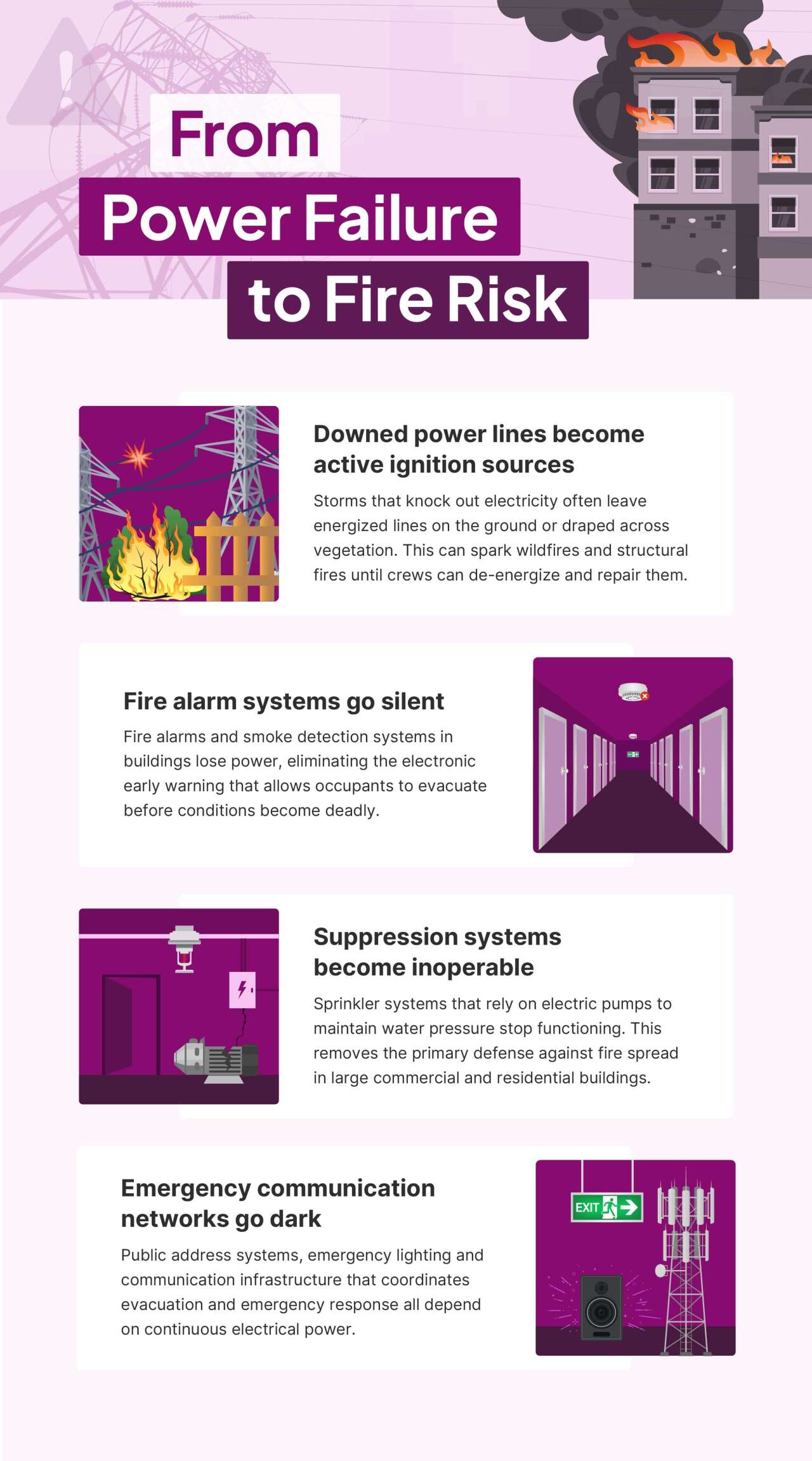
From Power Failure to Fire Risk
A power outage systematically dismantles the fire safety infrastructure that modern facilities depend on. Immediate fire safety crises emerge from downstream effects:
Downed power lines become active ignition sources: Storms that knock out electricity often leave energized lines on the ground or draped across vegetation. This can spark wildfires and structural fires until crews can de-energize and repair them.
Fire alarm systems go silent: Fire alarms and smoke detection systems in buildings lose power, eliminating the electronic early warning that allows occupants to evacuate before conditions become deadly.
Suppression systems become inoperable: Sprinkler systems that rely on electric pumps to maintain water pressure stop functioning. This removes the primary defense against fire spread in large commercial and residential buildings.
Emergency communication networks go dark: Public address systems, emergency lighting and communication infrastructure that coordinates evacuation and emergency response all depend on continuous electrical power.
This convergence of failures shows why preparing for fire watch during extreme weather has become a critical planning priority. Fire risks comparable to buildings constructed before modern safety codes existed now threaten facilities when all power-dependent fire safety measures fail simultaneously.
The Eight-Week Outlook
Late March through May marks the peak period for weather-related grid failures across much of the U.S. Official meteorological data, combined with known seasonal patterns, in this forecast, provides facility managers with a forward-looking risk assessment.
Late March to Early April
An upper-level ridge producing record-challenging heat across the western U.S. is increasing electricity demand and fire-weather risk. It’s also speeding up early-season snowmelt in the western mountains. Power demand surges, which drive this early-season heat wave, stress grid capacity when utilities would traditionally have comfortable reserve margins.
Facility managers in the southwestern states face a dangerous combination of elevated fire risk and strained grid capacity. Dry conditions and high temperatures turn vegetation into tinder, while the electrical infrastructure that powers fire suppression systems operates near its limits. Early-season heat also accelerates snowmelt in mountain ranges, which can later contribute to flooding downstream as runoff overwhelms river systems designed for more gradual spring thaws.
Peak Risk in April
April historically brings elevated risk for intense thunderstorms, high winds and tornadoes. Across the Mississippi Valley and Gulf Coast states, billion-dollar weather disasters are increasingly common. Violent storm clusters account for a significant part of the economic damage.
Winter-to-summer atmospheric transitions create instability during this seasonal weather peak, fueling explosive thunderstorm development. Resulting storms can knock out power across multistate regions, leaving properties without electronic fire protection for extended periods. Facility managers in these regions should be proactive, with fire watch contingency plans in place before storm season peaks.
Late April to May
Heat domes can expand into late April and May, straining electrical grids and rapidly drying out vegetation. Driving temperatures above normal for weeks at a time, these persistent high-pressure systems trap heat near the surface.
Extreme heat from climate change is increasingly threatening U.S. energy supply and reliability. By 2050, billions of dollars in economic value and up to 18% of U.S. generating capacity could be exposed to heat risk. Electrical infrastructure strain during heat dome events creates a vicious cycle. Increased cooling demand pushes the grid toward failure, while those failures disable the cooling systems and fire suppression equipment that buildings need most.
Dangerous fire weather conditions also come from heat domes, combining high temperatures with low humidity and persistent winds. Fire danger escalates rapidly when these atmospheric patterns settle over regions experiencing drought. A single spark from damaged electrical equipment or a lightning strike can ignite vegetation that burns with exceptional intensity under these conditions.
May and Tornado Alley
May through early June marks the statistical peak for tornado activity in the central Plains. Significant risk of grid damage from destructive storms arrives during this period, with tornadoes often accompanied by large hail, damaging straight-line winds and flash flooding.
Challenges from heat and violent thunderstorms that facility managers already face become compounded by the tornado threat. A single tornado can destroy transmission infrastructure across a miles-long path, while intense thunderstorms that spawn tornadoes knock out power across much wider areas through wind damage and lightning strikes. Entire regions can remain without power after the most intense tornado outbreaks, leaving facilities reliant on backup fire safety measures for extended periods.
Why Fire Watch Becomes Essential When the Power Goes Out
Power-dependent fire safety systems become inoperable during outages, making manual human monitoring the only viable countermeasure. Professional fire watch services address specific vulnerabilities:
Inoperable fire detection: Electronic systems require continuous electrical power to function. Buildings lose the ability to detect fires in their early stages and suppress them before they spread as that power goes offline.
Heightened fire hazards: Power outages often occur during intense weather events and create more fire risks, including downed power lines, lightning strikes and disrupted emergency services responding to multiple simultaneous incidents. Regular fire watch drills, scenario-based grid-outage risk assessments and staff cross-training all enhance resilience.
Regulatory and compliance: The National Fire Protection Association (NFPA) standards require a fire watch during periods when electronic fire protection systems are impaired or out of service. Maintaining compliance during extended outages protects you from regulatory penalties.
Critical need for human vigilance: Trained fire watch guards provide continuous, 24/7 monitoring to detect fires early. This ensures emergency services can be contacted immediately and that compliance with fire codes is maintained during outages of any duration.
As outages become more common, regulators may tighten compliance windows and require digital logs of fire watch patrols. Fire watch personnel operate independently of electrical infrastructure, using visual patrols, communication equipment with backup power and direct coordination with emergency services to maintain fire safety when technology-based systems stop functioning. Continuing to function regardless of grid status, weather conditions or infrastructure damage, this human element provides a layer of protection.
A New Era of Preparedness
Extreme weather drives power failures, which disable the electronic systems that facilities depend on to detect and suppress fires. Relying solely on technology that requires uninterrupted electricity is no longer a sufficient safety strategy.
Manual fire watch has become a fundamental part of resilient property management. As such, professional fire watch services are crucial for commercial properties and emergency scenarios, including residential facilities, hot worksites, construction zones and special events. Trained guards deliver continuous, 24/7 monitoring that operates independently of the grid, ensuring early fire detection and compliance with OSHA and NFPA standards during system outages.
Preparedness must evolve as climate patterns intensify and grid vulnerabilities multiply. Fire watch may have once been a reactive measure reserved for emergencies, but now it’s a proactive safeguard that belongs in every modern facility safety plan.






(0) comments
Welcome to the discussion.
Log In
Post a comment as Guest
Keep it Clean. Please avoid obscene, vulgar, lewd, racist or sexually-oriented language.
PLEASE TURN OFF YOUR CAPS LOCK.
Don't Threaten. Threats of harming another person will not be tolerated.
Be Truthful. Don't knowingly lie about anyone or anything.
Be Nice. No racism, sexism or any sort of -ism that is degrading to another person.
Be Proactive. Use the 'Report' link on each comment to let us know of abusive posts.
Share with Us. We'd love to hear eyewitness accounts, the history behind an article.