Agritopia is made up of tree-lined streets, well-designed homes and neighborly businesses, at the center of which sits Agritopia Farm. Photo by Jenelle Bonifield.
Greek mythology paints lemons as a symbol of wealth and love. It was believed that tucking dried lemon leaves under a pillow at night would translate to sweet dreams.
Today, lemons are still a form of yellow gold, albeit a different kind, among chefs and consumers around the world, including in Arizona.
Agritopia Farm, which sits at the center of the 166-acre Agritopia neighborhood in the town of Gilbert, Arizona, raises 80 kinds of fruit and vegetables for surrounding restaurants and the community, with three varieties of lemons among them.
Agritopia is made up of tree-lined streets, well-designed homes and neighborly businesses, at the center of which sits Agritopia Farm. Photo by Jenelle Bonifield.
Not your average farm
A vision of sorts, Agritopia Farm was dreamed up by Joe Johnston as a way to expand and grow his family’s farm.
“I saw the writing on the wall,” says Johnston, who kicked off the execution of what was originally called “The Farm at Agritopia” in the late 90s. “I could see houses on the horizon. We could sell or we could be proactive and create a place that would also allow us to continue our stewardship of the land.”
Joe Johnston
Johnston’s father Jim originally purchased the land in 1960, raising his family there as well as cotton and a few other crops, like alfalfa. Once ownership transferred to Joe, the farmer’s son got busy turning the cotton farm where he grew up into a community-centered agrarian utopia, hence its name.
The neighborhood of Agritopia is made up of tree-lined streets, well-designed homes and neighborly businesses, at the center of which sits the 11-acre Agritopia Farm. The produce raised in Agritopia is distributed to area restaurants, members of the farm’s CSA subscription program, local food banks as well as a co-op that aggregates from a variety of local farms to distribute produce throughout the state.
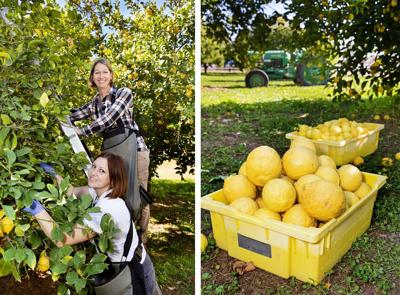
Agritopia’s lead farmer, Kelly Saxer, and farm director, Katie Critchley
Lemon love
The farm’s annual yield of 1,000 pounds of organic lemons comes from about 20 trees of varying age. The orchard in which the lemon trees grow is populated by many fruit-bearing trees, including grapefruit, pomelo, a few varieties of orange, peach and apple.
Kelly Saxer, Agritopia’s lead farmer, counts Lisbon, Meyer and Ponderosa lemons among her crops, each with its own unique appearance and flavor.
Lisbon lemons, which have a thick, bright yellow skin and a bitter flavor, are among the most commonly available lemons in the U.S. Fragrant and pungent, these medium-size fruits are ideal for everyday use in recipes both savory and sweet, and they’re also great for household cleaning.
Meyer lemons are small in size and treasured by bakers and chefs for their high volume of juice, edible rind and sweet tartness. They are the result of crossing a lemon with a mandarin orange, hence their thin, golden skin and low acidity level.
Ponderosa lemons measure about 10 centimeters — about twice the size of more common lemons (like the aforementioned Lisbon). A hybrid of citron and pomelo, Ponderosas are often grown ornamentally due to their size and notable fragrance. They have a thick rind and render ample juice.
Lisbon and Ponderosa lemons
For those who live in colder climates, citrus season offers a bit of colorful reprieve. Citrus harvest begins in December and (for some varieties) extends through the end of February.
“We use flood irrigation here at the farm, which helps with the heat in the warmer months. The citrus likes that and the mild winters,” Saxer explains.
“Lemons and other citrus need the cold to ripen, but it can’t get cold enough to freeze the fruit. Arizona has nice, mild winters that are really ideal for growing citrus.”
Agritopia CEO William Johnston
An entire ecosystem
Agritopia Farm raises honey bees to help with pollination, and the trees are fertilized using chicken manure, but no pest management is required. Clover is used as a cover crop to support nitrogen fixation in the soil.
William Johnston, Joe’s son and the CEO of the family company, considers the farm’s variety of produce one of its strengths as the center of its community.
“Adding olives and dates to our harvest really allowed us to bridge the gap during the hottest part of the year,” says Will. “Citrus keeps us going through most of the winter months.”
Crop diversification has allowed the farm’s CSA to extend its season to 48 weeks a year.
“I think one of the best things I've learned while living here is the seasonality of food,” says Agritopia Farm Director Katie Critchley, who has lived within the community since 2004.
“It gives me a deeper appreciation for where my food comes from. I think citrus is one of those things that we, as Arizonans, take for granted,” she says. “Seeing visitors so blown away by how plentiful our citrus growth always renews my excitement for the season.”
Katie and her husband fell in love with the neighborhood when it was still utilizing model homes to sell houses.
“We came back again and again; I think we visited thirteen times before we decided to buy our home. We got married on the farm, and have a lemon tree in our backyard,” she says. “We were totally enraptured with Agritopia. It felt like a dream.”
(The Center Square) – Cost of living, immigration, water and data centers were among the issues debated Wednesday night by candidates for Arizona’s Congressional District 1.
(The Center Square) - An Arizona candidate in a key congressional race has expressed opposition to data centers being built in his district, even though as a state legislator, he voted for giving the centers a tax break that cost millions of dollars of taxpayers' money. Former state Rep. Amish Shah, D-Phoenix, is facing off against Republican candidate Jay Feely for Arizona's 1st Congressional District seat, which is among the competitive races that could determine which party controls the House after the Nov. 3 midterm election. Shah, a doctor, says on his campaign website that he is against building data centers in the 1st Congressional District, citing water concerns.However, while in the state Legislature in 2021, Shah voted for House Bill 2649, which extended a data center tax incentive for qualified equipment until 2033.The original tax incentive passed in 2013 was set to expire in 2023 unless the state Legislature passed an extension. When Gov. Katie Hobbs signed the new 2027 state budget, it paused new applications for the state’s data center tax break from July 1 until June 30, 2029.Between Fiscal Years 2023 and 2025, the tax break cost the state an estimated $63.5 million, according to the Governor’s Office.Two years after supporting the data center tax break, Shah voted for Senate Bill 1274, which eliminated a restriction on certain data center-related tax refunds.Shah was in the Legislature from 2019 to 2024. The Center Square reached out to Shah’s campaign several times, but it did not respond before publication time.Unlike Shah, Feely has backed data centers. In a June debate with Republican candidates before the party’s primary elections, Feely said data centers can be created “without them adding to the cost of the local consumer.”Data centers should invest in local areas and reduce consumers’ electricity costs, Feely said. He added they should reuse water to avoid wasting it.The Center Square reached out multiple times to the Feely campaign, but it did not respond before publication time.Arizona Republican Party Chairman Sergio Arellano said Shah is “going to say whatever he needs to to get elected. Rather than explaining his previous position to voters, he is taking an easy way out and hoping voters are stupid.”“Unfortunately for Dr. Shah, voters are not stupid. They are doing their homework, and we are making sure they know about his flip-flops,” Arellano told The Center Square by email.Arellano noted Arizona voters have “legitimate concerns” about data centers.“They do not want to be stuck with some corporation's energy cost and they shouldn't be,” he explained. “Our representatives need to address the complexities of this issue and speak candidly about it.”According to Arellano, “most reasonable people understand that data centers are necessary.”“Communities should have a voice in where these facilities are built, how they impact surrounding neighborhoods, and what they are going to require from our water and energy infrastructure,” he added.Josh Heywood, the executive director of Project 48 Arizona, a nonprofit that supports data center development, said the industry in Arizona “generated over $1 billion in state and local tax revenue in 2024.”Heywood noted that data centers increase Arizona tax revenue and investment and only use 0.15% of the state’s annual water supply.Arizona could turn off all its data centers, and the state would “still be facing cuts on the Colorado River,” Heywood said, adding that it would “have less money to help pay for conservation and new water supplies.”When the large data center project in Pima County called Project Blue is online, it will use an estimated 15,000 to 20,000 gallons of water per day, less than the average commercial warehouse over 200,000 square feet, he told The Center Square.According to 2012 Energy Information Administration data, these types of commercial warehouses use 22,000 gallons of water per day. 2012 is the latest year for comparable EIA water-use data for commercial warehouses.Most Arizonans have an unfavorable opinion of data centers, according to a poll from Noble Predictive Insights. The survey showed almost 60% of Arizona registered voters opposed new large data centers.Heywood said Arizonans are concerned about artificial intelligence taking their jobs and how it's becoming part of everyday life.Many Arizonans have only heard “one side of the story,” Heywood said, noting many concerns about water use, electricity and noise levels can be fixed by proper zoning laws.Project 48’s position is if a data center wants to come to Arizona, the developer “should be required to pay all the costs associated with bringing them online," Heywood said.Arizona’s three main utility providers - Arizona Public Service, Salt River Project and Tucson Electric - previously told The Center Square that new data centers won’t raise existing ratepayer prices.
Offering bright, sweet and sour relief to cold days, lemons are a winter citrus we love for many reasons. Dig into some of our best tips, recipes and surprising lemon facts.
Keep it Clean. Please avoid obscene, vulgar, lewd,
racist or sexually-oriented language. PLEASE TURN OFF YOUR CAPS LOCK. Don't Threaten. Threats of harming another
person will not be tolerated. Be Truthful. Don't knowingly lie about anyone
or anything. Be Nice. No racism, sexism or any sort of -ism
that is degrading to another person. Be Proactive. Use the 'Report' link on
each comment to let us know of abusive posts. Share with Us. We'd love to hear eyewitness
accounts, the history behind an article.








(0) comments
Welcome to the discussion.
Log In
Post a comment as Guest
Keep it Clean. Please avoid obscene, vulgar, lewd, racist or sexually-oriented language.
PLEASE TURN OFF YOUR CAPS LOCK.
Don't Threaten. Threats of harming another person will not be tolerated.
Be Truthful. Don't knowingly lie about anyone or anything.
Be Nice. No racism, sexism or any sort of -ism that is degrading to another person.
Be Proactive. Use the 'Report' link on each comment to let us know of abusive posts.
Share with Us. We'd love to hear eyewitness accounts, the history behind an article.